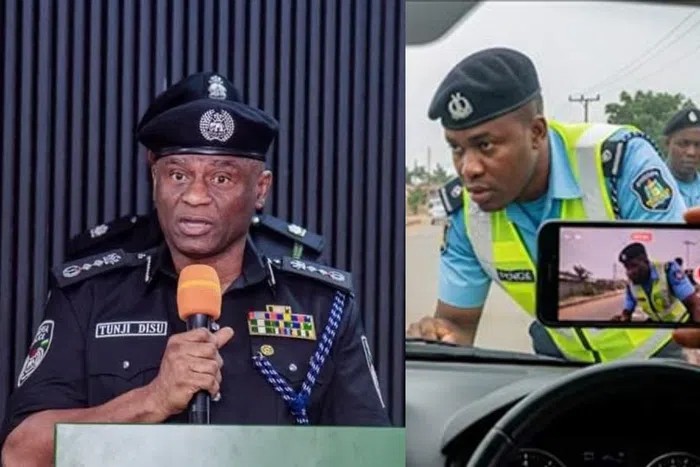
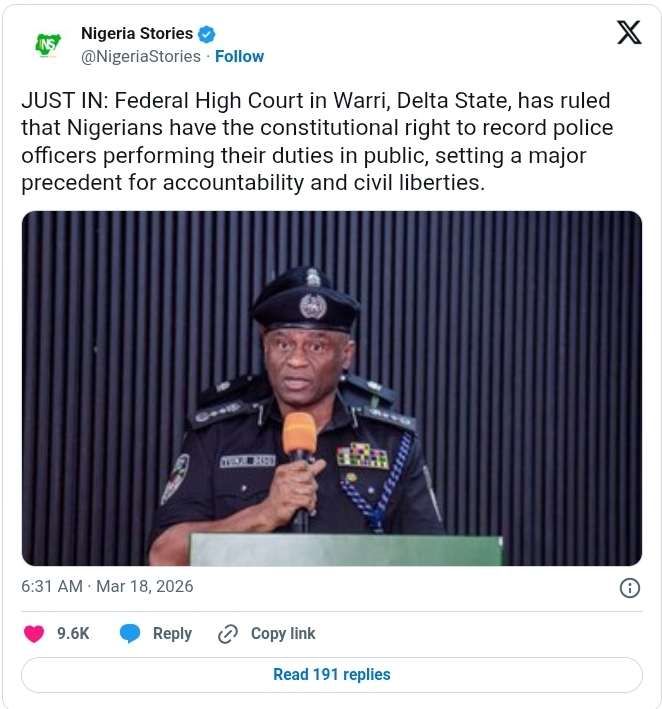
The Federal High Court in Warri, Delta State, has delivered a landmark judgment affirming that Nigerians have the constitutional right to record, photograph, and document police officers while they are on duty. The court also ruled that the practice of “anonymous policing,” where officers operate without visible identification, is unlawful and unconstitutional.
The decision was delivered by Justice H. A. Nganjiwa in Suit No. FHC/WR/CS/87/2025, filed by lawyer Maxwell Nosakhare Uwaifo against the Nigeria Police Force and other respondents. The case, brought in the public interest, stemmed from an encounter Uwaifo had with unidentified officers at a checkpoint.
According to court documents, the incident occurred on May 10, 2025, while Uwaifo was travelling from Benin to Warri. Shortly after passing the Sapele Roundabout, he came across what appeared to be a police checkpoint, where a group of armed men had blocked the road and were stopping vehicles.
Uwaifo said the officers acted aggressively and questioned him without any clear justification. Suspecting possible harassment or extortion, he attempted to record the interaction with his phone. However, one of the officers warned him to stop recording or risk being arrested.
Read more on: Nigeria Left Out as Pope Leo XIV Unveils Africa Visit Plans
He noted that none of the officers wore name tags or identified themselves, and the vehicle they used, a black Toyota Sienna, had no police markings or registration number. This made it difficult for him to confirm their identity or authority.
Feeling threatened, Uwaifo said he chose to comply and leave the scene to avoid being harmed or unlawfully detained. He added that the officers’ conduct prevented him from gathering evidence or properly documenting the incident.
He also referenced a similar experience in June 2025 near Effurun Roundabout in Warri, where officers conducting stop-and-search operations again failed to display any form of identification.
The suit was filed under relevant provisions of the 1999 Constitution, the African Charter on Human and Peoples’ Rights, the Fundamental Rights Enforcement Procedure Rules, and the Nigeria Police Act 2020.
In his arguments, Uwaifo relied on Section 66(1) of the Police Act, which mandates officers to display their name tags and identification numbers while on duty. He argued that this requirement is essential for transparency and accountability, and that failing to comply undermines public trust and opens the door to abuse.
Read more on: Planned Power Outage Sparks Backlash from Lagos Residents
On the issue of recording, he maintained that citizens have a constitutional right under Section 39(1) to freely gather and share information. He emphasized that no Nigerian law prohibits recording public officials performing their duties, and any restriction on that right must be clearly backed by law, which is not the case.
He further cited several judicial precedents to support his position, arguing that public officials have no reasonable expectation of privacy while carrying out their duties, and that documenting their actions is a legitimate form of civic engagement.
Notably, although the Attorney-General of the Federation filed a written address, no counter-affidavit was submitted. As a result, the applicant’s evidence was not challenged and was accepted by the court.
In its ruling, the court upheld Uwaifo’s arguments, affirming that Nigerians have the right to record police officers in public and declaring the failure of officers to properly identify themselves while on duty a violation of the law.
Read more on: