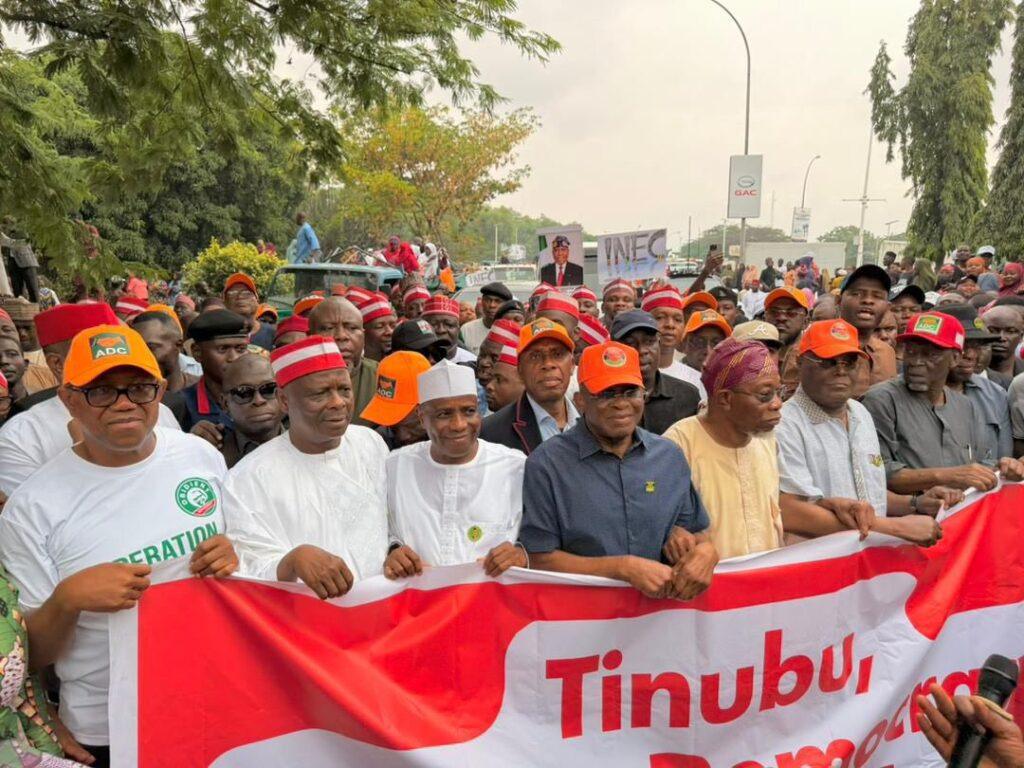
In an unprecedented display of political unity, Nigeria’s major opposition figures gathered today at the headquarters of the Independent National Electoral Commission (INEC) in Abuja to stage a protest over what they describe as systemic bias within the electoral body. The demonstration, organized under the banner of the “Save Democracy” movement, marks the first occasion that prominent leaders such as Atiku Abubakar of the People’s Democratic Party, Peter Obi of the Labour Party, and Rabiu Kwankwaso of the New Nigeria Peoples Party have appeared together in a coordinated street-level demonstration.
The coalition was also joined by key leaders of the African Democratic Congress (ADC), including former Senate President David Mark, signaling a potentially transformative realignment of Nigeria’s opposition politics. The protest was driven by concerns over INEC’s impartiality, the recently passed Electoral Act 2026, and the sudden rescheduling of the 2027 presidential election. Thousands of supporters gathered to fill the streets surrounding the commission’s headquarters, creating an atmosphere charged with energy, anticipation, and determination.
The protest comes after the expiration of a 72-hour ultimatum issued by the ADC youth wing and key opposition stakeholders, which demanded immediate action from INEC regarding perceived interference in internal party politics and the administration of elections under the new Electoral Act. One of the central grievances concerns INEC’s handling of internal disputes within the ADC. Opposition leaders accused the commission of taking sides in the party’s leadership crisis, specifically alleging that INEC failed to recognize the legitimate executive leadership headed by former Senate President David Mark and instead endorsed a faction perceived to be aligned with the ruling All Progressives Congress. They argue that this undermines the principles of fairness and neutrality expected of the nation’s electoral body.
Read more on: World Bank Stresses Policy Reforms as Essential for Smarter African Growth
Opposition figures also raised concerns over the Electoral Act 2026, which they contend contains provisions that could compromise the integrity of the electoral process. At the center of these concerns are rules governing the electronic transmission of results and the delineation of electoral wards, which they claim could be manipulated to favor the ruling party. Without urgent amendments, the opposition warns that the act has the potential to skew the 2027 elections before a single vote is cast.
Another factor driving the protest was INEC’s recent decision to reschedule the 2027 presidential election to January 16, 2027. Opposition leaders argue that the adjustment was made without adequate consultation and shortens the period available for coalition-building and voter mobilization, creating a disadvantage for opposition parties and undermining the credibility of the electoral process.
The protest marked a historic display of unity among leaders who have previously been political rivals. Peter Obi, addressing the massive crowd, emphasized the importance of standing together beyond party lines. He declared that the protest was not about party politics but about defending the democratic process in Nigeria, stating, “We are not here as members of different parties; we are here as Nigerians. When the umpire becomes a player, the game is over. We will not allow the 2027 elections to be written in a dark room before the first vote is even cast.”
Atiku Abubakar, also speaking to the gathered supporters, framed the protest as a patriotic duty. He warned against the gradual emergence of a one-party state and emphasized the need for transparency in electoral processes. Rabiu Kwankwaso expressed similar concerns, highlighting the growing impatience of Nigerian youth and warning that citizens would not tolerate manipulation of the electoral process. Their combined presence sent a powerful message that opposition parties and citizens were closely monitoring INEC and holding it accountable.
Read more on: UNIJOS Lecturers Begin Strike Action Over Delayed March Pay

The African Democratic Congress played a central role in organizing the protest. With prominent figures like David Mark and former Nollywood actor Kenneth Okonkwo taking leadership positions, the ADC has rapidly emerged as a hub for opposition collaboration. Today’s demonstration not only highlighted concerns about alleged bias within INEC but also served as a public validation of the ADC’s increasing influence in national politics. Analysts have suggested that the protest could indicate the formation of a larger opposition alliance, bringing together major parties under a shared platform to challenge the ruling APC in the 2027 elections.
Thousands of protesters gathered outside INEC headquarters, holding placards with messages such as “INEC is not a Branch of APC” and “Protect Our Votes.” Citizens from diverse backgrounds created a sea of movement and sound that extended far beyond the commission’s building. Security forces were present to maintain order, but the event remained largely peaceful, with no major disruptions reported. Protesters engaged in chants, marches, and speeches aimed at highlighting their demands for electoral reform and the recognition of legitimate party leadership. The atmosphere was charged, reflecting the deep frustration of citizens who feel excluded from decisions shaping the nation’s democratic future.
In response to the protest, INEC issued a brief statement defending its neutrality and adherence to the law. The commission emphasized that it had remained impartial in all party disputes and that its actions were guided strictly by the Electoral Act 2026. INEC also noted its openness to dialogue with political stakeholders, provided such engagement remained civil and respectful. Despite this reassurance, opposition leaders remained skeptical, maintaining that continued vigilance was necessary to prevent any manipulation of the electoral process.
The events of today signal a potentially turbulent period as Nigeria approaches the 2027 general elections. By uniting under a common cause, opposition leaders have significantly increased pressure on INEC to demonstrate transparency and fairness. The protest also underscores the growing importance of civic engagement in shaping the country’s political landscape. Analysts suggest that if the coalition of opposition leaders remains cohesive, it could provide a credible alternative to the ruling party, potentially reshaping the dynamics of political competition and voter mobilization in the lead-up to the elections.
Read more on: Trump Announces Two-Week Halt to Military Strikes on Iran
The opposition coalition has warned that if their demands regarding the Electoral Act and the recognition of legitimate party leadership are not met within seven days, the Abuja protest will mark the beginning of a nationwide “Occupy INEC” campaign. Such a movement would involve sustained demonstrations across multiple cities and could exert considerable pressure on the commission to respond to the grievances of opposition parties and civil society actors.
Political analysts have described today’s protest as a possible turning point for Nigeria’s democracy. Dr. Adebayo Adedoyin, a professor of political science at the University of Lagos, commented that the coalition of opposition leaders is a strategic effort to safeguard democratic norms. He highlighted that the rare convergence of historically rival political figures indicates a recognition that national democratic interests must sometimes take precedence over individual party agendas. Other analysts cautioned that the coalition’s success will depend on its ability to maintain unity and focus on shared objectives rather than succumbing to historical rivalries.
This protest comes at a critical time in Nigeria’s political and social landscape, as the country navigates a complex mix of economic, political, and security challenges. Citizens and political actors are acutely aware of the stakes involved in the 2027 elections. Issues such as party interference in electoral processes, rapid legislative changes, and sudden election rescheduling have heightened public scrutiny and mobilized citizens to actively participate in defending democratic norms.
The protest at INEC headquarters stands as a historic moment in Nigeria’s political history. By joining forces, the country’s leading opposition figures sent a strong message that electoral integrity is non-negotiable and that transparency and fairness must guide the conduct of elections. The coalition’s actions demonstrate the critical role of civic engagement in holding institutions accountable.
As the nation prepares for the 2027 elections, today’s events suggest that the political environment will be highly contested. Citizens and opposition parties will remain vigilant, and the unified stance of Atiku Abubakar, Peter Obi, Rabiu Kwankwaso, and the ADC leadership may redefine the contours of Nigerian opposition politics. In the coming weeks, it will become clearer whether INEC will engage substantively with the coalition’s demands or whether the proposed “Occupy INEC” campaign will gain traction, potentially reshaping public discourse and political strategy in one of the most consequential electoral periods in Nigeria’s history.
Read more on:
- Trump Announces Two-Week Halt to Military Strikes on Iran
- Dangote Petroleum Sparks Fuel Surge: Petrol at ₦1,275, Diesel at ₦1,950
- Trump Warns of Civilizational Destruction as Iran Deadline Approaches
- Kebbi Assembly Speaker Muhammad Usman Zuru Dies in Cairo After Prolonged Illness
- FG Sets Aside ₦135 Billion for 2027 Election Legal Disputes