In a wave of coordinated and intelligence-driven operations that have captured nationwide attention, the National Drug Law Enforcement Agency has arrested two unlikely suspects, a 93-year-old great-grandfather and a 69-year-old medical doctor. These arrests form part of an intensified nationwide crackdown targeting drug trafficking networks and their increasingly complex web of collaborators.
The development, disclosed on Sunday by the NDLEA Director of Media and Advocacy, Femi Babafemi, has sparked widespread reactions across Nigeria. According to the agency, the latest operations highlight a troubling reality about the depth and reach of the illicit drug trade, cutting across age groups, professions, and social classes. From elderly individuals in quiet rural communities to respected professionals living in suburban estates, the drug economy appears to have infiltrated multiple layers of society.
The Arrest of a 93-Year-Old Suspect in Abia State
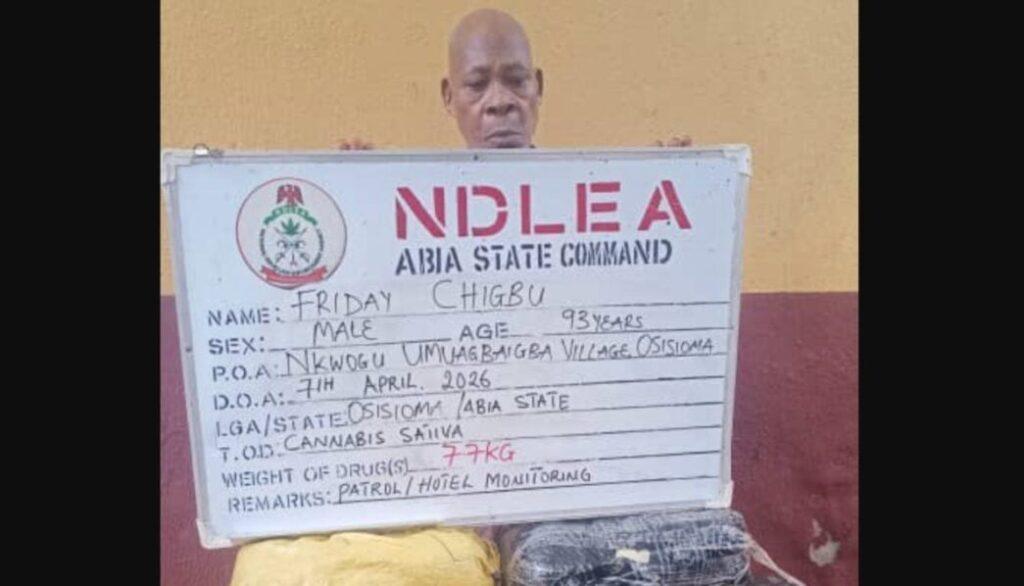
One of the most surprising aspects of the recent crackdown is the arrest of Pa Friday Ahukanna Chigbu, a 93-year-old great-grandfather, in Abia State. The operation took place on Tuesday, April 7, 2026, in the peaceful village of Umuagbaigba, located in Osisioma Local Government Area.
Acting on credible intelligence, NDLEA operatives raided the residence of the elderly man. During the search, officers uncovered 7.7 kilograms of skunk, a potent strain of cannabis, carefully stored within the premises. While the discovery itself was significant, what followed during interrogation added an even more startling dimension to the case.
Pa Chigbu reportedly admitted that he had been a long-time user of cannabis, claiming that his habit dates back to 1959. This suggests he has been consuming the substance for approximately 67 years. According to his statement, he spent most of his earlier life working in physically demanding jobs such as truck pushing, painting, and tiling.
He further disclosed that it was only about a year ago that he decided to begin selling the substance. What began as a personal habit, he explained, gradually transformed into a source of income in his advanced age. Despite his age and the sympathy it might evoke, NDLEA officials stressed that the quantity of drugs recovered indicated more than casual involvement. They believe his residence functioned as a distribution point within the local community.
The case has generated mixed reactions among Nigerians, with some expressing shock and disbelief, while others see it as a reflection of deeper socio-economic challenges. However, the agency has maintained that enforcement actions must remain consistent regardless of age or personal circumstances.
Read more on: Borno State Governor Addresses Military Strike in Border Market
Medical Doctor Linked to International Drug Syndicate
In a separate but equally significant development, NDLEA operatives arrested Dr. Chudi Daniel Ofomata, a 69-year-old medical doctor, at his residence in Teachers’ Land Estate, Magboro, in Obafemi Owode Local Government Area of Ogun State.
Unlike the Abia case, which appeared localized, the arrest of Dr. Ofomata was tied to a more sophisticated international drug trafficking network. His apprehension followed a detailed investigation triggered by an earlier arrest at the Mallam Aminu Kano International Airport in Kano.
The chain of events began on February 16, 2026, when NDLEA officers intercepted an Ivorian national identified as Gohouri Michael, also known as Anunwa Onyinye Michael. The suspect was preparing to board a flight to Milan, Italy, when he was stopped and subjected to a search.
Further examination revealed that he had ingested 82 wraps of cocaine, totaling 1.49 kilograms. The discovery led to an intensive investigation aimed at identifying the individuals behind the operation.
According to NDLEA findings, the courier was acting under instructions from a Nigeria-based coordinator who had managed to remain hidden during the initial stages of the probe. Through careful tracking, analysis of communication records, and intelligence gathering, the agency was able to trace the operation back to Dr. Ofomata.
Authorities allege that the doctor played a central role in organizing and directing the trafficking scheme. When operatives moved in to arrest him, they reportedly recovered several controlled substances from his residence. Among them were promazepam and promethazine injections, which are legitimate medical drugs but were allegedly being used outside approved clinical protocols.
The involvement of a licensed medical professional has raised serious concerns about ethical breaches within the healthcare sector. It also underscores the evolving tactics of drug syndicates, which increasingly rely on individuals with specialized knowledge and social credibility to evade detection.
Read more on: Six-Day Ultimatum as Bandits Demand 700 Cattle and 1,000 Sheep from Residents
Widespread Seizures Across Multiple States
The operations in Abia and Ogun States were only part of a broader nationwide campaign that has yielded significant seizures and arrests across several regions.
In Edo State, NDLEA operatives intercepted two trucks along Warrake Road in Auchi. The vehicles were found to be transporting a staggering 7,245 kilograms of skunk. The illicit cargo had been cleverly concealed among cartons of beer in an attempt to avoid suspicion. The scale of the seizure points to a well-organized supply chain capable of moving large quantities of drugs across state lines.
In Niger State, officers conducted a raid on a residential property, leading to the arrest of a couple suspected of involvement in drug trafficking. During the operation, authorities recovered 118 kilograms of skunk stored within the home. The discovery highlights the growing trend of using private residences as storage and distribution hubs.
Borno State also recorded a major breakthrough when a trailer transporting spare parts was intercepted. Upon inspection, the vehicle was found to be concealing a large quantity of controlled substances. These included 42,290 tablets of Rohypnol and thousands of bottles of codeine syrup, both of which are commonly abused for their psychoactive effects.
In the Federal Capital Territory, Abuja, NDLEA operatives carried out a raid on a well-known drug hotspot popularly referred to as Tora Bora. The operation resulted in the arrest of eight individuals and the seizure of more than 11 kilograms of cannabis. The raid is part of ongoing efforts to dismantle open drug markets and reduce street-level distribution.
Read more on: Another Top Legislator Passes Away as Circumstances Unfold
NDLEA Reaffirms Commitment to Targeting All Offenders
Reacting to the series of successful operations, the Chairman of the NDLEA, Brigadier General Mohamed Buba Marwa, praised the dedication and professionalism of the agency’s officers. He emphasized that the recent arrests demonstrate the effectiveness of intelligence-led strategies in combating drug trafficking.
Marwa reiterated that the agency is no longer focused solely on arresting couriers and low-level operatives. Instead, there is a deliberate shift toward identifying and apprehending the financiers, coordinators, and other key figures who sustain the drug trade.
According to him, the arrests of individuals such as a 93-year-old man and a respected medical doctor send a clear message that no one is above the law. Age, social status, and professional standing will not shield anyone found to be involved in criminal activities.
He further noted that dismantling drug networks requires a comprehensive approach that addresses every link in the chain, from production and transportation to distribution and consumption.
A Growing Concern for Society
The latest developments have sparked renewed conversations about the social and economic factors driving individuals into the drug trade. While the circumstances of each suspect may differ, the cases collectively highlight the far-reaching impact of the illicit drug economy.
For many observers, the involvement of both elderly individuals and professionals raises difficult questions about societal values, economic pressures, and the effectiveness of existing preventive measures. It also points to the need for stronger community awareness and rehabilitation programs aimed at reducing demand.
At the same time, the NDLEA’s actions demonstrate a firm commitment to enforcement and deterrence. By targeting not just the visible actors but also the hidden orchestrators, the agency hopes to disrupt the structures that enable drug trafficking to thrive.
Read more on: Atiku Criticizes Tinubu Over Nigeria and Kenya Fuel Price Comparison
Looking Ahead
As the suspects prepare to face prosecution, the outcomes of these cases are likely to set important precedents. They will also serve as a reminder of the complexities involved in tackling drug-related crimes in a rapidly changing environment.
The events of the past week have made it clear that the fight against drug trafficking in Nigeria is entering a new phase. With increased reliance on intelligence, technology, and inter-agency collaboration, authorities are aiming to stay ahead of increasingly sophisticated criminal networks.
Ultimately, the message from the NDLEA is unequivocal. In the pursuit of justice and public safety, no individual is exempt from scrutiny. Whether in a remote village or a gated estate, the long arm of the law is determined to reach every corner where illicit activities persist.
Read more on:
- 16 Residents Killed as Security Forces Neutralize 110 Bandits in Niger State
- Court Sentences Former Senatorial Candidate
- Court Schedules April 14 Hearing in ADC Leadership Rift
- Army Counters Misinformation, Clarifies Circumstances Surrounding General Braimah’s Death
- Eight Family Members Killed in Late Night Attack on Bokkos Community
- Bandits Trigger Panic, Demand 700 Cows and 1,000 Sheep