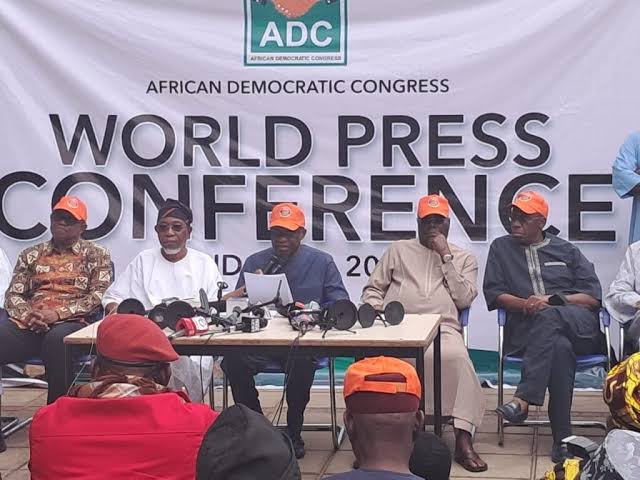
The political atmosphere in Nigeria reached a fever pitch on Thursday, April 2, 2026, as the African Democratic Congress (ADC) delivered a forceful ultimatum to the Federal Government, accusing the ruling administration of undermining the country’s democratic foundations. At a press briefing held in Abuja, party officials went beyond criticism, formally demanding the immediate removal of the Chairman of the Independent National Electoral Commission (INEC), Prof. Joash O. Amupitan, SAN, who took over from Mahmood Yakubu in late 2025. The ADC claimed that recent administrative maneuvers by INEC amounted to a deliberate effort to tilt the playing field in favor of the ruling All Progressives Congress (APC), raising fears of a de facto one-party state ahead of the highly anticipated 2027 general elections.
This bold move represents the most serious escalation in opposition politics since the controversial passage of the Electoral Act 2026 earlier this year, legislation that critics argue has significantly altered the rules governing the conduct of elections in Nigeria. The ADC’s public confrontation signals that the opposition is moving aggressively to assert its relevance in a political landscape many fear is increasingly dominated by the ruling party.
Allegations of a “One-Party Blueprint”
At the Abuja briefing, the ADC leadership did not mince words. The party’s National Chairman, flanked by members of the Working Committee, accused Prof. Amupitan and the current INEC administration of acting as an extension of the APC, rather than as a neutral arbiter in the electoral process. Describing the current situation as “a monarchy in disguise,” the ADC laid out a series of grievances that have stirred widespread concern among political observers.
Central to the party’s claim is what it describes as a “one-party blueprint” being quietly implemented through administrative changes to the 2027 election timetable. According to the ADC, these adjustments disproportionately favor the ruling party by constraining opposition coalition-building, limiting access to resources, and effectively narrowing the political space for dissenting voices.
The Electoral Act 2026, which President Tinubu defended in recent weeks as a milestone for the rule of law, is also at the heart of the controversy. ADC officials argued that the Act contains “hidden clauses” that permit INEC to arbitrarily de-register political parties that fail to meet funding and organizational benchmarks by the end of December 2026. These requirements, the opposition contends, are deliberately set at unattainable levels, effectively silencing smaller parties and consolidating political power in the hands of the ruling APC.
Adding to the tension is the implementation of the new Integrated Voter Verification System (IVVS), which ADC officials allege has been compromised by contractors with direct ties to APC stalwarts. The party claims that this arrangement poses a serious risk of voter suppression, particularly in regions that have historically supported opposition parties. By controlling the technical backend of the system, the ADC argues, the ruling party could manipulate the verification process to favor its candidates.
Read more on: INEC Withdraws Recognition of David Mark-Led ADC Leadership, Triggering Political Storm
Calls for Overhaul and Immediate Action
The opposition is not stopping at accusations. The ADC has called for a complete overhaul of INEC leadership, insisting that Prof. Amupitan step down immediately. In a formal communiqué released during the briefing, the party stated:
“We are witnessing the systematic dismantling of our democratic foundations. The current INEC Chairman has, through his recent actions and the lopsided appointment of Resident Electoral Commissioners, demonstrated that he is a player in the field rather than a referee. For the 2027 elections to have even a shred of credibility, the Chairman must go now.”
The party also outlined what it considers a fairer alternative: the appointment of the next INEC Chairman should be a collective decision reached through consensus among all registered political parties, rather than a direct appointment by the President. This, the ADC contends, would guarantee the commission’s independence and restore public confidence in the electoral process.
Read more on: Nation on Edge: Tinubu Redirects Visit to Plateau as UNIJOS Orders Urgent Student Evacuation
Government Pushback
The Presidency has responded swiftly, dismissing the ADC’s allegations as unfounded and politically motivated. Bayo Onanuga, the Special Adviser to the President on Information and Strategy, called the claims “baseless fear-mongering” and defended both the Electoral Act and INEC’s independence. In his statement, Onanuga highlighted that the Electoral Act 2026 was passed through a bipartisan National Assembly and designed to enhance the transparency and integrity of elections.
The Presidential adviser further emphasized that INEC operates under constitutional guarantees that ensure its autonomy. On the accusation that the IVVS system is compromised, Onanuga described the claims as “a hallucination borne out of the opposition’s inability to organize itself effectively for the upcoming polls.” He reiterated that INEC’s operations are transparent and that the administration remains committed to conducting free and fair elections in 2027.
Implications for the 2027 Elections
The ADC’s ultimatum comes at a sensitive time. With the Ekiti Governorship election scheduled for June 20, 2026, political analysts believe this confrontation could serve as a litmus test for the broader dynamics leading into the general elections next year. The opposition’s strategy appears to involve mobilizing public opinion while also exploring legal avenues to challenge the Electoral Act 2026.
In the coming days, several developments are expected to unfold:
- Opposition Coalition: Reports indicate that the ADC is in discussions with the New Nigeria Peoples Party (NNPP) and certain factions of the People’s Democratic Party (PDP) to form a “Grand Alliance” aimed at pushing for electoral reforms and organizing nationwide demonstrations.
- INEC Response: Prof. Amupitan is scheduled to meet with Resident Electoral Commissioners, where he is expected to address the allegations concerning the IVVS data backend and other claims of bias.
- Judicial Intervention: Legal experts anticipate that the ADC will file a suit at the Federal High Court in Abuja early next week, challenging the specific provisions of the Electoral Act 2026 deemed restrictive or anti-competitive.
Read more on: Iran Issues Stark Warning to U.S. Tech Firms as Conflict Enters Dangerous New Phase
The Road Ahead
Nigeria’s democracy appears to be at a crossroads. The government maintains that its reforms and policies are designed to strengthen electoral integrity and consolidate democratic resilience. Conversely, the opposition argues that these same measures represent a systematic effort to suppress dissent and entrench the ruling party’s dominance.
With N68.3 trillion earmarked in the 2026 federal budget and the countdown to the 2027 elections underway, the tension between enforcement and suppression, between governance and partisanship, is unlikely to abate soon. Analysts warn that the next few months could determine not only the political fortunes of the ruling APC but also the credibility of Nigeria’s electoral system itself.
For Nigerians, the unfolding drama is more than political theatre. It touches on the fundamental question of whether the country’s elections will remain free, fair, and open to genuine competition. With opposition forces mobilizing and legal challenges imminent, the nation is witnessing the beginning of what may be the most contentious electoral season in recent history a period in which the integrity of the ballot box will be tested like never before.
Read more on:
- Governor Sanwo-Olu Launches 2026 Budget of Shared Prosperity, Focuses on Growth and Infrastructure
- El-Rufai in Fresh Legal Developments as Courts Adjourn Bail, Allow Suit Withdrawal
- By-Elections Loom as Senate Declares Three Vacancies
- FG Declares End to University Strikes in Nigeria After Landmark ASUU Deal
- Nigeria’s Security Spending Under Spotlight After N2.3tn Disclosure