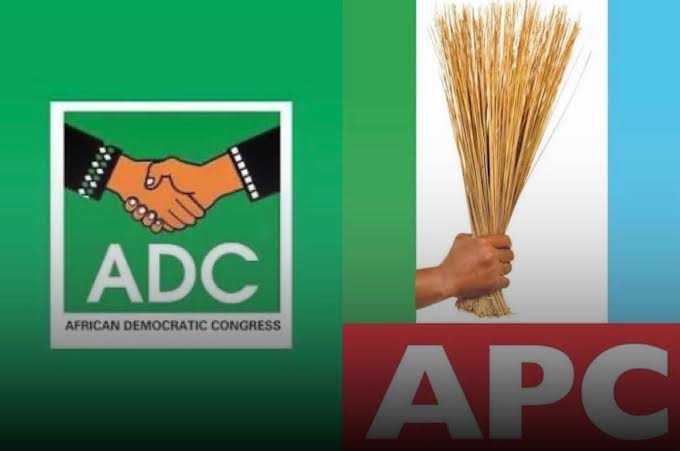
Nigeria’s political arena is once again heating up, this time with a fierce legal and political confrontation involving the ruling All Progressives Congress (APC), the Independent National Electoral Commission (INEC), and the African Democratic Congress (ADC). At the center of the unfolding drama is a push by the APC for the complete deregistration of the ADC, a move that has sparked intense debate about legality, fairness, and the future of multiparty democracy in the country.
This development comes at a time when political alignments are beginning to take shape ahead of the 2027 general elections. With court rulings, internal party disputes, and rising tensions between major and minor political players, the situation has evolved into a high-stakes contest that could significantly reshape Nigeria’s political landscape.
At the heart of the APC’s argument is a reliance on constitutional provisions that empower INEC to deregister political parties under specific conditions. According to Section 225A of the 1999 Constitution as amended, a political party can be removed from the official register if it fails to meet certain electoral benchmarks. These include winning at least one seat in the National Assembly or a State House of Assembly, securing a local government chairmanship, or obtaining a defined percentage of votes in presidential or gubernatorial elections.
Read more on: Northern CAN Calls on Members to Be Security Conscious
The APC maintains that the ADC has consistently failed to meet these requirements. Party insiders and legal advocates aligned with the ruling party argue that the ADC no longer commands meaningful electoral support across the country. From their perspective, retaining such a party on the ballot only contributes to unnecessary complexity during elections, potentially confusing voters and diluting the seriousness of the democratic process.
Beyond the constitutional argument, the APC has also pointed to the ADC’s ongoing internal crisis as further justification for its position. A major turning point occurred when INEC withdrew recognition from the ADC’s National Working Committee following a ruling by the Court of Appeal. This decision led to the removal of prominent figures such as former Senate President David Mark, who was serving as National Chairman, and former Osun State Governor Rauf Aregbesola, who held the position of National Secretary, from INEC’s official records.
For the APC, this leadership vacuum is a critical issue. The party argues that a political organization without a clearly recognized leadership structure cannot function effectively or participate legitimately in democratic activities. In their view, the ADC has effectively become inactive at a structural level, making its continued existence as a registered party questionable.
However, the ADC has strongly rejected these claims and has responded with equally forceful counterarguments. Leading voices within the party, as well as allied activists, have described the move as a calculated attempt to weaken opposition forces ahead of the next election cycle. They argue that what is being presented as a constitutional matter is, in reality, a politically motivated strategy designed to eliminate competition.
Read more on: Minister of State for Labour Onyejeocha Nkeiruka Exits Tinubu Cabinet
One of the most vocal critics of the situation has been activist Aisha Yesufu, who publicly questioned the independence of INEC. She accused the electoral body of acting in alignment with the interests of the ruling party rather than maintaining neutrality. Her remarks reflect a broader concern among opposition figures who believe that institutional independence is being compromised.
The ADC’s defense is built on several key points. First, the party alleges that its internal crisis did not arise organically but was fueled by external interference. According to this narrative, rival political interests may have supported factional disputes within the party in order to create instability. This instability is now being used as a justification for deregistration.
Second, the ADC has challenged INEC’s interpretation of recent court rulings. Party leaders insist that the decisions of the Court of Appeal are being selectively applied in a way that undermines their legitimacy. They argue that the removal of their leadership from INEC’s records does not equate to the dissolution of the party’s structure and that due process must be followed before any drastic action is taken.
Third, the ADC and its supporters have raised broader concerns about democratic pluralism. They warn that allowing performance-based deregistration to be used aggressively could set a dangerous precedent. In a diverse political system like Nigeria’s, smaller parties often serve as alternative platforms for emerging leaders and dissenting voices. Eliminating them, critics argue, could gradually lead to a concentration of power among a few dominant parties.
As the dispute continues, the matter has already found its way into the judicial system. A lawsuit filed by the Incorporated Trustees of the National Forum of Former Legislators is seeking a clear interpretation of the constitutional provisions governing party deregistration. The case also involves other political parties, including Accord, the Zenith Labour Party, and the Action Alliance, all of which could be affected by the court’s decision.
Read more on: Seven Family Members Among Ten Abducted in Katari Attack
INEC, for its part, has adopted a cautious approach. The commission has chosen to maintain the current situation by neither fully recognizing any faction within the ADC nor proceeding with immediate deregistration. This stance reflects an attempt to avoid taking sides while awaiting definitive legal guidance from the courts.
The implications of this unfolding situation are significant. If the APC succeeds in its push, it could lead to the removal of the ADC from Nigeria’s political map, marking a major shift in the balance of power. Such a development would not only affect the party’s leadership and members but could also influence the strategies of other political actors, particularly those considering alternative platforms outside the major parties.
For supporters of the APC’s position, the issue is one of maintaining order and credibility within the political system. They argue that enforcing constitutional standards is necessary to ensure that only viable and active parties participate in elections. From this perspective, deregistration is seen as a way to strengthen democracy by eliminating inactive or ineffective entities.
On the other hand, critics view the situation as a test of Nigeria’s commitment to democratic diversity. They caution that using legal provisions to sideline opposition parties could erode public trust and reduce the competitiveness of elections. For them, the survival of smaller parties like the ADC is essential for preserving a healthy political ecosystem.
The timing of this controversy also adds to its significance. With the 2027 elections on the horizon, political maneuvering is already intensifying. Many analysts believe that the current push is not solely about legal compliance but is also influenced by strategic considerations. By limiting the number of active parties, dominant political groups may be attempting to reduce the likelihood of vote splitting or the emergence of unexpected challengers.
As court proceedings continue and political rhetoric escalates, the future of the ADC remains uncertain. Party members, supporters, and observers across the country are closely watching developments, aware that the outcome could have far-reaching consequences.
In the coming weeks, the decisions made by the courts and INEC will play a crucial role in determining the direction of this dispute. Whether the ADC will be able to resolve its internal issues and retain its status, or whether it will be removed from the political register altogether, remains to be seen.
What is clear, however, is that this episode has opened up important conversations about the balance between legal enforcement and political fairness. It has also highlighted the ongoing challenges of maintaining a truly inclusive and competitive democratic system in Nigeria.
Read more on:
- Obi Criticizes Tinubu’s Airport Visit as “Leadership Failure”
- Nation on Edge: Tinubu Redirects Visit to Plateau as UNIJOS Orders Urgent Student Evacuation
- Iran Issues Stark Warning to U.S. Tech Firms as Conflict Enters Dangerous New Phase
- Governor Sanwo-Olu Launches 2026 Budget of Shared Prosperity, Focuses on Growth and Infrastructure