Even before the echoes of the last general election have fully faded, Nigeria’s political landscape is already shifting toward the next big contest. The year 2027 may still seem distant on paper, but within political circles, preparations, alliances, and rivalries are already taking shape with remarkable intensity. At the center of this unfolding drama is the Peoples Democratic Party, a party that once stood as a dominant force but now finds itself grappling with internal divisions that threaten its very foundation.
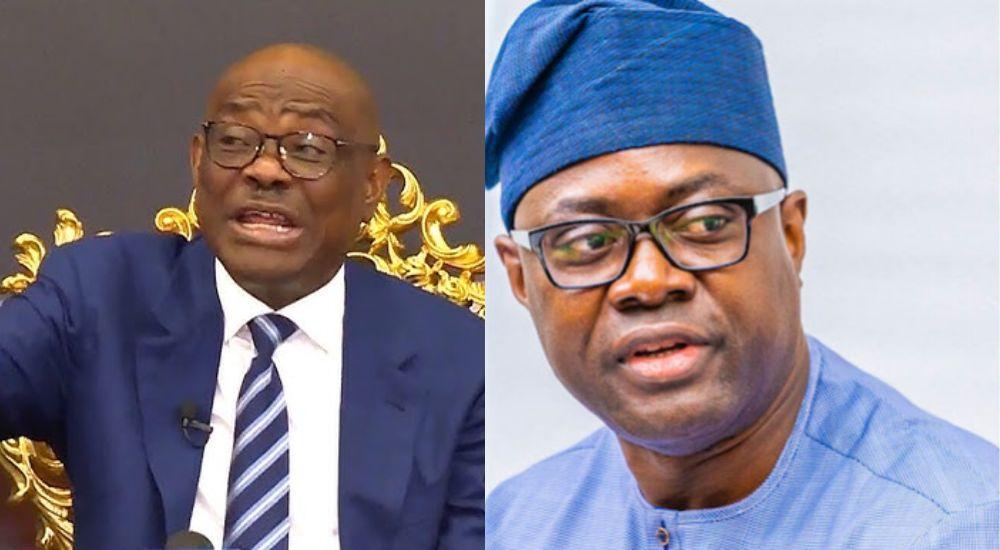
In recent days, fresh tensions have emerged, drawing attention to a deepening rift between the Minister of the Federal Capital Territory, Nyesom Wike, and Oyo State Governor Seyi Makinde. What initially began as quiet speculation has now evolved into a full scale confrontation, with both camps exchanging sharp words and strategic signals. Reports suggesting that Makinde is exploring an alignment with the African Democratic Congress have added fuel to an already volatile situation, pushing the party further into uncertainty.
For many observers, this moment represents more than just another disagreement among party leaders. It signals a critical turning point that could determine whether the PDP remains a unified opposition force or fractures into competing blocs ahead of the next election cycle.
Read more on: Trump Administration Petitioned by U.S. Lobbyists Over INEC’s ADC Decision
A Rumored Alliance That Sparked Political Tension
The controversy began with growing reports that Governor Makinde, a prominent figure within the PDP, is considering alternative political pathways outside the party’s current structure. These discussions have centered on the possibility of working with the African Democratic Congress or a similar platform that could serve as a rallying point for opposition figures across the country.
Makinde is not alone in this line of thinking. Within his circle are influential political actors who believe that the PDP, in its present state, may not be strong enough to effectively challenge the ruling All Progressives Congress in 2027. Among those often mentioned in these conversations are former presidential contenders and political heavyweights who command significant followings across different regions of Nigeria.
The idea of forming a broader coalition has gained traction because it offers a potential solution to the fragmentation currently weakening the opposition. By bringing together key figures under a new or restructured platform, proponents believe they can create a more formidable force capable of mounting a serious challenge in the next general election.
The African Democratic Congress has emerged as a possible vehicle for this ambition for several reasons. The party has maintained a relatively stable structure and has not been deeply entangled in the internal conflicts that have plagued larger parties. In states like Oyo, it also has historical relevance and a level of grassroots recognition that could be leveraged in a broader coalition effort.
Read more on: Atiku, Obi, Kwankwaso Lead Opposition Protest Claiming INEC Bias
For Makinde and his allies, exploring such an option may not necessarily mean an immediate departure from the PDP. Instead, it could serve as a strategic backup plan, a way to maintain political leverage while pushing for reforms within the party. However, even the suggestion of such a move has been enough to trigger strong reactions from other factions.
The Wike Camp Responds With Strong Opposition
Supporters of Nyesom Wike have reacted swiftly and forcefully to the reports of Makinde’s possible alignment with another platform. To them, the idea represents not just political maneuvering but a direct challenge to the unity and integrity of the PDP.
Within this camp, there is a growing belief that Makinde’s actions signal a lack of commitment to the party. They argue that attempting to build or join an alternative coalition while still holding a position within the PDP undermines the collective effort needed to rebuild and reposition the party for future elections.
At the same time, Makinde and his supporters have not remained silent. The Oyo State governor has openly criticized elements within the party that he believes are working against its progress. In his view, certain actions by the Wike aligned faction risk weakening the PDP’s identity and compromising its ability to function as a credible opposition.
These exchanges have taken on an increasingly public tone, with both sides using strong language to defend their positions. What was once an internal disagreement has now become a visible power struggle, attracting attention from party members, political analysts, and the general public.
Read more on: World Bank Stresses Policy Reforms as Essential for Smarter African Growth
Two Competing Visions for the Future
At the heart of this conflict lies a fundamental disagreement about strategy. Both factions claim to be acting in the best interest of the party, yet their approaches to achieving political relevance in 2027 differ significantly.
The group aligned with Wike appears to favor a more pragmatic approach that involves maintaining close ties with the existing power structure at the federal level. From this perspective, aligning with or cooperating with the ruling party could help preserve influence and ensure that members of the PDP remain politically relevant.
On the other hand, Makinde and his allies advocate for a more independent path. They argue that the PDP must rebuild its identity as a strong opposition party rather than appearing to align itself with those in power. For them, forming a grand coalition that brings together various opposition voices offers a better chance of challenging the ruling party effectively.
This divergence in strategy reflects deeper questions about the party’s direction. Should the PDP prioritize immediate political survival by forming alliances with those in power, or should it take a more long term approach focused on rebuilding trust and presenting a clear alternative to voters?
The Stakes for the PDP
The implications of this rift extend far beyond the personal ambitions of individual politicians. At stake is the future of the PDP as a national political force.
If Makinde and other influential figures were to move toward an alternative platform, the party could lose key strongholds, particularly in the southern region. Such a development would weaken its ability to compete effectively at the national level and could shift the balance of power in ways that are difficult to reverse.
Conversely, if the Wike aligned faction continues to dominate the party’s internal structure, there is a risk that the PDP could lose its identity as a distinct opposition voice. Critics have already raised concerns that too much alignment with the ruling party could blur the lines between the two, making it harder for voters to see the PDP as a credible alternative.
For party members, this situation creates a sense of uncertainty. Many are left wondering which direction the party will ultimately take and whether it can resolve its internal conflicts in time to present a united front in 2027.
Read more on: UNIJOS Lecturers Begin Strike Action Over Delayed March Pay
A Strategic Game Ahead of 2027
As the PDP moves closer to its next round of internal conventions, the current tensions are likely to play a significant role in shaping the outcome. The speculation surrounding Makinde’s potential alliance with the African Democratic Congress may also serve as a negotiating tool, allowing his faction to push for changes within the party.
In politics, such moves are rarely straightforward. What appears to be a plan for departure can sometimes be a strategy aimed at gaining leverage. By signaling a willingness to explore other options, Makinde and his allies may be attempting to force a recalibration within the PDP, encouraging reforms that could strengthen the party from within.
At the same time, the Wike faction is unlikely to yield easily. With considerable influence and experience, they remain a powerful force within the party and will continue to shape its direction in the months ahead.
The Broader Implication for Nigerian Politics
Beyond the internal dynamics of the PDP, this unfolding situation has wider implications for Nigeria’s political landscape. The possibility of a new coalition involving multiple opposition figures could reshape the contest for power in 2027, introducing new variables into an already complex equation.
For voters, these developments highlight the fluid nature of politics in the country. Alliances can shift quickly, and yesterday’s partners can become today’s rivals. While this can create uncertainty, it also reflects a dynamic system in which different ideas and strategies compete for prominence.
Read more on: Trump Announces Two-Week Halt to Military Strikes on Iran
At the same time, the ongoing tensions serve as a reminder of the challenges facing opposition parties. Building and maintaining unity is often difficult, particularly in a diverse and competitive political environment. Without a clear and cohesive strategy, even well established parties can struggle to maintain their relevance.
A Party at a Critical Crossroads
As events continue to unfold, one thing remains clear. The PDP is at a defining moment in its history. The choices made in the coming months will have lasting consequences, not only for the party itself but for the broader political landscape in Nigeria.
Whether the current rift leads to a complete split or eventually gives way to reconciliation remains to be seen. What is certain is that the road to 2027 will be shaped by the decisions and strategies emerging from this conflict.
For the average Nigerian, the constant maneuvering among political leaders may seem distant from everyday concerns. However, these developments ultimately influence the direction of governance and the options available to voters in future elections.
As the political chessboard continues to evolve, all eyes will remain on the PDP and its key players. Their ability to navigate this period of uncertainty will determine whether the party can reclaim its position as a strong and united force or continue to grapple with divisions that threaten its future.
Read more on: