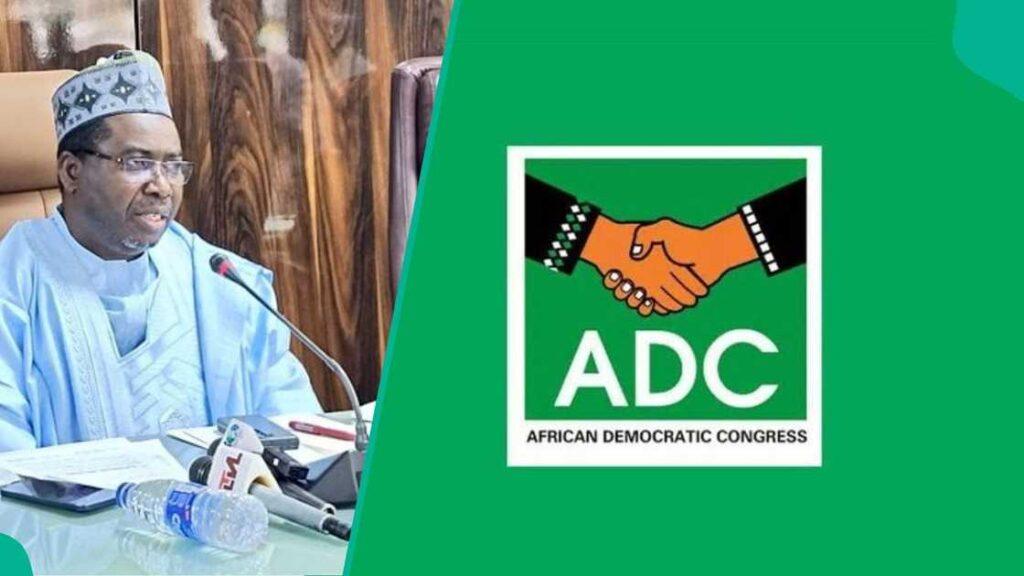
Nigeria’s political environment has been thrown into fresh uncertainty following an intense and rapidly escalating confrontation between the Independent National Electoral Commission and the African Democratic Congress. What initially appeared to be a routine internal leadership dispute within the ADC has now evolved into a full-blown national controversy, with far-reaching implications for the country’s opposition politics ahead of the 2027 general elections.
At the heart of the crisis is a deepening standoff between a faction of the ADC led by former Senate President David Mark and the electoral body under its chairman, Professor Joash Amupitan. The situation has grown increasingly tense after the commission reportedly issued a firm ultimatum, giving the party’s feuding leaders a limited window of time to resolve their differences or risk severe consequences that could ultimately sideline the party from participating in future elections.
This ultimatum, which has been described by political observers as one of the most consequential interventions by the electoral commission in recent times, has placed the ADC in a precarious position. According to reports, the leadership of the party has been instructed to immediately revert to what the commission describes as the legally recognized structure, in line with the most recent ruling of the Court of Appeal. Failure to comply within the stipulated timeframe could lead to the commission withdrawing its support for any activities carried out by the party.
Read more on: Nigerian Resident Doctors Begin Indefinite Strike
The implications of such a move are significant. One of the key warnings issued by the commission is that it will not monitor any national convention or state congress organized by the party if the leadership crisis remains unresolved. In Nigeria’s electoral system, the presence and recognition of the electoral commission at such events is critical, as it lends legitimacy to the processes through which candidates and party officials are selected. Without that recognition, any decisions taken at such gatherings could be deemed invalid.
Professor Amupitan is also said to have drawn attention to previous legal precedents in states like Zamfara and Plateau, where political parties suffered major setbacks after conducting primaries that were later ruled unlawful. In those cases, candidates who appeared to have won elections were eventually disqualified by the courts, leading to their opponents being declared winners. By referencing those examples, the commission appears to be sending a clear message that it will not hesitate to enforce similar outcomes if the ADC proceeds with what it considers to be illegitimate processes.
As the deadline set by the commission approaches, concerns are mounting within political circles that the ADC could face a scenario where it loses its ability to field candidates altogether. Such a development would represent a major blow to the party, which has in recent years positioned itself as a credible alternative to Nigeria’s dominant political forces.
Unsurprisingly, the faction aligned with David Mark has reacted strongly to the commission’s directive. At a press conference that drew significant attention, key figures within the group openly challenged the actions of the electoral body, accusing it of bias and political interference. Among those who spoke out was activist Aisha Yesufu, who delivered a pointed critique of the commission’s role in the unfolding crisis.
Members of the faction argue that the steps taken by the commission go beyond mere regulatory oversight and instead amount to a deliberate attempt to weaken the party at a critical moment. They claim that the withdrawal of recognition from their leadership structure is part of a broader strategy aimed at destabilizing what they describe as a growing opposition movement ahead of the next election cycle.
Read more on: Bloodshed on Easter Sunday as Gunmen Strike Kaduna Community
Another major point of contention raised by the group relates to the interpretation of court rulings. According to the faction, the commission is selectively applying judicial decisions in a manner that favors a rival group within the party. They insist that their own position is supported by earlier legal victories and argue that disregarding those outcomes undermines the rule of law.
The criticism has not been limited to legal arguments alone. Some members of the faction have framed the situation as a test of the independence of the electoral body itself. They have questioned whether the commission is acting impartially or whether it is being influenced by external political forces. These allegations have further heightened tensions and added a layer of political intrigue to an already complex dispute.
Beyond the immediate exchange of accusations, the crisis also highlights deeper structural challenges within Nigeria’s political system. The legal framework governing political parties requires that their leadership structures be clearly defined and recognized well in advance of elections. This is intended to ensure transparency and accountability in the nomination of candidates. However, when disputes arise and remain unresolved, they can create a vacuum that disrupts the entire process.
In the case of the ADC, the commission’s decision to restrict access to its digital portal has had particularly serious consequences. Without access to this platform, the party is unable to submit candidate lists or update its official records. This effectively freezes its ability to participate in key electoral activities, including by-elections and preparatory exercises for larger contests.
Read more on: Man Arrested for Burning His Father Alive in Kazaure
Additionally, any attempt by the party to organize internal elections or conventions during this period risks being invalidated. The commission has made it clear that it will not recognize outcomes from processes conducted outside the framework it considers lawful. This places the party in a difficult position, as it must either resolve its internal differences quickly or face the prospect of being sidelined.
The timing of the crisis has also attracted attention from political analysts. In recent months, there has been growing speculation about the possibility of a broader coalition emerging to challenge the dominance of established parties. The ADC has been mentioned as a potential platform for such an alliance, particularly given reports linking prominent figures like former Vice President Atiku Abubakar and Rabiu Kwankwaso to efforts aimed at building a stronger opposition front.
While these developments remain largely speculative, they have nonetheless contributed to the perception that the stakes surrounding the ADC are unusually high. Control of the party’s leadership structure could have implications that extend far beyond internal politics, potentially influencing the dynamics of the next presidential race.
As the situation continues to unfold, attention is now focused on whether the party’s factions can find a way to reconcile their differences within the limited timeframe provided. The challenge is not only to reach an agreement but also to ensure that any resolution is recognized by the electoral commission and consistent with existing legal rulings.
For many observers, the crisis represents a critical moment for the ADC. The party has built a reputation as a platform for alternative voices and reform-minded politicians. However, its ability to maintain that position depends on its capacity to navigate internal disputes without undermining its credibility or operational viability.
Read more on: Minister of State for Labour Onyejeocha Nkeiruka Exits Tinubu Cabinet
The broader implications of the standoff are also significant. A prolonged conflict that results in the exclusion of a major political party from the electoral process could raise concerns about the inclusiveness and competitiveness of Nigeria’s democracy. It could also affect voter confidence, particularly among those who see the ADC as a vehicle for political change.
At the same time, the electoral commission faces its own set of challenges. It must balance the need to enforce legal and procedural standards with the imperative of maintaining public trust. Any perception of partiality or overreach could have lasting consequences for its reputation.
In the coming days, the actions taken by both the ADC leadership and the electoral commission will be closely scrutinized. The outcome of this confrontation will likely shape the political landscape in the lead-up to 2027, influencing not only the fortunes of the party itself but also the broader trajectory of opposition politics in Nigeria.
For now, the situation remains fluid, with uncertainty hanging over the future of the ADC. Whether the party emerges from this crisis intact or faces a more difficult path ahead will depend largely on its ability to resolve its internal divisions and meet the conditions set by the electoral authorities.
Read more on: