The security situation in Borno State has once again been thrown into mourning following a deadly roadside explosion that claimed the lives of a senior military officer and several soldiers. On Sunday, April 12, 2026, an Improvised Explosive Device detonated along the Gubio–Magumeri road, killing a Commanding Officer and six of his men in what has been described as one of the most devastating recent attacks on Nigerian troops in the Northeast.
The incident is another painful reminder of the persistent insecurity in the region, where despite ongoing military operations and territorial gains against insurgent groups, the threat of ambushes, hidden explosives, and guerrilla-style warfare continues to endanger both military personnel and civilians. The latest attack highlights how insurgents operating in parts of Borno State have adapted their tactics, relying more heavily on roadside bombs and ambush strategies rather than direct confrontations with security forces.
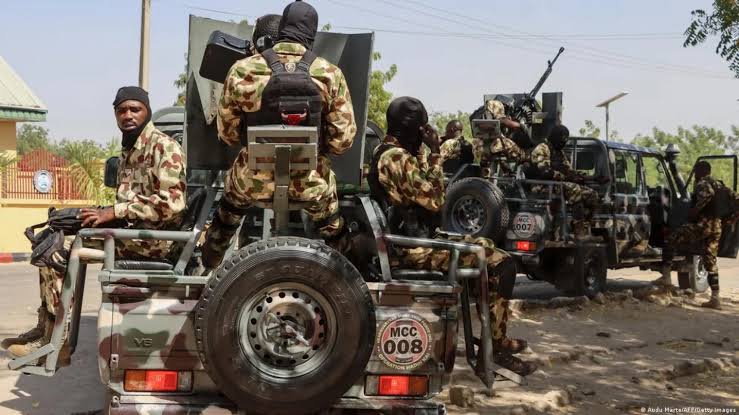
According to preliminary reports from security sources, the military convoy was carrying out a routine operational movement between Gubio and Magumeri Local Government Areas when the explosion occurred. The convoy was reportedly traveling along a route that is frequently used by both troops and local commuters, making it a known but vulnerable transit corridor in the area.
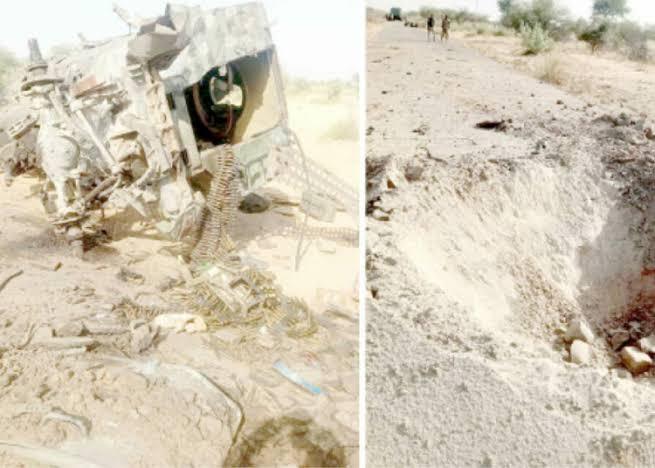
Investigations suggest that the Improvised Explosive Device had been carefully planted along the road in advance and concealed beneath sand and debris to avoid detection. The attackers are believed to have monitored troop movement patterns before triggering the explosion remotely when the lead vehicle, which was carrying the Commanding Officer, reached the designated point. The precision of the timing indicates a high level of surveillance and planning by the perpetrators.
Read more on: NDLEA Nabs 93-Year-Old Man, Doctor in Shocking Nationwide Drug Crackdown
Immediately after the explosion, the situation reportedly escalated further as armed fighters suspected to be members of the Islamic State West Africa Province opened fire from nearby vegetation. This secondary attack appeared to be aimed at preventing rescue operations and inflicting additional casualties on surviving members of the convoy. The combination of an explosive device and gunfire created a chaotic and dangerous environment for the troops who were caught in the ambush.
Tragically, the Commanding Officer, identified as a Lieutenant Colonel whose name has not yet been officially released pending notification of his family, was killed instantly in the blast. Six other soldiers also lost their lives at the scene, while three additional personnel sustained injuries of varying severity. The injured soldiers were later evacuated to a military medical facility in Maiduguri, where they are currently receiving treatment.
Military authorities have confirmed the incident and described it as a significant loss to ongoing counterinsurgency operations in the region. The death of a senior officer in such circumstances is considered a serious blow, not only to operational command structures but also to troop morale in an already challenging theatre of conflict.
The Gubio–Magumeri axis, where the attack occurred, has long been identified as one of the volatile corridors in northern Borno State. Although Nigerian forces have made considerable progress in reclaiming territory from Boko Haram and ISWAP in recent years, these groups continue to carry out sporadic but deadly attacks using asymmetric tactics. Rather than engaging in open battlefield confrontations, they now rely heavily on improvised explosive devices, hit and run ambushes, and targeted assassinations.
Security analysts note that this shift in strategy reflects both pressure from sustained military operations and an attempt by insurgents to remain operational despite losing control of major territories. By targeting supply routes and patrol convoys, they aim to disrupt military mobility, weaken morale, and create the perception that insecurity remains widespread even in areas that are officially under government control.
Read more on: Borno State Governor Addresses Military Strike in Border Market
In 2026, the use of Improvised Explosive Devices has become one of the most concerning trends in the Northeast conflict. These devices are often constructed using locally available materials, including fertiliser-based explosives, metallic fragments, batteries, and mobile phone components used for remote detonation. Their simplicity in design makes them difficult to detect using conventional security methods, especially when planted along dusty rural roads that lack surveillance infrastructure.
Military experts describe these devices as particularly dangerous because they can be hidden in everyday environments without raising suspicion. Roads used by civilians, farmers, traders, and security forces alike become potential danger zones, forcing troops to operate under constant risk of hidden explosives. In many cases, the unpredictability of these attacks is what makes them especially lethal.
The recent attack is not an isolated incident. Just days before the Gubio–Magumeri explosion, reports emerged of another deadly assault in a different part of Borno State where a senior military officer was also killed during a jihadist attack. The repeated targeting of high ranking personnel suggests a deliberate strategy by insurgent groups to weaken command structures and create operational gaps within military formations.
Following the latest incident, military authorities have launched an extensive search and clearance operation in the affected axis. Reinforcements from the 7 Division of the Nigerian Army have been deployed to secure the Gubio–Magumeri road and surrounding communities. Engineers and explosive ordnance disposal units have also been mobilised to sweep the area for any additional devices that may have been planted to target responding forces or civilian traffic.
Read more on: Six-Day Ultimatum as Bandits Demand 700 Cattle and 1,000 Sheep from Residents
The ongoing operation is expected to involve both ground patrols and aerial surveillance in order to track insurgent movements and dismantle any hidden camps in the surrounding bushland. Military officials have stated that efforts are underway to identify those responsible for the attack and bring them to justice.
In the broader context of the conflict in the Northeast, the incident underscores the continuing evolution of insurgent tactics. While large scale territorial control by Boko Haram and ISWAP has significantly reduced over the years, their ability to carry out targeted attacks remains a major security concern. The focus has shifted from holding land to disrupting stability, particularly through unpredictable violence along key transport routes.
Security observers have described the current phase of the conflict as a form of “persistent low intensity warfare,” where insurgents rely on stealth, mobility, and surprise rather than conventional military engagement. This approach allows them to inflict casualties while avoiding prolonged confrontations with better equipped government forces.
The emotional impact of such attacks is also significant. The death of a Commanding Officer carries symbolic weight within the military hierarchy, as such individuals are often central to planning and executing field operations. Their loss can temporarily disrupt coordination and affect the confidence of troops operating in high risk environments.
In communities near the affected area, fear and uncertainty have once again increased. Residents who depend on the Gubio–Magumeri road for trade and transportation are likely to experience heightened restrictions as security operations intensify. In similar past situations, road closures and increased checkpoints have often been implemented to prevent further attacks, although these measures can also disrupt daily economic activities.
Read more on: Another Top Legislator Passes Away as Circumstances Unfold
Meanwhile, defence analysts and security stakeholders continue to call for enhanced investment in counter IED technologies. There is growing concern that current detection capabilities may not be sufficient to address the evolving threat. Suggestions include the deployment of advanced ground sensing equipment, increased use of unmanned aerial surveillance, improved intelligence gathering at the community level, and better protective vehicles for troop movement.
Some analysts have also stressed the importance of addressing the local supply chains that enable the construction of explosive devices. This includes monitoring the movement of fertiliser and other materials that can be repurposed for bomb making, as well as strengthening intelligence networks within vulnerable rural communities.
As of now, the Nigerian Army has reiterated its commitment to continuing operations aimed at eliminating insurgent elements in the Northeast. Officials have stated that despite the setback, military efforts will not be slowed and that all necessary measures are being taken to ensure the safety of troops and civilians in the region.
The loss of seven soldiers and a senior officer in a single incident has once again highlighted the dangerous and unpredictable nature of the conflict in Borno State. It serves as a stark reminder that while significant progress has been made in the fight against insurgency, the threat has not been fully eliminated. Instead, it has adapted, requiring equally adaptive and sustained responses from security forces and supporting institutions.
As operations continue in the Gubio–Magumeri axis, attention remains focused on both the immediate pursuit of those responsible and the longer term challenge of preventing similar attacks in the future.
Read more on:
- Atiku Criticizes Tinubu Over Nigeria and Kenya Fuel Price Comparison
- 16 Residents Killed as Security Forces Neutralize 110 Bandits in Niger State
- Court Sentences Former Senatorial Candidate
- Court Schedules April 14 Hearing in ADC Leadership Rift
- Army Counters Misinformation, Clarifies Circumstances Surrounding General Braimah’s Death