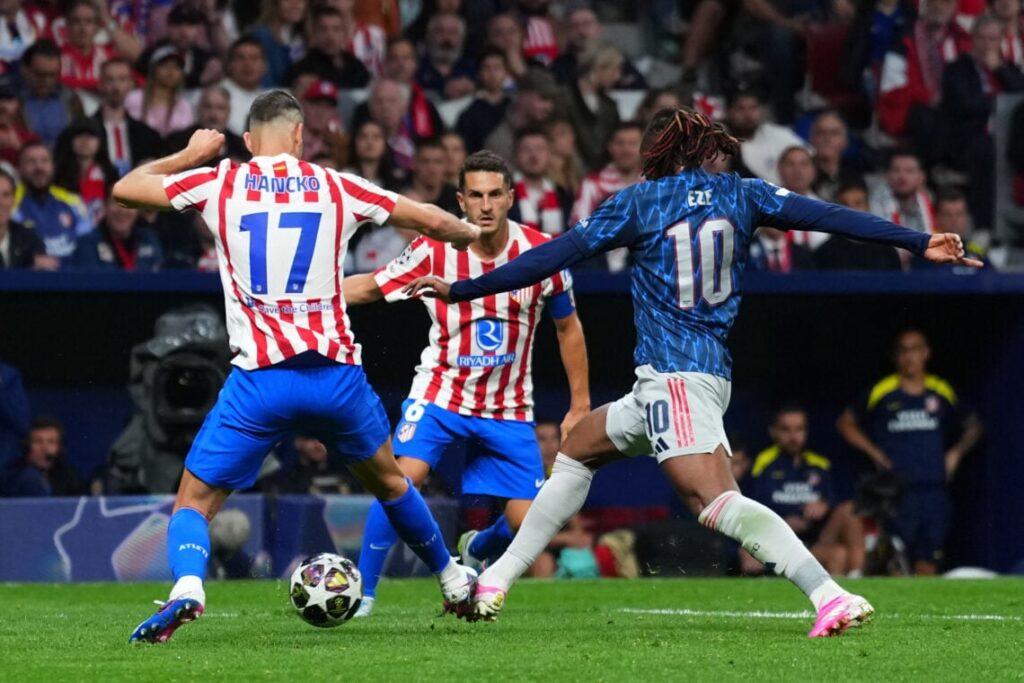
The fallout from Arsenal’s tense 1 to 1 draw against Atlético Madrid in the Champions League semi final has continued to dominate headlines, with attention fixed on a controversial refereeing decision involving Eberechi Eze late in the match. What initially looked like a decisive moment for the Gunners quickly turned into frustration after a VAR intervention reversed a penalty call that could have shifted the balance of the tie. UEFA has now issued an official explanation, but rather than settling the debate, it has only added more fuel to an already heated discussion among fans, analysts, and football figures.
The incident occurred in the 78th minute at the Riyadh Air Metropolitano, with the match finely poised and both teams pushing for an advantage ahead of the second leg in London. Eberechi Eze, who had come on as a substitute, made a sharp run into the penalty area and appeared to get to the ball just ahead of Atlético defender Dávid Hancko. In real time, it looked as though Hancko’s challenge caught Eze, causing him to go down. Referee Danny Makkelie reacted immediately by pointing to the spot, awarding Arsenal what seemed like a crucial penalty at a defining stage of the game.
What followed was a lengthy VAR review that changed everything. After being advised to take a second look, Makkelie went to the pitchside monitor, where he spent close to a minute reviewing multiple angles of the incident. Reports indicate that as many as thirteen different replays were examined before the referee made his final decision. When he returned to the field, he overturned the original call, signaling that there was no penalty. The stadium erupted, with Atlético supporters celebrating the reversal while Arsenal players expressed visible disbelief.
Read more on: Cristiano Ronaldo Shines Again With Decisive Goal To Secure The Title
UEFA’s official statement, released the following day, offered a brief explanation for the decision. According to the governing body, the penalty was cancelled because no foul had been committed. The statement specifically referenced Hancko, asserting that the defender did not infringe upon Eze in a way that warranted a penalty. While this clarification confirmed the final ruling, it stopped short of providing a detailed breakdown of the reasoning behind the assessment, particularly regarding the nature of the contact between the two players.
That lack of detail has become a central point of frustration, especially among Arsenal supporters and neutral observers who expected a more transparent explanation. Replays of the incident show that Eze did make contact with the ball before any collision occurred, which initially strengthened the case for a penalty. However, UEFA’s position appears to be that the subsequent contact from Hancko was too minimal to qualify as a foul. This interpretation has divided opinion, with some agreeing that football is a contact sport where not every collision should result in a penalty, while others argue that any contact preventing a player from continuing a promising attack inside the box should be punished.
Beyond the decision itself, the process has come under intense scrutiny. Critics have questioned whether the situation met the standard required for VAR intervention, which is supposed to correct clear and obvious errors. The fact that the referee needed to review the incident multiple times from various angles has led many to argue that the original call could not have been a clear mistake. This line of reasoning has been echoed by pundits and former players, who believe that such extended deliberation undermines the purpose of VAR and introduces more uncertainty rather than clarity.
Read more on: Arsenal Hold Atlético Madrid to Draw in Tense Champions League Semi Final First Leg
Arsenal manager Mikel Arteta did not hide his frustration when addressing the media after the match and again the following morning. He described the decision as deeply disappointing and suggested that it went against the principles that were communicated to clubs at the start of the season. According to Arteta, if a referee needs to analyze an incident repeatedly before reaching a conclusion, it should not qualify as a clear and obvious error. He emphasized that decisions of this magnitude can alter the course of a tie, especially at the semi final stage of Europe’s most prestigious club competition.
Arteta also pointed to what he perceived as inconsistency in officiating. Earlier in the match, Atlético Madrid had been awarded a penalty for a handball by Ben White, a decision that some observers considered soft. While that call stood without the same level of scrutiny, Arsenal’s opportunity was removed after extensive review. For Arteta, this contrast highlighted what he sees as a lack of uniformity in how key decisions are evaluated, further adding to his dissatisfaction.
The match itself was a tightly contested affair that reflected the tactical discipline of both sides. Arsenal took the lead just before halftime through Viktor Gyökeres, who converted from the penalty spot after a separate incident. Atlético responded in the second half, with Julián Alvarez equalizing from their own penalty. Both teams had moments of control, but neither was able to establish a decisive advantage, leaving the tie delicately balanced heading into the second leg.
Read more on: Atlético Madrid vs Arsenal: Tactical Battle Set in Champions League Semi Final (UCL)
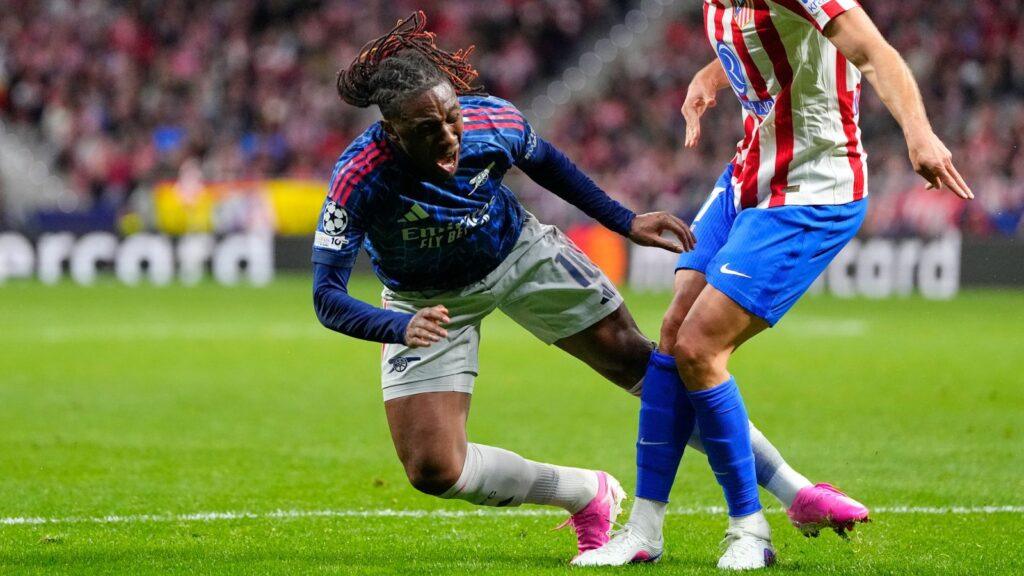
The overturned penalty involving Eze has taken on even greater significance because of the context. Had the decision stood and Arsenal converted, they would have carried a 2 to 1 lead back to the Emirates Stadium. Instead, the tie remains level, meaning that both teams will effectively start from scratch in the return leg. With the away goals rule no longer in effect, the emphasis will be on securing a straightforward victory, which adds to the pressure on both sides.
The atmosphere inside the Metropolitano during the VAR review has also been a topic of discussion. The stadium is known for its intensity, and the reaction of the crowd, combined with the animated presence of Atlético manager Diego Simeone on the touchline, created a high pressure environment. Some pundits, including former Liverpool captain Steven Gerrard, have suggested that these factors may have influenced the referee’s thinking. While there is no concrete evidence to support this claim, it reflects a broader concern about how external elements can impact decision making in critical moments.
For Atlético Madrid, the decision was seen as a moment of relief and perhaps even justice, depending on perspective. From their point of view, the review process worked as intended by correcting what they believed to be an incorrect call. Their focus now shifts to maintaining their defensive solidity and finding a way to break down Arsenal in the second leg, where the challenge will be just as demanding.
Read more on: Barcelona Open Talks for Osimhen in €100m+ Summer Transfer Move
For Arsenal, however, the sense of frustration lingers. The players showed composure throughout the match and demonstrated their ability to compete at the highest level, but the feeling that they were denied a significant opportunity has not gone away. The club is reportedly considering whether to seek further clarification from UEFA regarding the application of VAR in this instance, although it is widely understood that the result of the match will not be changed.
This incident is the latest in a series of debates surrounding the use of VAR in football. While the technology was introduced to reduce errors and improve fairness, situations like this highlight the ongoing challenges in its implementation. The subjective nature of many decisions means that interpretation still plays a major role, and different officials may reach different conclusions even when presented with the same footage.
As the conversation continues, attention will gradually shift back to the pitch, where the outcome of the tie will ultimately be decided. Arsenal will return to London knowing that they have the support of their home crowd and the opportunity to take control of their destiny. Atlético Madrid, meanwhile, will rely on their experience and resilience as they aim to secure a place in the final.
Read more on: PSG Edge Bayern in Nine-Goal Champions League Classic
The debate over the Eze incident is unlikely to fade quickly, as it touches on broader questions about consistency, transparency, and the role of technology in modern football. For now, it stands as a defining moment in a closely contested semi final, one that could have far reaching implications depending on what happens in the return leg.
Whether the decision was correct or not may never be universally agreed upon, but its impact is undeniable. It has shaped the narrative of the tie, intensified scrutiny on officiating standards, and reminded everyone that even in an era of advanced technology, football remains a game where interpretation and human judgment continue to play a decisive role.
Read more on:
- Anthony Joshua Confirms Next Fight After Surviving Devastating Crash
- Premier League confirms new run-in dates for Arsenal, Man City, Chelsea
- Arsenal Receive Double Injury Lift Ahead of Atletico Semi-Final Clash
- Eze’s Moment of Magic Sends Against NewsArsenal Past Newcastle in Hard-Fought Emirates Victory
- West Ham Edge Everton in Intense London Stadium Battle