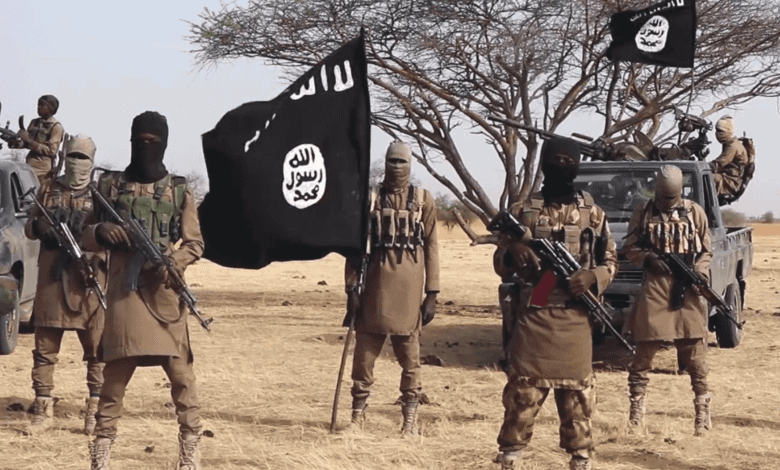
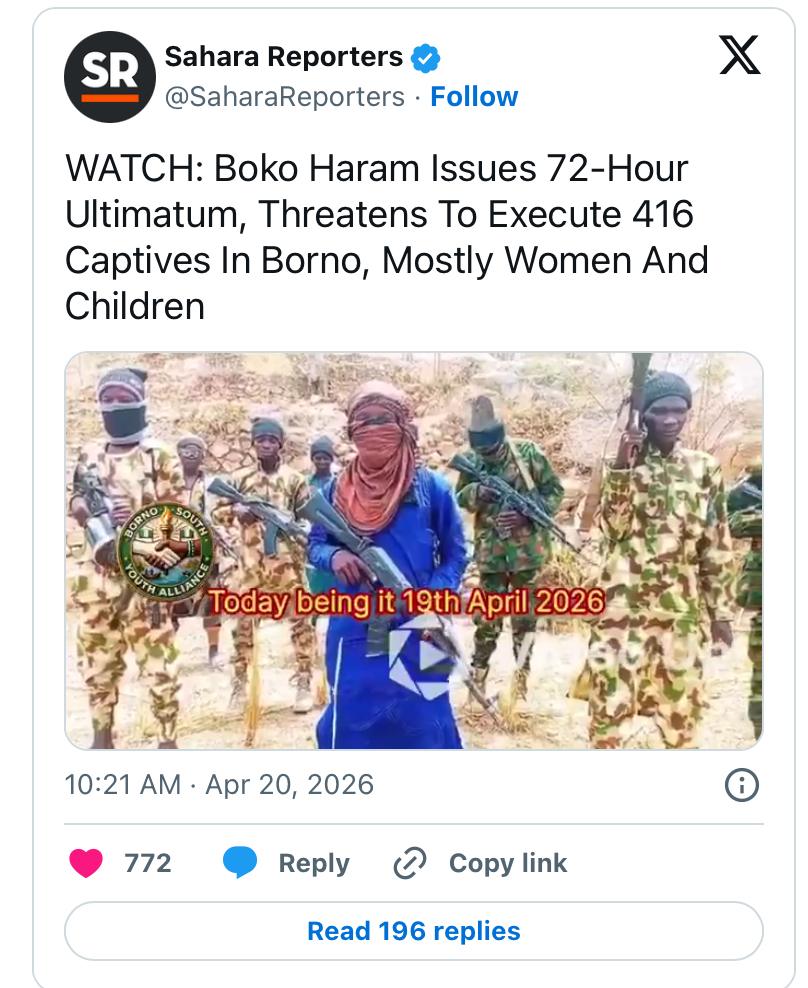
A fresh wave of fear has swept across Nigeria’s North East following the emergence of a deeply disturbing threat from the Boko Haram insurgent group. In a video released late Sunday night 19th of April, the group claimed to be holding 416 women and children and threatened to “share” them—a euphemism for forced marriages and human trafficking. In the footage, the insurgents issued a stark ultimatum to the Federal Government, demanding a massive ransom payment within a strict time frame or facing consequences that have horrified communities and observers alike.
According to the message delivered in the video, Boko Haram claims it has 416 women and children in its custody. The group warned that if a ransom of five billion naira is not paid within seventy two hours, it will disperse the captives among its fighters. This chilling language has been widely interpreted as a threat of forced marriages, sexual exploitation, and trafficking, practices that have long been associated with the insurgency’s tactics. The scale of the claim, combined with the bluntness of the demand, has sparked renewed concern about the security situation in the Lake Chad basin and the continued vulnerability of civilian populations.
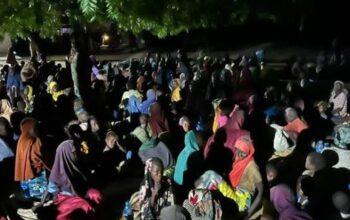
The video itself began circulating late Sunday night, initially appearing on encrypted messaging platforms before spreading rapidly across social media. It shows a large group of women and children seated on the ground in what appears to be a remote location, surrounded by armed men dressed in military style clothing. The captives look subdued and visibly distressed, while the masked spokesperson delivering the message speaks in a mix of Hausa and Kanuri, languages commonly used in the region.
Read more on: Iran launches drone attack on U.S. warships
In the recording, the group insists that the individuals shown were captured during a series of coordinated raids carried out over the past month. These attacks, they claim, targeted internally displaced persons camps as well as isolated farming communities. Such locations are often soft targets due to limited security presence and the concentration of already vulnerable populations. The figure of 416, repeatedly emphasized in the video, has added to the gravity of the situation, suggesting a large scale operation that may have gone undetected or underreported until now.
The ultimatum itself is clear and leaves little room for interpretation. The spokesperson states that the government has seventy two hours from Sunday midnight to meet their demand. Failure to do so, he warns, will result in the captives being separated and distributed among fighters, after which they would likely disappear into remote areas where rescue becomes nearly impossible. The phrasing used in the threat has struck a particularly painful chord, given the history of similar incidents in the region and the long term trauma experienced by victims.
As of now, the Federal Government has not released an official statement addressing the video or the claims made within it. However, indications from within the security apparatus suggest that intelligence agencies are actively working to verify the authenticity of the footage. Determining whether the video is recent, where it was filmed, and whether the number of captives is accurate will be critical in shaping the government’s response.
The situation places President Bola Ahmed Tinubu’s administration in a difficult and highly sensitive position. Nigeria’s legal framework currently prohibits the payment of ransom to terrorist groups, a policy enshrined in the 2022 amendment to the Terrorism Prevention Act. This law was introduced to discourage the financing of criminal and insurgent activities, but it also creates a moral and strategic dilemma in situations where lives are at immediate risk.
Read more on: Benue Kidnapping: Gunmen Demand ₦9 Million per Passenger
Complicating matters further are recent controversies surrounding similar incidents. Earlier in 2026, reports emerged suggesting that a large ransom may have been paid to secure the release of students abducted from a school in Niger State. Although the government denied these claims, the episode fueled public skepticism and raised questions about how such crises are handled behind closed doors. In light of this history, the current situation is likely to intensify scrutiny on the government’s actions.
At the same time, there is growing pressure on the military to consider a rescue operation. Nigeria’s armed forces have conducted similar missions in the past, sometimes with success but often at great risk. Attempting to extract such a large number of hostages from potentially hostile terrain presents enormous logistical and operational challenges. Any miscalculation could endanger the lives of those being held, making the decision to act or hold back an incredibly complex one.
The broader context of this threat points to a troubling resurgence in large scale abductions across the country. Since late 2025, there has been a noticeable increase in incidents involving the mass kidnapping of civilians, particularly in northern regions. One of the most prominent cases occurred in November 2025, when more than three hundred students and teachers were taken from a school in Niger State. Although many were eventually released, the circumstances surrounding their freedom remain a subject of debate.
Security analysts have noted that insurgent groups are increasingly targeting internally displaced persons camps. These camps, which house individuals who have already fled violence in their home communities, often lack adequate protection. The concentration of people in these settings makes them attractive targets for groups seeking to maximize impact while facing minimal resistance. This trend has raised serious concerns about the safety of some of the most vulnerable populations in the country.
Read more on: Former Nigeria Football Federation Chief Dies as Details Emerge
The timing of the current threat has also drawn attention from advocacy groups. The Bring Back Our Girls movement, which recently marked the twelfth anniversary of the Chibok schoolgirls’ abduction, issued a statement condemning the situation. The group described the development as a failure of intelligence and called for urgent action to prevent a repeat of past tragedies. Their message reflects a broader frustration with the persistence of such incidents despite years of effort to combat insurgency.
Beyond the political and security dimensions, the human impact of this crisis is profound. In communities across Borno State and surrounding areas, families are grappling with fear and uncertainty. Many are unsure whether their missing relatives are among those mentioned in the video. For these families, the ultimatum represents not just a threat but a countdown filled with anxiety and helplessness.
Stories emerging from affected areas paint a heartbreaking picture. Individuals who have not heard from loved ones since recent attacks are now confronted with the possibility that they may be among the captives. The emotional toll of this uncertainty is immense, as families struggle to cope with the thought of what might happen if the demands are not met. For many, the idea of their relatives being forcibly separated and taken away is almost too painful to bear.
From a strategic perspective, the scale of the alleged abduction raises important questions. Moving and holding more than four hundred people in remote regions such as the Sambisa Forest or the Mandara Mountains would require significant coordination and resources. It also suggests a level of operational capability that security forces will need to assess carefully. At the same time, the demand for a large ransom may indicate financial pressure within the insurgent group, possibly linked to ongoing military operations that have disrupted their supply lines.
Read more on: Bauchi PDP-APC Realignment Talks Collapse in Deadlock
Nigeria’s military has been engaged in sustained efforts to weaken Boko Haram and its affiliates, including Operation Hadin Kai. These operations have targeted key strongholds and disrupted traditional smuggling routes, limiting the group’s access to resources. However, incidents like this highlight the adaptability of insurgent networks and their ability to exploit gaps in security.
As the deadline set by the group approaches, the situation remains fluid and highly uncertain. The government faces a difficult balancing act between adhering to its stated policies and responding to the immediate humanitarian crisis. Any decision made in the coming hours will carry significant implications, not only for the individuals directly affected but also for the broader fight against insurgency.
For now, the focus remains on verifying the claims, gathering intelligence, and exploring possible courses of action. Whether through negotiation, military intervention, or a combination of approaches, the priority will be to secure the safety of those reportedly being held. The coming days will be critical in determining how this crisis unfolds and whether a resolution can be reached without further loss or suffering.
In the midst of this uncertainty, one thing is clear. The threat has once again exposed the enduring challenges of security and governance in parts of Nigeria. It serves as a stark reminder that despite progress in some areas, significant work remains to ensure the safety and dignity of all citizens. As families wait anxiously for news, the hope is that swift and effective action will prevent yet another chapter of tragedy in a region that has already endured so much.
Read more on: