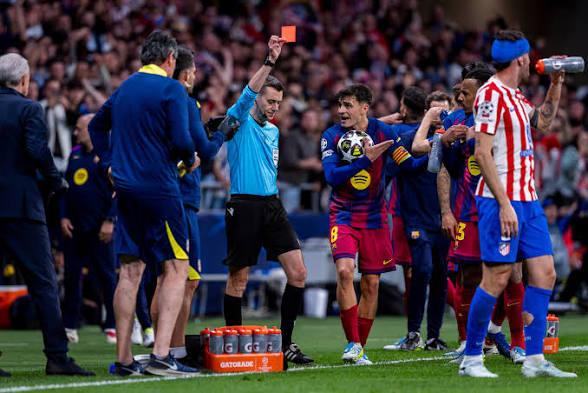
The fallout from FC Barcelona’s dramatic exit from this season’s UEFA Champions League continues to intensify, with the club taking the unusual step of submitting a second formal complaint to European football’s governing body. The Catalan side is insisting that a sequence of controversial refereeing decisions across both legs of their quarter final tie against Atlético Madrid played a decisive role in their elimination.
This latest move comes just days after UEFA’s Control, Ethics and Disciplinary Body dismissed Barcelona’s initial protest, describing it as inadmissible. Undeterred, club president Joan Laporta and his board have returned with renewed arguments, claiming that fresh incidents from the second leg in Madrid further strengthen their case that officiating errors materially affected the outcome of the tie.
At the heart of Barcelona’s complaint is the assertion that these decisions were not merely subjective calls open to interpretation, but rather failures in the proper application of the Laws of the Game. The club argues that such errors have resulted in what they describe as both a significant sporting injustice and a measurable financial setback.
Read more on: Arsenal Poised to offload Kai Havertz and Gabriel Jesus to finance €120m
A Tie Defined by Controversy
Barcelona’s frustration stems from a series of moments spread across the two matches that, in their view, consistently went against them. While controversial refereeing decisions are not uncommon in high stakes European fixtures, the club believes the cumulative effect of these incidents crossed a threshold that demands formal review.
The first flashpoint occurred during the opening leg at the Spotify Camp Nou. In that match, Atlético Madrid defender Marc Pubill appeared to handle the ball inside his own penalty area following a short goal kick taken by goalkeeper Juan Musso. Barcelona players immediately appealed for a penalty, arguing that the ball was already in play when the contact occurred.
From Barcelona’s perspective, not only should a penalty have been awarded, but Pubill should also have received a second yellow card, which would have resulted in his dismissal. Such an outcome, they argue, could have significantly altered the trajectory of the tie from its early stages.
However, the match officials, led by referee Istvan Kovacs and supported by VAR official Christian Dingert, ruled that the ball was not yet in play at the time of the incident. On that basis, no offence was given. UEFA later supported this interpretation when it rejected Barcelona’s first complaint, effectively closing the door on that particular argument.
Despite that setback, the club has continued to reference the incident as part of a broader pattern of decisions that they believe worked against them.
Read more on: First-ever World Cup halftime show is confirmed by FIFA as global stage is eyed by Nigeria
Second Leg Tensions Reach Breaking Point
If the first leg planted the seeds of frustration, the return fixture at the Riyadh Air Metropolitano brought those tensions to a boiling point. Barcelona won the match 2 to 1 on the night but fell short on aggregate, losing the tie 3 to 2. For the club, however, the scoreline only tells part of the story.
One of the most contentious moments came with the sending off of defender Eric García. The Barcelona camp has strongly criticized the decision, describing it as baffling and disproportionate to the incident in question. According to their interpretation, the challenge did not meet the criteria required for a denial of an obvious goal scoring opportunity, commonly referred to as DOGSO.
Barcelona’s complaint suggests that even if the referee initially viewed the incident as a red card offence, the VAR system should have intervened to recommend a review. In their view, the failure to do so represents a clear breakdown in the decision making process.
The dismissal left Barcelona at a numerical disadvantage during a crucial phase of the match, further complicating their efforts to overturn the aggregate deficit. Club officials argue that this moment had a direct and significant impact on the final result.
Another major point of contention came late in the game, when Dani Olmo went down inside the Atlético penalty area following a challenge that Barcelona players believed warranted a spot kick. Despite strong appeals, the referee allowed play to continue.
For Barcelona, this incident served as the final confirmation of what they see as a pattern of unfavorable decisions. Several players did not hide their frustration after the match, with forward Raphinha openly criticizing the officiating and suggesting that the team had been unfairly treated.
Read more on: Bayern Edge Real Madrid in All Time Classic to Seal Semi Final Place
UEFA’s Position and the Challenge Ahead
While Barcelona has framed its complaint around the idea of technical errors, UEFA’s established approach to such cases presents a significant obstacle. The governing body generally distinguishes between errors in the application of the rules and subjective decisions made by referees during the course of a match.
In most cases, only clear procedural mistakes, such as misapplying a rule, are considered grounds for disciplinary action or further review. Judgement calls, even if controversial, are typically regarded as part of the natural flow of the game and are not subject to retrospective correction.
By labeling Barcelona’s first complaint as inadmissible, UEFA effectively signaled that it viewed the disputed incidents as falling within the realm of referee discretion rather than technical misapplication. This makes it highly unlikely that the second complaint will lead to any change in the official outcome of the tie.
Even so, Barcelona appears determined to press its case, emphasizing the need for what it describes as greater transparency and consistency in officiating standards.
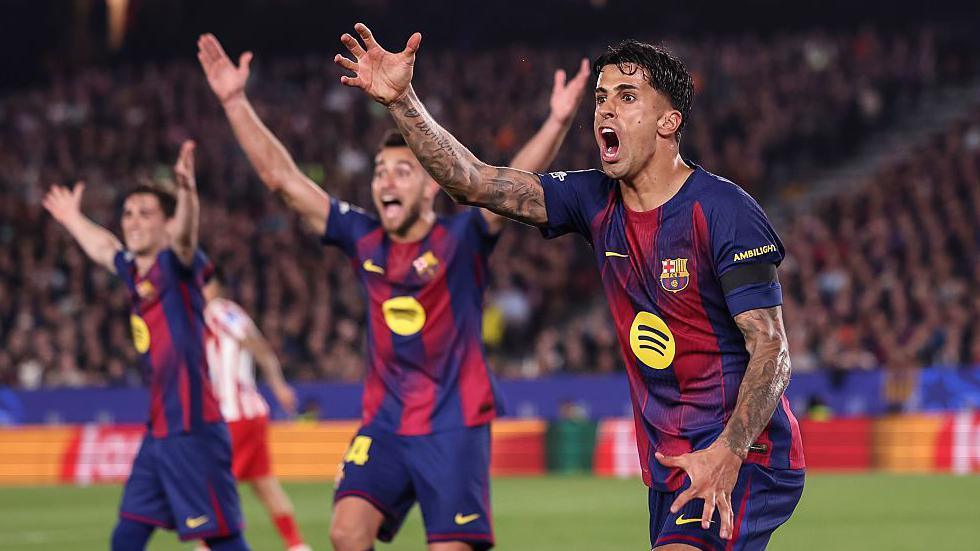
In an official statement, the club reiterated its position that the accumulation of questionable decisions had a direct influence on both matches and ultimately shaped the final result. It also called on UEFA to ensure a more rigorous and fair application of the rules moving forward.
Read more on: Arsenal Grind Out Sporting Draw to Reach Champions League Semi-Finals
Financial Stakes Behind the Dispute
While the sporting implications of the elimination are obvious, the financial dimension is equally significant. Progressing to the semi finals of the Champions League would have secured Barcelona an additional 12.5 million euros in prize money, along with the commercial benefits associated with hosting a high profile match at home.
For a club that has spent recent years navigating financial challenges, such revenue streams are far from trivial. The board’s strong reaction is therefore not only about perceived injustice on the pitch but also about the broader economic impact of their early exit.
In addition, the result may have implications for Barcelona’s ambitions to qualify for the expanded FIFA Club World Cup scheduled for 2029. Participation in that tournament is expected to be highly lucrative, making Champions League performance a critical factor in long term planning.
From this perspective, the club’s insistence on pursuing the matter can be seen as part of a wider effort to protect its competitive and financial interests.
Critics Point to Wider Context
Not everyone has been sympathetic to Barcelona’s position. Rival supporters and some voices within the Spanish media have highlighted the ongoing Negreira case as a complicating factor in the narrative.
The case, which involves historical payments made by the club to a former referees’ official, has cast a shadow over Barcelona’s relationship with officiating authorities. Critics argue that the club’s current complaints risk appearing contradictory in light of these unresolved issues.
Some have suggested that the renewed protest may serve as a way to shift focus away from both on field shortcomings and ongoing legal scrutiny. Others, however, maintain that each case should be judged on its own merits and that concerns about refereeing standards deserve to be addressed regardless of external context.
Read more on: Real Madrid Mourns Santamaría as Bayern Clash Sets Stage for Emotional Comeback Bid
Focus Shifts Back to Domestic Ambitions
Amid the ongoing dispute, head coach Hansi Flick has attempted to steer attention back toward the team’s immediate objectives. While acknowledging the disappointment of the Champions League exit, he has emphasized the importance of regrouping and maintaining focus on domestic competitions.
Flick noted that his side delivered a strong performance, particularly in the first half of the second leg, and expressed pride in the players’ efforts. At the same time, he acknowledged that the team must accept the result and move forward.
With the La Liga title race still in play, Barcelona has an opportunity to salvage the season by securing domestic success. Achieving that goal could help ease some of the frustration surrounding their European campaign.
What Happens Next
UEFA is expected to review Barcelona’s second complaint within the coming days, although expectations of any dramatic outcome remain low. Legal experts widely agree that the chances of a replay or reversal of the result are virtually nonexistent under current regulations.
More likely is that the case will end with another dismissal, reinforcing UEFA’s stance on protecting referees’ authority and preserving the finality of match results.
Nevertheless, Barcelona’s actions have reignited debate about the role of VAR, the consistency of officiating, and the mechanisms available for clubs to challenge decisions they believe to be unjust.
Read more on: Chelle Targets NPFL Stars for Unity Cup Auditions Ahead of Key Friendlies
A Debate That Goes Beyond One Match
At its core, this situation raises broader questions about accountability in modern football. As technology continues to play a larger role in decision making, expectations around accuracy and fairness have increased accordingly.
For Barcelona, the belief remains that they were denied a fair outcome in a competition that carries enormous sporting and financial significance. For UEFA, maintaining the integrity and authority of match officials is equally critical.
Whether this particular dispute leads to any tangible changes remains to be seen. What is clear, however, is that the conversation it has sparked will continue to resonate well beyond this single tie.
As the dust slowly settles, Barcelona must balance its pursuit of answers with the practical need to move forward. The disappointment of elimination will linger, but so too will the determination to compete at the highest level and to ensure that future campaigns are defined by performance rather than controversy.
Read more on: