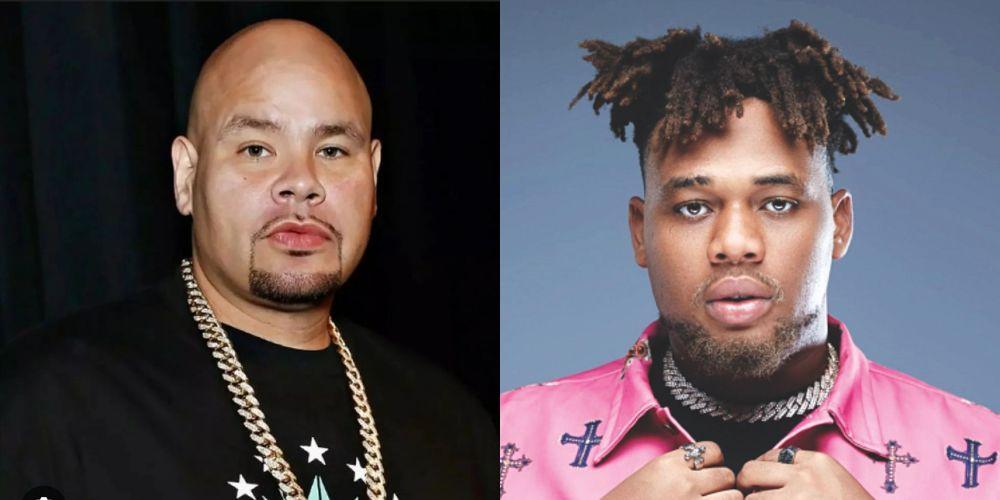
The global Afrobeats community has been thrown into a fresh wave of debate after a set of striking comments by American rap veteran Fat Joe. Known for his long-standing influence in hip hop, the “Lean Back” rapper has stirred conversation across continents by suggesting that he played a decisive role in pushing Nigerian music star BNXN, formerly known as Buju, to abandon his old stage name. His remarks have quickly gained traction online, setting off reactions from fans, critics, and industry insiders alike.
The controversy began to gather momentum on Thursday, April 23, 2026, after clips from a recent podcast appearance started circulating widely. Fat Joe appeared alongside Jamaican reggae icon Buju Banton, and during their conversation, he spoke confidently about what he described as his involvement in the Nigerian artist’s rebranding. According to him, the situation revolved around the use of the name “Buju,” which he implied was too closely tied to Buju Banton’s established legacy.
In the now-viral clip, Fat Joe did not hold back. He referred to BNXN as someone who had been using a name that already carried weight and history in global music. He framed the issue as one of respect, suggesting that adopting the same name as a legendary artist could be seen as disregarding that legacy. He went further by claiming that he had publicly addressed the matter during his time as a guest host on The Wendy Williams Show in 2022.
Read more on: Court Delivers Surprise Ruling in Mercy Johnson’s Defamation Case Against Angela Okorie
Recounting that moment, Fat Joe stated that he used the platform to call out the Nigerian singer on live television. In his words, the criticism was direct and effective. He claimed that the message reached its target and forced a change. He recalled telling the artist that there was only one Buju Banton and suggested that this public statement played a major role in the eventual rebrand. He even mocked BNXN’s current name, joking about its unusual spelling and presentation, implying that it came as a reaction to the pressure he helped create.
Buju Banton, who was part of the same conversation, added a different layer to the discussion by emphasizing the personal significance of his own name. He explained that “Buju” was not just a stage identity but something given to him by his mother, carrying cultural and emotional meaning. His remarks highlighted a contrast between artists who inherit names with deep roots and those who adopt names for branding or creative reasons.
As the clip spread online, it did not take long for BNXN to respond. The Nigerian artist addressed the claims directly on social media, offering a different perspective on how and why the name change happened. His response was calm but firm, acknowledging the influence of music legends while also correcting what he described as a misleading narrative.
BNXN made it clear that the decision to move from Buju to BNXN was not driven by any public criticism or televised remarks. Instead, he explained that it was a calculated business move guided by legal and branding considerations. According to him, his management team and legal advisors had already been working on the transition well before any external commentary surfaced. He suggested that the change was part of a broader strategy aimed at positioning him for long-term global success.
Read more on: Blessing CEO Starts Refunding Donors Amid Controversy Over Alleged Cancer Scam
His explanation aligns with what many industry observers had already understood about the situation. The shift from Buju to BNXN in early 2022 was widely seen as a strategic rebranding effort designed to eliminate confusion and strengthen his identity in the international music market. At the time, the name “Buju” presented challenges, particularly in digital spaces where search results were heavily dominated by Buju Banton. This made it difficult for the Nigerian artist to establish a distinct presence on streaming platforms and search engines.
By adopting the name BNXN, pronounced Benson, the artist was able to create a unique and recognizable brand. The stylized spelling also gave him a modern edge, helping him stand out in an increasingly competitive industry. It allowed for clearer trademark registration, which is essential for artists looking to secure deals and expand their reach in markets like the United States and the United Kingdom.
Beyond the legal and technical factors, the rebrand also marked a new phase in BNXN’s career. It coincided with a period of artistic growth and increased international visibility, particularly with projects that showcased his evolving sound and identity. For many fans, the new name quickly became associated with his rise as a global Afrobeats figure, rather than a departure forced by controversy.
While the name debate alone was enough to generate headlines, Fat Joe’s comments did not stop there. During the same podcast appearance, he made another claim that sparked even more intense reactions. He suggested that Afrobeats as a genre originated in Jamaica, a statement that immediately drew criticism from Nigerian music historians, cultural commentators, and fans.
Read more on: Laycon Reflects on How BBNaija Win Saved His Mother’s Life
This assertion touched on a sensitive and deeply rooted topic. Afrobeats, as widely recognized today, traces its origins to Nigeria and is strongly linked to the pioneering work of Fela Kuti, who developed Afrobeat by blending traditional African rhythms with jazz, funk, and highlife. Over time, Afrobeats evolved into a modern genre distinct from Afrobeat, incorporating elements of pop, dancehall, and hip hop while maintaining its African core.
Fat Joe’s statement appeared to blur these distinctions, leading to a wave of responses aimed at clarifying the history. Many critics argued that while Jamaican music, particularly reggae and dancehall, has undeniably influenced global sounds, it is inaccurate to credit Jamaica as the origin of Afrobeats. Instead, they pointed to the genre’s Nigerian roots and its subsequent evolution through artists who have carried it onto the global stage.
The reaction from fans has been varied and passionate. Supporters of BNXN have rallied behind him, emphasizing that his use of the name “Buju” had its own context and meaning within Nigeria. Some pointed out that the word carries different interpretations across cultures and should not automatically be viewed as an attempt to replicate another artist’s identity.
On the other side, fans of Buju Banton have expressed understanding for Fat Joe’s stance, arguing that a name associated with a legendary figure should be treated with a certain level of exclusivity. For them, the issue is less about business strategy and more about preserving legacy and respect within the music community.
Read more on: Davido and Chris Brown Finally Set to Release Long-Awaited Joint Album
Industry observers have taken a more analytical approach, suggesting that Fat Joe’s comments reflect a broader pattern of American voices asserting influence over global narratives. Some critics have described his remarks as an example of overreach, noting that the rebranding decision was likely already in motion before his televised comments ever aired. They argue that while his perspective adds to the conversation, it may not accurately represent the full story.
As of now, the conversation continues to trend across social media platforms, with hashtags related to both BNXN and Fat Joe gaining significant traction. The debate has also sparked curiosity about whether other major artists will weigh in, particularly those who have worked across different regions and genres. Figures like Wizkid and Burna Boy, who have collaborated with both Jamaican and American artists, are seen as potential voices who could offer a more nuanced perspective.
Despite the noise surrounding the situation, one thing remains clear. BNXN has continued to thrive under his new identity, building a strong presence both locally and internationally. His music has reached wider audiences, and his brand has become more defined since the change. This suggests that regardless of the various narratives about what prompted the shift, the outcome has been beneficial for his career.
In the end, the situation highlights the complex interplay between culture, identity, and business in the modern music industry. Names carry meaning, history, and branding power, and decisions about them are rarely simple. While Fat Joe may view the change as a response to his intervention, BNXN’s explanation points to a more strategic and internally driven process.
The debate also underscores the importance of accurately representing the origins and evolution of musical genres. As Afrobeats continues to gain global recognition, conversations about its roots and influences are likely to become more frequent and more intense. For now, the discussion sparked by these recent comments serves as a reminder of how interconnected and sometimes contentious the global music landscape can be.
Read more on:
- Mr P disclose his change of birthday date amid ongoing fued with twin brother Paul
- Blord Speaks Out Following Kuje Prison Release, Hints at Next Big Move
- Adekunle Gold celebrates Simi at 38 with luxury Mercedes-Benz GLE and diamond ring
- Tunde Perry Reveals What He Would’ve Done if Portable Damaged Soberekon’s Rolls-Royce