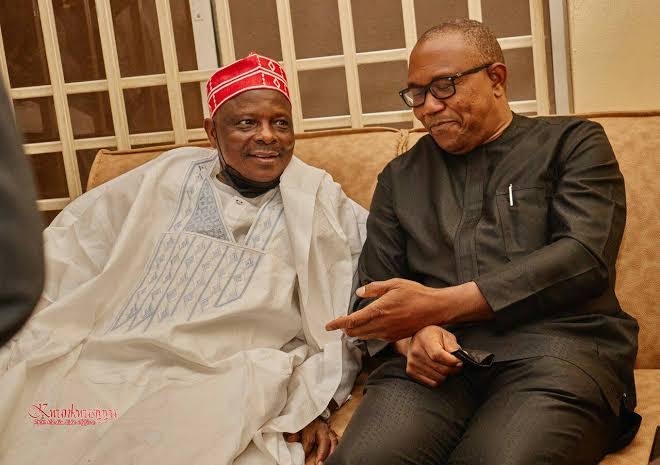
Nigeria’s political atmosphere shifted dramatically today as former Anambra State Governor and prominent opposition figure Peter Obi publicly addressed his decision to leave the African Democratic Congress and align himself with the Nigeria Democratic Congress. Standing side by side with Senator Rabiu Musa Kwankwaso during a widely anticipated press briefing in Abuja, Obi offered a detailed explanation for his departure, framing it not as a sudden or impulsive move but as the outcome of prolonged internal challenges that, in his view, made it impossible to continue under the ADC platform.
For many observers, the announcement confirmed what had been whispered in political circles for weeks. Tensions within the ADC had reportedly reached a boiling point, with multiple factions laying claim to leadership positions and dragging the party into a series of legal battles. While the party had initially been seen as a potential rallying point for opposition forces seeking to challenge the dominance of the ruling All Progressives Congress, the internal crises gradually eroded confidence in its ability to function as a cohesive political force.
Obi did not shy away from addressing these issues directly. Speaking with a tone that balanced frustration and resolve, he emphasized that the constant litigation and internal divisions had created an environment that was no longer conducive to serious political engagement. According to him, the situation had gone beyond routine disagreements and had evolved into a full-blown crisis that threatened the party’s very existence.
He explained that a political platform must offer stability, clarity of purpose, and a unified direction if it is to serve the interests of the people effectively. In the case of the ADC, he argued, those essential elements had been compromised. The ongoing court cases involving rival factions not only consumed valuable time and resources but also distracted from the broader mission of presenting a credible alternative to the current administration. For Obi, this was a fundamental problem that could not be overlooked or managed indefinitely.
Read more on: China Rejects U.S. Sanctions on Iranian Oil Trade
Another key factor he highlighted was the deepening division within the party’s leadership structure. What might have begun as manageable differences had, over time, hardened into entrenched camps, each unwilling to give ground to the other. This fragmentation, he noted, made it increasingly difficult to coordinate strategy, mobilize supporters, or project a clear and unified message to the electorate. In a political landscape as competitive as Nigeria’s, such disunity can be particularly damaging.
The situation was further complicated by the involvement of the Independent National Electoral Commission. Recent decisions by INEC to withdraw recognition from conflicting factions within the ADC pending the resolution of their disputes effectively created a state of uncertainty around the party’s legal standing. Obi described this development as creating a political vacuum, one that posed significant risks for anyone hoping to build momentum ahead of the 2027 general elections.
In his words, it became clear that remaining within the ADC would mean operating in an environment defined by instability and unpredictability. He stressed that his decision to leave was driven not by personal ambition but by a broader concern for the future of opposition politics in Nigeria. He argued that the country needs a strong, organized, and forward-looking opposition capable of holding the government accountable and offering viable policy alternatives.
It was within this context that the Nigeria Democratic Congress emerged as a new political home. Obi described the move to the NDC as a strategic decision aimed at consolidating opposition forces and creating a platform that is better equipped to navigate the challenges ahead. The party, which has been quietly building its structure and expanding its reach, now finds itself at the center of national attention following the entry of two major political figures.
Read more on: 11 Killed as Bandits Carry Out Reprisal Attacks on Katsina Villages
The alliance between Obi and Kwankwaso is perhaps the most significant aspect of this development. Both men bring with them substantial political capital and loyal support bases that span different regions of the country. Obi’s appeal, particularly among younger voters and urban populations, has been a defining feature of recent electoral cycles. Kwankwaso, on the other hand, commands a strong following in the northern part of Nigeria through the well-established Kwankwasiyya movement.
Their decision to come together under one platform signals an effort to bridge regional divides and present a more unified national front. While details of their arrangement are still emerging, there are strong indications that they are considering a joint presidential ticket for the 2027 elections, with Obi as the presidential candidate and Kwankwaso as his running mate. Such a pairing would represent a calculated attempt to combine their respective strengths and address the longstanding challenge of building a truly national coalition.
Political analysts have been quick to weigh in on the implications of this alliance. Many see it as a pragmatic move that reflects a growing recognition among opposition leaders of the need to avoid fragmentation. The experience of previous elections, particularly in 2023, demonstrated how a divided opposition can struggle to compete effectively against a well-organized ruling party. By coming together early in the electoral cycle, Obi and Kwankwaso appear to be signaling their intention to avoid repeating past mistakes.
Another point of discussion has been Obi’s reference to the issue of money in politics. He has consistently spoken out against what he describes as the excessive monetization of the political process in Nigeria. In aligning with the NDC, he suggested that he sees an opportunity to promote a different approach, one that places greater emphasis on ideas, accountability, and grassroots engagement rather than financial influence.
Read more on: Galadima Reveals Obi, Kwankwaso Set to Exist ADC Amid Rising Tensions
Reactions to the announcement have been swift and varied. Supporters of Obi, many of whom identify with the “Obidient” movement, have expressed a mix of excitement and cautious optimism. For them, the move represents a chance to reset and build a more stable political structure capable of sustaining their momentum. At the same time, some have raised questions about how the transition will be managed and whether the values that attracted them to Obi in the first place will be preserved within the new arrangement.
Kwankwaso’s supporters have also responded positively, viewing the alliance as an opportunity to expand their influence beyond their traditional strongholds. The prospect of combining the energy of the Obidient movement with the organizational strength of the Kwankwasiyya network has generated considerable interest among political observers.
Not everyone, however, is convinced that the move will deliver the desired results. Critics have pointed out that forming alliances is one thing, but maintaining them over time is another challenge entirely. Nigerian political history is filled with examples of coalitions that initially appeared promising but eventually unraveled due to internal disagreements and competing interests. For the NDC to succeed, it will need to establish clear structures, transparent processes, and mechanisms for resolving conflicts.
The impact of Obi’s departure on the ADC is another area of concern. The party, which once held considerable promise as a platform for opposition politics, now faces an uncertain future. Losing key figures of this magnitude is likely to weaken its position significantly, both in terms of public perception and organizational capacity. The remaining leadership will need to act quickly to stabilize the party and redefine its role within the broader political landscape.
Read more on: Fresh Police Killing in Oyo Triggers Nationwide Anger
As events continue to unfold, attention will inevitably turn to how the NDC plans to integrate its new members. Bringing together different political traditions, support bases, and leadership styles is a complex task that requires careful planning and effective communication. The party’s National Working Committee will play a crucial role in this process, as it seeks to create a structure that accommodates its expanded membership while maintaining coherence and discipline.
There is also the question of how this development will influence the strategies of other political actors. The ruling party will undoubtedly be watching closely, assessing the potential threat posed by a more unified opposition. Other opposition figures, including those who remain outside the NDC, may also reconsider their positions in light of the new alignment. The coming months could see further realignments as politicians position themselves for the 2027 elections.
For Obi, the decision marks a new chapter in a political journey that has been characterized by both rapid ascent and significant challenges. His ability to mobilize support and inspire a sense of possibility among many Nigerians has made him a central figure in contemporary politics. The move to the NDC represents both a risk and an opportunity, offering the chance to build something new while also exposing him to the uncertainties that come with any major transition.
Kwankwaso, for his part, brings experience, structure, and a loyal base that could prove invaluable in the years ahead. His willingness to align with Obi suggests a recognition of the changing dynamics of Nigerian politics and the need for collaboration in the face of entrenched power structures.
Read more on: Nigeria Launches Free Evacuation Flights as xenophobia Crisis Increase
Ultimately, the significance of this moment lies not just in the movement of individuals from one party to another, but in what it reveals about the state of Nigeria’s political system. It highlights the challenges of building sustainable institutions, the importance of unity within opposition ranks, and the ongoing search for effective ways to engage with an electorate that is increasingly demanding accountability and results.
As the dust begins to settle, one thing is clear. The road to 2027 has taken an unexpected turn, and the decisions made in the coming months will play a crucial role in shaping the outcome. Whether the alliance between Obi and Kwankwaso will succeed in redefining the political landscape remains to be seen, but it has already succeeded in capturing the attention of the nation and setting the stage for what promises to be a highly contested electoral cycle.
Read more on:
- UNICROSS Mourns Loss of Three Students and Staff in Tragic Highway Crash
- Delta Police Officer Faces Murder Charge After Fatal Shooting of Suspect in Custody in Effurun
- President Tinubu Embarks on France, Kenya, Rwanda Trip for Strategic Summits
- Silence in Wike Camp as APC Stakeholders Present Fubara with Re-election Forms