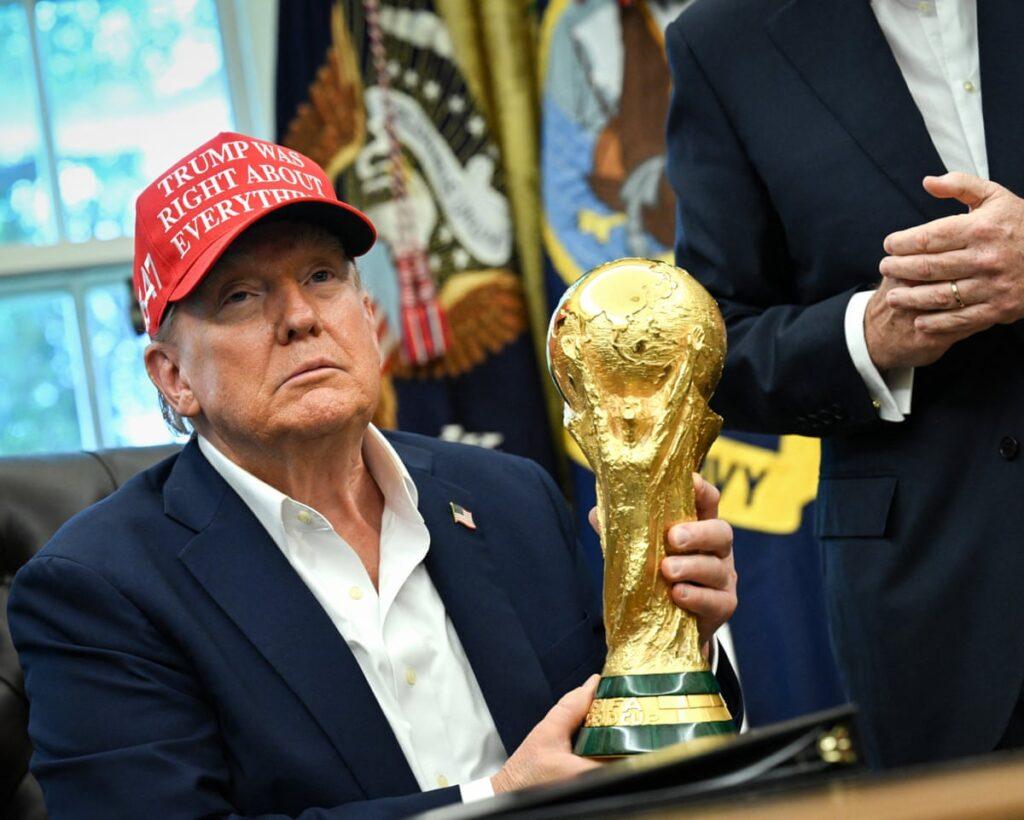
Donald Trump holding the FIFA World Cup trophy in the Oval Office.
A remarkable and highly controversial proposal has emerged at the intersection of international politics and global football, as a senior envoy linked to U.S. President Donald Trump has suggested that FIFA consider removing Iran from the 2026 World Cup and offering their place to Italy. The idea, which has already stirred intense debate across diplomatic and sporting circles, represents an unusual attempt to use football as a tool for easing geopolitical strain while simultaneously reshaping one of the biggest tournaments in the world.
At the center of this development is Paolo Zampolli, the United States Special Representative for Global Partnerships, who has reportedly communicated the proposal to both President Trump and FIFA President Gianni Infantino. Zampolli, who has Italian roots, described the possibility of Italy’s inclusion in the tournament as a “dream” scenario, pointing to the nation’s rich footballing history and global appeal. According to reports from major international outlets, the suggestion is not merely about footballing merit but is also deeply tied to ongoing diplomatic tensions involving the United States, Iran, and Italy.
Italy’s absence from the 2026 World Cup had already been confirmed following a painful playoff defeat to Bosnia and Herzegovina earlier this month. The loss, decided via a penalty shootout, extended a worrying trend for the Azzurri, who have now failed to qualify for three consecutive World Cups. For a nation that has lifted the trophy four times and has long been considered one of football’s traditional powerhouses, the failure sparked widespread disappointment and internal upheaval, including the resignation of the head of the Italian football federation.
Zampolli’s proposal appears to offer an unexpected lifeline to Italian football, albeit one rooted in extraordinary circumstances. In his remarks to reporters, he emphasized Italy’s pedigree and the excitement their participation would generate, especially with the tournament set to be co-hosted by the United States, Canada, and Mexico. His vision suggests that Italy’s inclusion could enhance the spectacle of the competition while also serving broader diplomatic purposes.
Read more on: Barcelona Edge Celta Vigo to Extend La Liga Lead
Those broader purposes are where the situation becomes far more complex. Behind the scenes, the proposal is widely viewed as part of an effort to mend strained relations between President Trump and Italian Prime Minister Giorgia Meloni. The relationship between the two leaders has reportedly deteriorated in recent weeks following a series of public disagreements. Tensions escalated after President Trump made critical remarks about Pope Leo XIV, who has been outspoken in his opposition to the ongoing conflict between the United States and Iran. Meloni responded strongly to Trump’s comments, describing them as unacceptable, which in turn prompted a sharp reaction from the U.S. President.
Diplomatic observers believe that offering Italy a pathway into the World Cup could serve as a symbolic gesture aimed at repairing this rift. Football holds enormous cultural significance in Italy, and the national team’s participation in a major tournament hosted partly by the United States could be framed as a goodwill gesture toward both the Italian government and its citizens. In this context, the proposal is less about sporting fairness and more about strategic diplomacy carried out through one of the world’s most influential cultural platforms.
The suggestion to replace Iran, however, is tied to an even more sensitive and volatile backdrop. The United States and Iran are currently in a state of heightened conflict following a series of military escalations earlier in the year, including air strikes that have significantly worsened relations between the two nations. This situation has raised serious concerns about the logistics and security of Iran’s participation in a tournament that will feature matches played on American soil.
Some officials have expressed worries about the safety of Iranian players, staff, and supporters, particularly in cities such as Los Angeles and Seattle where matches are scheduled to take place. There are also broader concerns about potential protests, political tensions spilling into the sporting arena, and the overall feasibility of hosting a team from a nation currently at odds with the host country.
Read more on: Man City Edge Burnley to Reclaim Premier League Summit as Haaland Ends Drought
The Iranian Football Federation has acknowledged these challenges but has not indicated any willingness to withdraw from the competition. Instead, officials from Tehran have previously suggested that their matches could be relocated to Mexico, one of the co-host nations, in order to avoid complications associated with playing in the United States. As of the latest statements, Iran remains committed to participating in the tournament and has insisted that it has every right to compete, having earned qualification through the standard process.
FIFA, for its part, has maintained a firm stance on the issue. President Gianni Infantino recently addressed the matter during a public forum in Washington D.C., making it clear that Iran’s place in the tournament is secure. He emphasized that the World Cup is a competition based on sporting merit and that teams qualify through their performances on the field, not through political considerations. Infantino also highlighted the importance of separating football from geopolitical disputes, noting that players represent their people rather than their governments.
This position reflects FIFA’s long-standing principle of neutrality, although history has shown that politics and sport are not always easily separated. There have been rare instances where teams were excluded from international competitions due to political circumstances. One frequently cited example is Yugoslavia’s expulsion from the 1992 European Championship due to international sanctions. Denmark, who replaced them, went on to win the tournament in one of football’s most remarkable underdog stories.
Read more on: Chelsea Dismiss Liam Rosenior Following Poor Run of Results
Despite such precedents, applying a similar approach to the World Cup would be far more contentious. The scale and significance of the tournament, combined with the legal and ethical implications of removing a qualified team, make the scenario highly unlikely. Any attempt to disqualify Iran would almost certainly face immediate legal challenges, potentially reaching the Court of Arbitration for Sport. Such a move could also trigger backlash from other nations and undermine confidence in the integrity of the qualification process.
From a purely footballing perspective, the idea of Italy participating in the tournament is undeniably appealing to many fans. The Azzurri bring history, passion, and a global following that enhances any competition they are part of. Their absence from recent World Cups has been widely felt, and their return would add a layer of intrigue and quality to the tournament. However, the manner in which that return would occur is at the heart of the controversy.
Critics argue that allowing a team to enter the World Cup through political maneuvering rather than sporting achievement would set a dangerous precedent. It could open the door to future interventions driven by diplomatic interests rather than fairness, fundamentally altering the nature of international competition. Supporters of Iran’s inclusion point out that the players have worked hard to qualify and should not be punished for circumstances beyond their control.
There is also the question of how such a decision would be received globally. Football is often described as a unifying force, capable of bringing people together across cultural and political divides. Using it as a tool for geopolitical strategy risks undermining that ideal, turning the sport into an extension of international power struggles.
Read more on: Mbappe Scores as Real Madrid Secure 2-1 Win Over Alaves in La Liga
As things stand, the proposal remains just that, a proposal. FIFA has given no indication that it is considering any change to the current lineup of qualified teams, and Iran continues to prepare for the tournament as planned. Italy, meanwhile, faces the reality of missing yet another World Cup, a situation that has prompted calls for reform within its domestic football structure.
The broader implications of this situation extend beyond the immediate question of who will participate in the 2026 World Cup. It raises fundamental issues about the relationship between sport and politics, the limits of diplomatic influence, and the principles that govern international competition. While football has often intersected with political narratives, moments like this bring those intersections into sharp focus.
For now, the spotlight remains on FIFA and its commitment to maintaining the integrity of the tournament. Whether the governing body will face increased pressure in the coming weeks is uncertain, but the stance it takes could have lasting consequences for how similar situations are handled in the future.
In the meantime, fans, analysts, and officials alike continue to debate the merits and risks of the proposal. Some see it as an innovative use of soft power, while others view it as an overreach that threatens the core values of the sport. What is clear is that the 2026 World Cup, even before a ball has been kicked, is already shaping up to be one of the most politically charged editions in the history of the game.
Read more on:
- European Hopes Are Dealt a Blow as Chelsea Lose 3-0 to Brighton
- European Giants Man City, Inter, Chelsea and Juventus Head to Hong Kong
- West Ham Earn Draw at Crystal Palace to Climb Two Points Clear of Relegation Zone
- Arteta accused of avoiding responsibility
- FC Barcelona Line Up Two Strikers Target to Replace Robert Lewandowsk