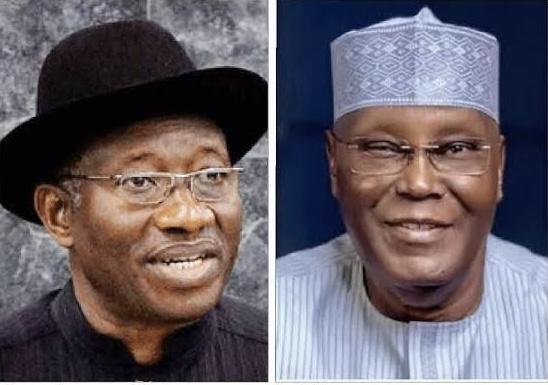
The political temperature in Nigeria has risen noticeably following a rare and unusually direct exchange between two towering figures in the country’s modern democratic history. Former President Goodluck Jonathan has now responded publicly to remarks made by former Vice President Atiku Abubakar, who recently described Jonathan’s time in office as being shaped by “inexperience.” The response, delivered in Jonathan’s characteristically calm but firm tone, has added a new layer of tension to an already evolving political landscape as conversations around the 2027 general elections begin to gather momentum.
Jonathan made his remarks on Monday while speaking at the 2025 Association of Retired Career Ambassadors of Nigeria (ARCAN) awards ceremony in Abuja. Although he refrained from mentioning Atiku by name, the context of his comments left little room for doubt about who he was addressing. For a man widely regarded as one of Nigeria’s most reserved political figures, particularly since leaving office in 2015, the decision to speak out at all was significant. It underscored not only his willingness to defend his legacy but also hinted at the growing stakes within opposition politics as key actors begin to reposition themselves.
The controversy began earlier in the week during an interview Atiku granted on Arise TV. In that appearance, the former vice president, who is actively seeking the presidential ticket of the African Democratic Congress ahead of the 2027 elections, offered an assessment of Jonathan’s presidency that many observers found both pointed and strategic. While acknowledging Jonathan as a “decent young man,” Atiku argued that his administration struggled because he lacked the necessary experience to manage the complexities of leading a country like Nigeria.
Read more on: FG Slams 13-Count Treason Charges on Alleged Coup Plotters
According to Atiku, Jonathan’s perceived inexperience became particularly evident during moments of national difficulty, when decisive leadership and political maturity were required. The comment quickly gained traction across political circles and media platforms, with analysts interpreting it as more than just a historical critique. For many, it was seen as part of a broader attempt by Atiku to frame himself as a more seasoned and capable leader, especially in contrast to both past administrations and potential rivals within the opposition space.
Atiku’s remarks also appeared to subtly reframe the ongoing conversation about age and leadership in Nigerian politics. At 79, he has increasingly emphasized the value of experience, presenting it as a critical asset rather than a liability. By drawing attention to Jonathan’s supposed shortcomings, he seemed to be making the case that Nigeria’s challenges require not just good intentions or personal decency, but a depth of experience that only long years in the political arena can provide.
Jonathan’s response, however, pushed back strongly against that narrative. Speaking before an audience of seasoned diplomats, he questioned the assumption that age alone equates to competence. In a moment that drew both laughter and reflection, he asked rhetorically whether one must be “100 years old” before being considered qualified to lead a nation. The remark, though delivered lightly, carried a deeper message about the nature of leadership and the dangers of reducing it to a simple function of age.
He went on to remind his audience of the breadth of his own political journey, which he described as both extensive and unique. Before ascending to the presidency, Jonathan had served in multiple key roles, including deputy governor, governor of Bayelsa State, vice president, and acting president. This progression, he implied, provided him with a comprehensive understanding of governance at different levels, making it difficult to accept the claim that he was unprepared for the responsibilities of the presidency.
Read more on: APC Unveils 2027 Election Timetable, Reveals Costs for Presidential and Governorship Forms
Supporters of the former president were quick to echo this point, arguing that few Nigerian leaders have climbed the political ladder in such a systematic way. In their view, Jonathan’s rise through the ranks equipped him with firsthand experience in both executive and administrative functions, thereby challenging the idea that he lacked the necessary background to lead effectively.
Jonathan also adopted a candid tone when reflecting on his time in office, acknowledging that, like any leader, he made mistakes. Rather than denying or downplaying these errors, he framed them as an inevitable part of governance. No individual, he suggested, could occupy positions such as governor or president without encountering challenges or making decisions that might later be questioned. This admission added a layer of humility to his defense, distinguishing it from a purely defensive or combative response.
Beyond addressing the question of experience, Jonathan highlighted what he considered to be key achievements of his administration, particularly in the area of foreign policy. He pointed to Nigeria’s successful election to the United Nations Security Council during his tenure as evidence of effective leadership and diplomatic engagement. For Jonathan, such accomplishments demonstrated that his administration was capable of navigating complex international processes and advancing Nigeria’s interests on the global stage.
He credited much of this success to the collaborative efforts of the Ministry of External Affairs and other government institutions, emphasizing that leadership is rarely the work of one individual alone. Nevertheless, he maintained that these achievements would not have been possible if he had been as inexperienced as critics suggested. His argument, in essence, was that results should speak louder than labels.
Read more on: Former Senator Set to Announce New Political Direction as ADC Crisis Deepens
Outside of Jonathan’s own remarks, reactions from his supporters have been more forceful. Groups aligned with his legacy have described Atiku’s comments as an example of revisionist history, accusing the former vice president of attempting to reshape public perception for political advantage. They argue that it is contradictory for someone who has never held the presidency to question the experience of someone who has occupied the office and navigated its demands firsthand.
This exchange between Jonathan and Atiku is not occurring in isolation. It reflects broader shifts within Nigeria’s opposition politics, particularly in light of ongoing tensions and realignments within parties such as the African Democratic Congress. As political actors begin to position themselves ahead of the 2027 elections, narratives about competence, experience, and leadership are becoming central to their strategies.
For Atiku, the decision to critique Jonathan’s record may be part of a calculated effort to distinguish himself from both past administrations and current competitors. By emphasizing his own longevity in politics and framing it as a strength, he is attempting to appeal to voters who may be seeking stability and proven expertise. At the same time, his comments can be seen as an attempt to preempt criticism about his age by turning it into a defining advantage.
Jonathan’s intervention, on the other hand, suggests that he is not entirely removed from the political arena, despite his post-presidency image as a statesman and international mediator. While he is not widely expected to contest the 2027 elections, his willingness to defend his record indicates that he remains attentive to how his legacy is portrayed. It also signals that he may play a more active role, even if indirectly, in shaping the political discourse leading up to the election.
Read more on: Terror group gives 72-hour Ultimatum, demands ₦5bn for 416 abducted women and children
The broader implication of this exchange lies in what it reveals about the evolving dynamics of Nigerian politics. As the country approaches another election cycle, debates about leadership are increasingly focusing on questions of experience versus innovation, age versus energy, and past performance versus future potential. The Jonathan-Atiku episode encapsulates these tensions, offering a glimpse into the arguments that are likely to dominate political conversations in the coming months.
Ultimately, the question raised by this controversy goes beyond the personal rivalry between two individuals. It touches on a fundamental issue about what qualities Nigerians should prioritize in their leaders. Is experience, measured in years and positions held, the most important factor? Or should greater weight be given to outcomes, adaptability, and the ability to unite a diverse nation?
Jonathan’s record, which includes both notable achievements and acknowledged shortcomings, provides one perspective on this debate. His peaceful concession of power in 2015, often cited as a defining moment in Nigeria’s democratic history, remains a significant part of his legacy. Atiku’s long political career, spanning decades and multiple roles, represents another perspective, one that emphasizes continuity and accumulated knowledge.
As the political landscape continues to shift, it is clear that these competing narratives will play a crucial role in shaping public opinion. Whether voters ultimately align with Atiku’s emphasis on experience or Jonathan’s defense of his record, the conversation itself underscores the importance of accountability and reflection in a functioning democracy.
For now, what began as a single comment during a television interview has evolved into a broader debate about leadership, legacy, and the future direction of Nigeria. And as more political actors weigh in, the ripple effects of this exchange are likely to be felt well beyond the immediate headlines, influencing the tone and substance of the journey toward 2027.
Read more on:
- Iran launches drone attack on U.S. warships
- Benue Kidnapping: Gunmen Demand ₦9 Million per Passenger
- Former Nigeria Football Federation Chief Dies as Details Emerge
- Bauchi PDP-APC Realignment Talks Collapse in Deadlock
- Security forces uncover Lagos baby factory, rescue 18 women
- Iran Reopens Strait of Hormuz to Commercial Vessels