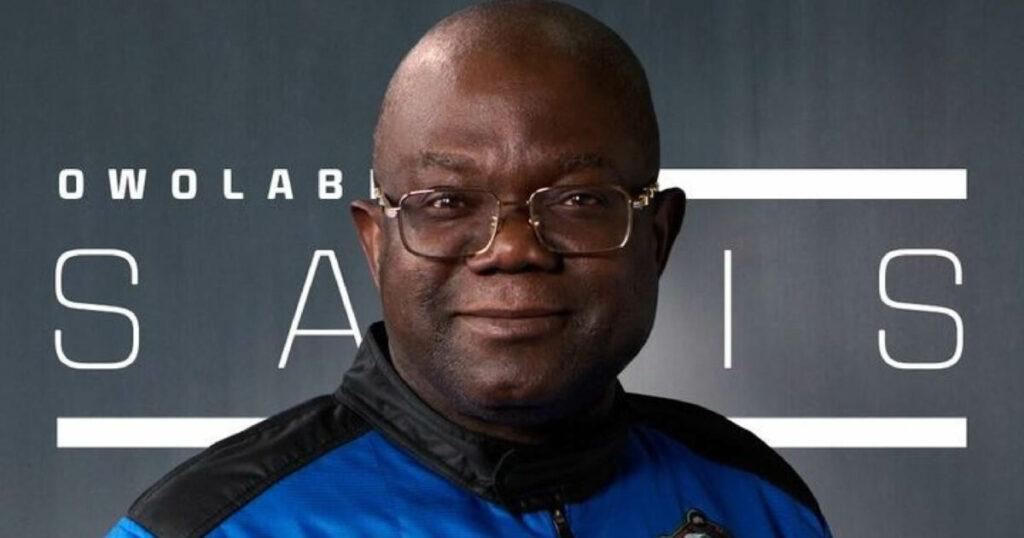
The story of Nigerian achievement has taken an extraordinary leap into unfamiliar territory, expanding far beyond the traditional domains where the country has long excelled. For decades, Nigeria has been celebrated globally for its influence in music, sports, literature, and more recently, technology. Now, a new chapter has been written, one that reaches beyond the skies and into the vastness of space itself. At the center of this milestone is Chief Owolabi Salis, a man whose journey has redefined the limits of what Nigerians can aspire to achieve.
On June 29, 2025, Chief Salis secured his place in global history by becoming the first Nigerian to travel beyond the Earth’s atmosphere. It was a moment that resonated far beyond national pride, symbolizing a shift in perspective for a country often associated with terrestrial accomplishments. His journey demonstrated that Nigerian ambition is not confined to the ground, nor even to the skies, but can extend into the far reaches of space.
The mission that made this possible was part of Blue Origin’s NS-33 flight, one of the commercial space company’s human spaceflight missions using its New Shepard rocket. This particular mission marked the 13th time the company had successfully carried humans into suborbital space, and it featured a crew of six individuals from diverse backgrounds. Among them, Chief Salis stood out not only as the first Nigerian on such a journey but also as the only Black astronaut on that specific flight, further underscoring the historic nature of his participation.
The launch took place in West Texas, from Blue Origin’s private facility, where the New Shepard rocket lifted off with precision and power. The experience, though brief in duration, carried immense significance. Within minutes, the spacecraft ascended beyond the dense layers of Earth’s atmosphere, eventually reaching an altitude of 105.2 kilometers, equivalent to over 345,000 feet above sea level. This altitude is particularly important because it crosses the Kármán Line, widely recognized as the boundary that separates Earth from outer space.
Read more on: 7 African Countries Named After Historical Figures
Crossing this line is what officially qualifies a journey as spaceflight, and for Chief Salis, it marked the realization of a historic first for Nigeria. During the flight, which lasted approximately ten minutes from launch to landing, he and his fellow crew members experienced a period of weightlessness, floating freely inside the capsule as the forces of gravity temporarily loosened their grip. At the same time, they were treated to one of the most breathtaking sights known to humanity: the curvature of the Earth set against the endless darkness of space.
This phenomenon, often described as the “overview effect,” is known to profoundly alter how astronauts perceive the world. It offers a unique vantage point that highlights both the beauty and fragility of the planet, often leaving a lasting emotional and philosophical impact on those who experience it. For Salis, this moment was not just scientific or visual; it carried a deeper personal meaning that aligned with his broader worldview.
To understand the significance of this journey, it is important to look beyond the mission itself and examine the man behind the achievement. Chief Owolabi Salis hails from Ikorodu in Lagos State, and his life story is characterized by versatility and a pattern of breaking new ground. Long before his venture into space, he had already established himself in multiple fields, building a career that spans law, finance, politics, and humanitarian work.
Read more on: 12 Common Daily Mistakes That Can Make You Look Older
Professionally, Salis is both an attorney and a chartered accountant, with credentials that allow him to practice in Nigeria as well as in the United States. His legal and financial expertise have earned him recognition in international circles, particularly in New York, where he has been actively engaged in high-level practice. Yet his ambitions have never been confined to the corporate or professional sphere alone.
In the political arena, Salis has made his presence felt as well. He has previously contested for the governorship of Lagos State, campaigning on ideas centered around inclusivity and grassroots development. One of the key philosophies he promotes is something he calls “Equitocracy,” a concept that emphasizes fairness, diversity, and balanced representation within governance systems. Through this framework, he has consistently advocated for a political structure that reflects the complexity and diversity of society.
At the same time, Salis is also deeply involved in spiritual and humanitarian pursuits. As the leader of the Soul Makers Ministry Worldwide, he blends his interest in personal development with broader community outreach efforts. This combination of professional achievement, political ambition, and spiritual leadership makes his journey to space particularly unique, as it represents not just a scientific milestone but also a philosophical one.
His fascination with exploration did not begin with space. In fact, before ever stepping into a spacecraft, Salis had already achieved a rare feat on Earth. He became the first Black African to visit both the North Pole and the South Pole within the same season, a remarkable accomplishment that underscores his commitment to pushing boundaries. He also explored major ice formations in Antarctica and Greenland, experiences that likely contributed to his desire to venture even further beyond the planet.
Read more on: Early Warning Signs of Diabetes Many People Overlook
For Salis, the journey into space was never solely about prestige or adventure. He has repeatedly described it as a deeply meaningful experience, one that represents a blend of science, spirituality, and purpose. Prior to the launch, he referred to the mission as a spiritual journey, emphasizing its role in inspiring others and encouraging a broader way of thinking about human potential.
Upon returning safely to Earth, he reflected on the rarity of his experience. Out of the estimated 117 billion people who have ever lived, only a tiny fraction have traveled into space. As of 2025, that number stood at just over 700 individuals. Chief Salis was officially recognized by the Fédération Aéronautique Internationale, the global authority on air and space records, and his name was recorded as the 702nd human being to have crossed into space. This distinction places him among an extremely exclusive group, highlighting the magnitude of his achievement.
The impact of his journey extends far beyond personal recognition. Across Nigeria, his accomplishment has been widely celebrated as a symbol of national pride and possibility. Institutions such as the National Space Research and Development Agency (NASRDA) have publicly acknowledged the significance of his flight, describing it as an important step in raising awareness about space science and exploration within the country.
Perhaps even more importantly, his story has begun to resonate with younger generations. In a country where access to opportunities in advanced scientific fields can sometimes feel limited, Salis’s journey offers a powerful message. It demonstrates that Nigerians can participate in global innovations at the highest level, including in industries that were once considered distant or inaccessible.
Read more on: Lassa Fever Outbreak Spreads Across Nigeria
His hope is that this achievement will inspire increased interest in science, technology, engineering, and mathematics, encouraging young people to pursue careers that contribute to technological advancement and global progress. The symbolism of a Nigerian traveling to space carries weight not just because it is rare, but because it expands the realm of what is considered possible.
Efforts are also being made to preserve and commemorate this milestone. Plans have been announced for the creation of a permanent monument honoring his journey, designed by California-based sculptor Steve N. Barber. The monument is expected to eventually be relocated to Ikorodu, his hometown, serving as a lasting reminder of what determination and vision can achieve.
As of April 21, 2026, nearly a year after the mission, Chief Owolabi Salis continues to maintain a visible presence both in Nigeria and internationally. He remains active in political discussions and continues to advocate for governance models rooted in diversity and fairness. At the same time, he uses his platform to encourage people to think beyond immediate limitations and to embrace a broader vision of possibility.
His message consistently emphasizes the idea that exploration, whether physical or intellectual, is essential for growth. By sharing his experience, he aims to challenge conventional thinking and inspire others to pursue goals that may initially seem out of reach.
Read more on: Artemis II Astronauts Make Successful Return to Earth
In many ways, his journey represents a shift in how the “Nigerian Dream” is perceived. Traditionally associated with success in business, education, or the arts, it now encompasses something far more expansive. It suggests that Nigerians can aspire not only to excel within established fields but also to break new ground in areas that are still being defined.
Chief Owolabi Salis did more than travel to space. He expanded the boundaries of national imagination, proving that ambition, when combined with opportunity and determination, can transcend even the most daunting limits. His story is not just about a single flight or a brief moment of weightlessness. It is about the enduring impact of daring to go further than anyone before you, and in doing so, opening the door for others to follow.
Read more on: