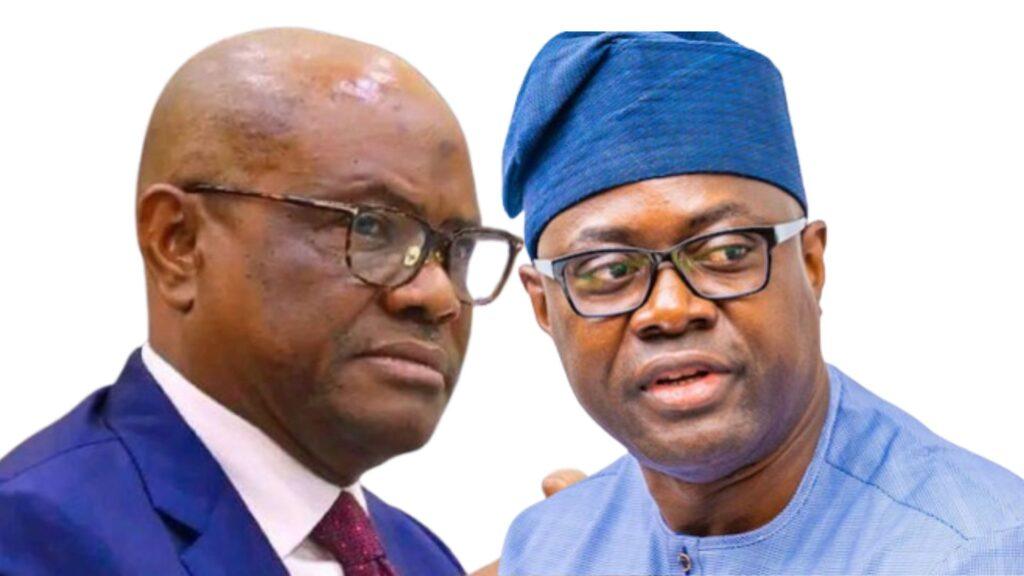
Nigeria’s political atmosphere has taken a sharper and more intense turn following a fresh round of heated exchanges within the Peoples Democratic Party (PDP). At the center of the unfolding drama is the Minister of the Federal Capital Territory, Nyesom Wike, whose latest remarks have once again stirred controversy and deepened divisions within the opposition.
Known for his blunt and often combative style, Wike has launched a strong verbal attack on his former ally, Oyo State Governor Seyi Makinde. What was once seen as a powerful political partnership during the 2023 elections has now evolved into a very public and bitter rivalry. His comments have not only targeted Makinde’s political ambitions but have also cast doubt on emerging alliances within the opposition.
This latest development has sent ripples across the PDP and raised fresh questions about the party’s unity ahead of the 2027 general elections.
Wike Dismisses Makinde’s Presidential Ambition
Governor Makinde has recently been making moves that suggest a possible presidential run in 2027. His statements and political positioning have led many observers to believe that he is preparing to step onto the national stage. However, Wike has wasted no time in shutting down that narrative.
In his remarks, the FCT Minister described Makinde’s presidential ambition as “dead on arrival,” a phrase that has quickly gained traction in political discussions. According to Wike, Makinde does not possess the national reach or political structure required to mount a serious presidential campaign.
He argued that politics at the presidential level goes beyond regional influence and requires a deep and well-established network across the country. In his view, Makinde’s influence remains largely confined to the South West, which he believes is not enough to secure nationwide support.
Wike’s comments reflect a broader skepticism about Makinde’s readiness to compete at the highest level of Nigerian politics. They also signal a clear departure from the mutual support both men once shared during their time as part of the G5 Governors.
Read more on: Makinde Declares Presidential Ambition, Leads New PDP-APM Coalition
The PDP-APM Alliance Under Fire
Another major point of contention is the reported alliance between a faction of the PDP and the Allied Peoples Movement. The proposed collaboration has been presented by Makinde’s camp as a strategic effort to strengthen the opposition and present a united front against the ruling All Progressives Congress.
Wike, however, has strongly rejected the idea, describing it as nothing more than deception. He went as far as calling the alliance “419,” a term commonly used in Nigeria to describe fraudulent schemes. By using such language, Wike made it clear that he does not see the alliance as credible or legitimate.
According to him, the so-called partnership is a desperate attempt by politicians who are struggling to maintain relevance. He suggested that the narrative of a strong opposition coalition is being pushed to mislead the public into believing that the PDP is regaining strength.
Wike also questioned the legal and structural basis of the alliance. He pointed out that any serious political agreement must involve the recognized leadership of the party, not just a faction operating independently. In his view, the absence of backing from the PDP’s core organs makes the alliance questionable and unlikely to succeed.
His remarks have further complicated the already fragile state of the party, as different factions continue to pursue their own strategies without a unified direction.
From Close Allies to Political Rivals
The tension between Wike and Makinde is particularly striking given their recent history. Both men were key members of the G5 Governors, a group that played a significant role in challenging the PDP leadership during the 2023 election cycle. At the time, they were seen as united in their efforts to push for internal reforms within the party.
However, that alliance has clearly broken down. The current conflict highlights just how quickly political relationships can change, especially when ambitions and loyalties begin to shift.
One of the major points of disagreement appears to be their stance on President Bola Tinubu’s administration and the 2027 elections. Wike, who currently serves as a minister under Tinubu, has shown support for the government and is widely believed to favor continuity. Makinde, on the other hand, has taken a different path, positioning himself as part of an emerging opposition movement.
Makinde recently alleged that Wike had assured President Tinubu that he would help secure control of the PDP for the ruling party. This claim has added another layer of tension to their already strained relationship. Wike has denied any wrongdoing, insisting that he remains a committed member of the PDP while also emphasizing that he will not support what he describes as insincerity within the party.
The exchange of accusations has only widened the gap between the two camps and made reconciliation increasingly unlikely.
Read more on: Trillions in the Ground, Still Searching for Bars As NCC Reveals Telcos’ N2.5tn Infrastructure Gamble
The Broader Implications for the PDP
The ongoing clash between Wike and Makinde is more than just a personal dispute. It reflects deeper structural issues within the PDP, including leadership struggles, ideological differences, and competing ambitions.
For a party that aims to present itself as a strong alternative to the ruling government, internal unity is crucial. However, the current situation suggests that achieving that unity may be difficult in the near term.
Wike’s continued criticism of fellow party members could weaken the PDP’s chances of building a cohesive strategy for 2027. At the same time, Makinde’s efforts to form alliances outside the traditional party structure may further fragment the opposition.
Political analysts believe that if these divisions persist, the PDP could face significant challenges in mobilizing support and presenting a credible challenge in the next election cycle. The lack of a unified front may also create opportunities for other parties to gain ground.
A Question of Strategy and Influence
At the heart of this conflict is a fundamental question about what it takes to succeed in Nigerian politics. Wike’s comments emphasize the importance of structure, influence, and nationwide reach. He has repeatedly suggested that ambition alone is not enough without the backing of a strong political network.
Makinde, on the other hand, appears to be exploring a different approach by building alliances and appealing to a broader base of voters. Whether this strategy will prove effective remains to be seen.
What is clear, however, is that the battle for influence within the PDP and the wider opposition space is far from over. Both men are seasoned politicians with significant followings, and their actions will likely shape the direction of the party in the coming years.
Read more on: Iran Carries Out Execution of 32-Year-Old Accused of Spying for Israel
Looking Ahead to 2027
As Nigeria moves closer to another election cycle, the stakes continue to rise. The conflict between Wike and Makinde is just one of many developments that will influence the political landscape.
For voters, the situation raises important questions about leadership, unity, and the future of opposition politics in the country. For the PDP, it presents both a challenge and an opportunity to reassess its strategy and rebuild its internal cohesion.
Wike’s recent remarks serve as a reminder that politics in Nigeria remains highly competitive and often unpredictable. His criticism of Makinde may resonate with some, while others may see it as part of a broader pattern of political confrontation.
In the end, the outcome will depend on how these dynamics evolve in the months and years ahead. What is certain is that the road to 2027 is already taking shape, and the divisions within the opposition could play a decisive role in determining the final outcome.
For now, the exchange between Wike and Makinde has added a new layer of intensity to Nigeria’s political discourse, ensuring that the conversation around the next presidential election remains as lively and contested as ever.
Read more on: