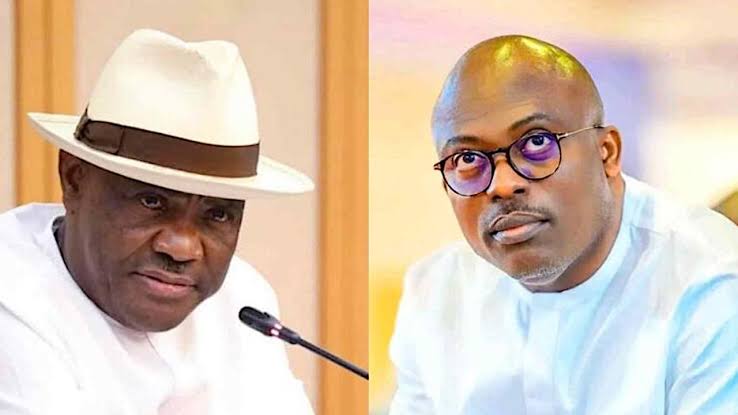
The road to the 2027 governorship election in Rivers State has taken a dramatic and unpredictable turn, as internal divisions within the All Progressives Congress became impossible to ignore over the weekend. What was expected to be a routine screening exercise for aspirants quickly evolved into a tense and revealing political showdown, exposing the widening cracks between Governor Siminalayi Fubara and his predecessor, Nyesom Wike.
The screening, which took place at the Plateau State Governor’s Lodge in Asokoro, Abuja, drew some of the most influential political figures connected to Rivers State. Beneath the formal setting and procedural expectations, however, there was a strong undercurrent of rivalry, suspicion, and strategic maneuvering. By the time the exercise concluded, it was clear that the contest for Rivers State’s top seat in 2027 would be anything but straightforward.
A Screening Exercise Turns Confrontational
The highlight of the weekend came on Sunday, when Governor Siminalayi Fubara reportedly left the venue abruptly. His sudden departure immediately became the focal point of discussions, with many interpreting it as a sign of deep discomfort and dissatisfaction with how the process was unfolding.
According to eyewitness accounts, the governor appeared unsettled by what was described as a cold and unwelcoming atmosphere from members of the screening committee. While no official statement has been released to confirm the exact trigger, those present suggested that the tone of engagement between Fubara and the panel was far from cordial.
Originally, the screening committee was expected to be led by APC National Chairman Nentawe Yilwatda. His absence shifted leadership responsibilities to the party’s National Secretary, Ajibola Basiru, who presided over the proceedings. The change in leadership may have contributed to the dynamics at play, as different factions within the party appeared to assert their influence in subtle but noticeable ways.
Fubara’s exit has since been interpreted in multiple ways. Some see it as a protest against perceived bias, while others believe it reflects deeper concerns about the governor’s standing within his new political home. Regardless of the interpretation, the incident has intensified speculation about whether the APC can successfully manage the competing interests within its ranks ahead of the election.
Read more on: Peter Obi Emerges Frontline Candidate as NDC Zones Presidency to South
Wike’s Loyalists Make Their Move
While Fubara’s presence drew significant attention, the participation of key allies of Nyesom Wike added another layer of complexity to the unfolding drama. Their appearance at the screening signaled that the former Rivers governor remains a powerful force, even as he operates from his current position as Minister of the Federal Capital Territory.
Among those screened was Kingsley Chinda, a former Minority Leader of the House of Representatives and a long-time associate of Wike. His entry into the race is widely seen as a strategic move to ensure that Wike’s influence remains deeply embedded in Rivers politics.
Also present was Alabo Dakorinama George Kelly, the state’s Commissioner for Works. His inclusion further underscored the depth of Wike’s network and the readiness of his camp to contest for control of the state’s political future.
The screening of these figures suggests that the contest is not simply about individual ambition but rather a broader struggle for dominance between two powerful political blocs. On one side is the incumbent governor seeking to consolidate his authority, and on the other is a former leader determined to retain his grip on the political structure he built over the years.
The Shadow of a Broken Agreement
At the heart of the current crisis lies a political agreement that has now unraveled. In late 2025, President Bola Ahmed Tinubu reportedly facilitated a peace deal aimed at resolving the escalating conflict between Fubara and Wike. As part of that arrangement, Fubara defected from the Peoples Democratic Party to the APC in December of that year.
The defection was seen as a strategic move to stabilize the political situation in Rivers State and to protect the governor from mounting pressure, including threats of impeachment from the state assembly. In exchange, it was widely believed that Fubara agreed not to seek a second term in 2027.
For a time, the agreement appeared to hold, offering a fragile sense of calm in an otherwise turbulent political environment. However, that calm was shattered last week when an ally of the governor, Honorable Awaji Inombek Abiante, purchased governorship nomination forms on Fubara’s behalf.
The move was interpreted as a clear indication that the governor intends to seek re-election, effectively reneging on the earlier understanding. This development triggered immediate backlash from Wike’s camp, which viewed the action as a breach of trust and a direct challenge.
Since then, tensions have escalated rapidly, with both sides mobilizing their supporters and positioning themselves for a prolonged political battle. The screening exercise in Abuja was the first major test of strength since the fallout, and it has only deepened the divide.
Read more on: Gunmen Kill Son of Osun Accord Party Leader, Political Tension Rises
A Party Divided Against Itself
The unfolding situation has placed the APC in a difficult position. On one hand, the party has welcomed Fubara into its fold and has benefited from his incumbency. On the other hand, it must contend with the influence of Wike, who, despite his affiliation with the opposition PDP, maintains strong ties with key figures within the ruling party.
Reports indicate that some APC governors and party leaders have openly expressed support for Fubara, viewing him as a valuable asset who can deliver electoral success. Others, however, appear more aligned with Wike’s camp, either out of loyalty or strategic calculation.
This internal division raises important questions about the party’s ability to present a united front. If not carefully managed, the rivalry could weaken the APC’s chances in Rivers State and potentially open the door for opposition forces to capitalize on the discord.
Familiar Faces and New Calculations
Beyond the Fubara and Wike camps, other political actors are also entering the fray, adding further complexity to an already crowded field. One notable figure is Tonye Cole, a businessman and long-time ally of former Minister Rotimi Amaechi.
Cole has contested the governorship in both 2019 and 2023 and has made it clear that he intends to try again in 2027. His persistence reflects not only personal ambition but also the continued relevance of the Amaechi political structure within the state.
His presence introduces a third dimension to the contest, one that could disrupt the binary narrative of Fubara versus Wike. Depending on how alliances shift in the coming months, Cole could either emerge as a compromise candidate or further fragment the vote.
Read more on: Ex-Humanitarian Affairs Minister Sadiya Umar Farouq Declared Wanted by EFCC
What Lies Ahead
As the APC prepares to release the official screening results, attention is already shifting to the next stages of the process. The party has scheduled a brief window for appeals, during which dissatisfied aspirants can challenge the outcomes or raise concerns about the conduct of the exercise.
These proceedings are expected to provide additional insights into the internal dynamics of the party and may either ease tensions or exacerbate them, depending on how disputes are handled.
Ultimately, however, the real battle will be fought beyond Abuja. In Port Harcourt and across Rivers State, political actors are gearing up for what promises to be a highly competitive and emotionally charged contest. Grassroots mobilization, alliance building, and strategic messaging will all play crucial roles in determining the outcome.
What is already clear is that the struggle for control of Rivers State has entered a new phase. The events of the past weekend have not only highlighted the depth of the divisions within the APC but have also set the stage for a prolonged and intense political confrontation.
As 2027 approaches, the stakes will continue to rise, and the decisions made in the coming months will shape the future of one of Nigeria’s most politically significant states.
Read more on: