The fragile structure holding together diplomatic efforts in the Middle East is coming under extreme pressure as fresh waves of military escalation unfold across multiple fronts. Although peace discussions are still ongoing in Qatar, the rapid intensification of violence on Tuesday has significantly weakened hopes that the conflict might soon be brought under control.
What was already a tense regional standoff has now widened further. Israel has expanded its ground operations in southern Lebanon, the United States has carried out new strikes it describes as defensive against Iranian-linked targets, and Iran has issued a strong warning suggesting that it may respond directly against American military positions in the region. Together, these developments point to a situation where diplomacy is struggling to keep pace with battlefield realities.
Escalation Across Multiple Fronts
The most recent developments span three major areas of confrontation, each feeding into the other and creating a wider cycle of retaliation.
In Lebanon, Israeli forces have pushed deeper into southern territory, with reports of intense clashes between the Israel Defense Forces and Hezbollah fighters. The fighting is especially concentrated around strategic zones near the Litani River, an area long considered a key military threshold for Israeli security planners. Both sides have exchanged heavy fire, with drone activity, artillery exchanges, and close ground engagements reported in multiple locations.
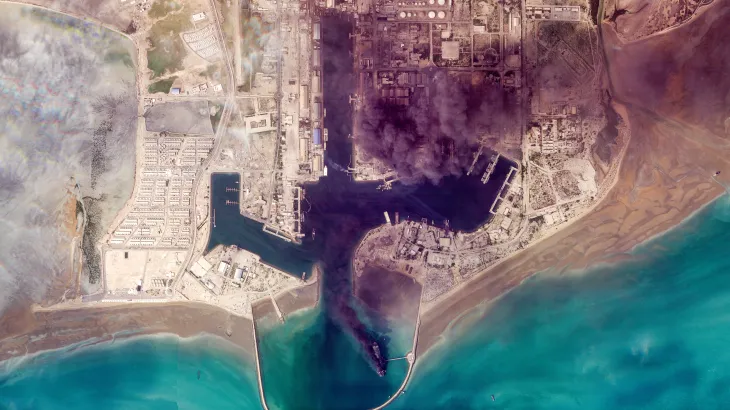
At the same time, in the Gulf region, United States Central Command confirmed it carried out air operations targeting Iranian-linked military infrastructure. According to US statements, the strikes focused on missile launch sites and vessels believed to be involved in laying naval mines close to the strategic waters near Bandar Abbas. American officials described the action as necessary to prevent imminent threats to maritime movement in the Strait of Hormuz, a critical global energy corridor.
Iran, however, strongly rejected that explanation. Tehran accused Washington of disguising offensive military action as defensive measures, calling the strikes a violation of existing understandings between both countries.
Meanwhile, Iranian leadership has issued increasingly forceful rhetoric. Supreme Leader Ayatollah Ali Khamenei warned that American bases across the Middle East are no longer beyond reach. His remarks suggested that Iran may broaden the scope of its response if attacks continue, raising fears that US assets in multiple countries could become potential targets.
Read more on: EFCC Arraigns Fake Presidential Aide Over Alleged ₦25.9 Million Crypto License Fraud
Civilian Impact and Rising Displacement
The humanitarian situation continues to deteriorate as the conflict expands. One of the most recent Israeli air operations in Lebanon’s Bekaa Valley reportedly resulted in the deaths of at least 11 civilians. This adds to a growing civilian toll that has alarmed humanitarian agencies operating in the region.
Since the beginning of the renewed conflict cycle in early March, more than one million people are believed to have been displaced from their homes across affected areas. Entire communities in southern Lebanon have been forced to evacuate as fighting intensifies, while infrastructure damage continues to disrupt access to food, medical care, and basic services.
Aid organizations warn that continued escalation will further strain already limited humanitarian corridors. Relief delivery has become increasingly difficult due to ongoing hostilities, shifting frontlines, and security risks faced by aid workers.
Israel Expands Its Northern Military Campaign
Despite the existence of a ceasefire agreement brokered in mid April, Israeli leadership has signaled that military operations will not be paused. Prime Minister Benjamin Netanyahu has reportedly instructed the military to accelerate its offensive operations in northern Lebanon, stating that Israel’s priority remains the dismantling of Hezbollah’s military infrastructure.
In a public address, Netanyahu reaffirmed his government’s position that the campaign will continue until what he described as a complete neutralization of threats along Israel’s northern border. He rejected suggestions that external diplomatic negotiations should influence military decisions on the ground.
Israeli forces have since advanced further toward the Litani River region, an area that has historically been viewed as a significant strategic boundary. Hezbollah, in response, has escalated its own operations, launching drones and rocket attacks targeting Israeli military positions in the north, including areas near Shomera and Misgav Am.
Hezbollah officials have stated that their operations will continue as long as Israeli troops remain inside Lebanese territory. The group has framed its response as defensive resistance against occupation and ongoing strikes.
Read more on: Amaechi Rejects ADC Presidential Primary Outcome, Calls It A “Sham”
US Military Action and Diplomatic Contradictions
The escalation on the battlefield is unfolding at the same time as diplomatic talks continue in Doha, Qatar. Delegations from the United States and Iran are engaged in discussions aimed at producing a broader understanding that could reduce tensions across the region.
However, the continuation of military strikes has created a sharp contradiction between negotiation efforts and operational realities. US officials maintain that recent strikes against Iranian-linked targets were carried out to prevent imminent threats, particularly to international shipping lanes in the Gulf.
A spokesperson for US Central Command described the operations as strictly defensive and necessary to protect maritime security. The targeted vessels were accused of preparing to deploy naval mines, which could have disrupted one of the most important global trade routes.
Iranian authorities rejected this justification and accused the United States of acting in bad faith while simultaneously participating in peace negotiations. The Iranian Foreign Ministry characterized the strikes as hostile and unlawful, arguing that they undermine the credibility of ongoing diplomatic discussions in Qatar.
Read more on: Tinubu Reassures Nigerians on Security, Urges Unity and Renewed Hope for National Progress
Diverging Goals in Peace Negotiations
One of the central obstacles preventing meaningful progress in negotiations is the deep divergence in priorities among the main actors involved.
The United States is primarily focused on limiting Iran’s nuclear program and ensuring the uninterrupted flow of commercial shipping through the Strait of Hormuz. From Washington’s perspective, a stable maritime corridor and nuclear containment are the key objectives of any agreement.
Iran, however, insists that any final understanding must be far broader in scope. Tehran argues that a lasting agreement must include an end to military operations affecting its regional allies, particularly Hezbollah in Lebanon. Iranian officials have repeatedly stated that they cannot accept a partial agreement that ignores what they describe as parallel fronts of conflict.
Israel maintains an even more rigid position. Israeli leadership strongly opposes linking the Lebanon conflict to Iran negotiations. Officials in Tel Aviv argue that their military campaign against Hezbollah is a separate security matter and must remain outside the scope of international diplomacy involving Tehran.
This fundamental disagreement over the structure and scope of any potential agreement has made it extremely difficult to reach a unified framework for de escalation.
Read more on: FG and World Bank Cancel $717.7 Million Power Sector Loan as Reform Programme Ends Early
Uncertain Path Forward
US Secretary of State Marco Rubio has suggested that negotiations could still reach a conclusion within days, although he acknowledged that significant gaps remain between the parties. At the same time, US President Donald Trump has publicly expressed cautious optimism about the direction of talks, while also warning that any agreement must deliver substantial outcomes or there would be no deal at all.
Despite these statements, the situation on the ground continues to evolve rapidly. Military operations are intensifying in Lebanon, tensions remain high in the Gulf, and the risk of broader regional involvement continues to grow.
Analysts warn that if Israel sustains its advance in Lebanon and Iran follows through on threats to target American installations in the region, the conflict could expand beyond its current boundaries. In such a scenario, diplomatic negotiations may lose relevance entirely as military developments dictate the trajectory of events.
For now, the region stands at a critical point where diplomacy and warfare are unfolding simultaneously, but not in coordination. The gap between the negotiating table in Doha and the battlefields of Lebanon and the Gulf is widening, and the coming days may determine whether that gap can still be bridged or whether it becomes irreversible.
Read more on: