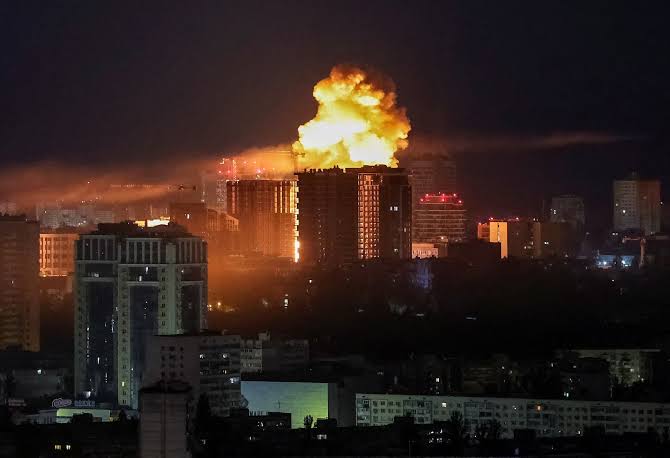
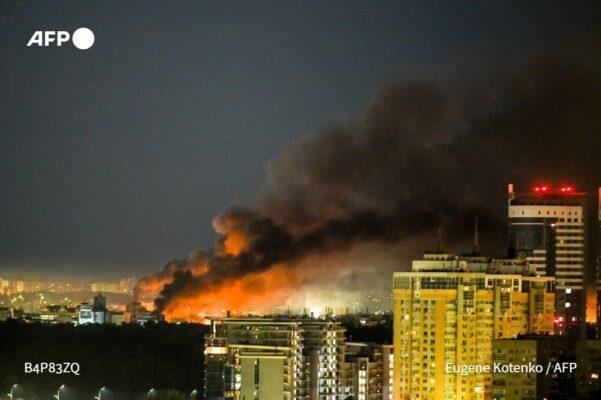
Ukraine was plunged into another night of widespread devastation after Russian forces launched a large-scale, coordinated aerial assault involving missiles and long-range attack drones in the early hours of Tuesday, June 2, 2026. The attack, described by officials and residents as one of the most intense in recent months, struck multiple cities simultaneously and left a trail of destruction across residential areas and key infrastructure.
Ukrainian authorities confirmed that the strikes have killed at least 21 civilians and injured more than 140 others, including children. Emergency services continue to search through rubble in several locations as fears grow that the death toll could rise further in the coming days.
The overnight bombardment affected several major urban centres, with Kyiv and Dnipro suffering the most severe impacts. Other regions including Kharkiv, Sumy, Zaporizhzhia, Poltava, Chernihiv, and Dnipropetrovsk also reported explosions, damaged buildings, and disruptions to essential services. In several areas, energy infrastructure was hit, triggering widespread power outages and forcing emergency crews to work through the night to restore electricity.
Scale of the attack and air defence response
According to the Ukrainian Air Force, Russia deployed an exceptionally large wave of aerial weapons in the operation, combining both drones and missiles in an attempt to overwhelm Ukraine’s air defence systems. Officials reported that approximately 656 long-range attack drones and 73 missiles were launched during the assault. These included ballistic missiles and high-speed aero-ballistic weapons designed to evade interception.
Despite the intensity of the attack, Ukrainian air defence units managed to intercept a significant portion of the incoming weapons. More than 600 drones and around 40 missiles were reportedly shot down or neutralised before reaching their targets. However, the sheer scale of the barrage meant that 38 separate locations across the country were still struck, resulting in widespread damage.
Read more on: House of Reps Demands Urgent Action from FG over Mass School Abductions
Kyiv hit as explosions shake the capital
In the capital city, residents were awakened by continuous explosions and air raid sirens that lasted well into the morning. Multiple districts of Kyiv were affected, with residential buildings, a medical facility, and critical infrastructure sustaining damage.
Mayor Vitali Klitschko confirmed that at least six people were killed in the capital, while more than 60 others were injured. Several high-rise apartment buildings in districts such as Shevchenkivskyi and Podilskyi were partially destroyed, with emergency crews working urgently to rescue survivors trapped under debris.
Eyewitness accounts described scenes of chaos and fear as families rushed into underground metro stations for shelter while explosions lit up the night sky. One resident, Olha Mudra, who survived the attack with her young daughter, described the experience as overwhelming and surreal, saying the city looked like it had been turned into something unrecognisable amid smoke, dust, and collapsing structures.
The strikes also disrupted power supply across parts of the capital, leaving tens of thousands of residents without electricity for several hours before restoration efforts gradually restored service in most areas.
Heavy losses reported in Dnipro
The city of Dnipro experienced some of the most severe destruction during the assault. Local officials reported that at least 15 people were killed there, including children, after a missile struck a residential building and caused it to collapse.
Emergency responders worked through the rubble of a heavily damaged four-storey apartment block, where entire sections had been reduced to debris and twisted metal. Among those recovered was a toddler, highlighting the scale of civilian loss in the attack.
Authorities also confirmed the death of rescue personnel during the operation, including Major Anton Yarmolenko, who was killed while responding to emergency calls at the height of the bombardment. His death has been widely mourned within emergency service circles.
Read more on: CAN Calls on Federal Government to Declare Emergency Over Rising Insecurity
Conflicting narratives from Moscow and Kyiv
Following the attack, both Russia and Ukraine presented sharply different accounts of the events and their justification.
The Russian Defence Ministry confirmed that a large-scale strike had been carried out, claiming that the intended targets were industrial and military infrastructure used in Ukraine’s defence production and logistics networks. Moscow also framed the attack as a retaliatory measure linked to a reported Ukrainian strike in the occupied Luhansk region, which it claimed resulted in multiple casualties.
Ukrainian officials strongly rejected these claims, insisting that the attack deliberately targeted civilian areas. Foreign Minister Andriy Sybiga condemned the strikes in strong terms, accusing Moscow of continuing what he described as a campaign of terror against civilians rather than engaging in legitimate military operations.
President Volodymyr Zelenskyy also used the incident to renew urgent appeals for additional international military support, particularly in strengthening Ukraine’s air defence capabilities. He warned that current supplies of interceptor missiles are insufficient to match the scale and frequency of Russian aerial assaults, urging Western allies to accelerate deliveries of critical defence systems.
Growing pressure on Ukraine’s air defence systems
Military analysts say the latest attack underscores the increasing strain on Ukraine’s air defence network. While interception rates remain high, the growing volume and frequency of drone and missile launches are placing significant pressure on available ammunition and equipment.
Ukrainian officials noted that throughout May, air defence units had successfully intercepted a large majority of incoming threats. However, the latest wave of strikes demonstrates a shift toward saturation tactics, where overwhelming numbers are used to ensure that at least some weapons penetrate defensive systems.
President Zelenskyy has repeatedly warned that without sustained and expanded support from international partners, Ukraine risks facing more frequent incidents where large-scale attacks overwhelm existing defences.
Read more on: US and Iran Exchange Fresh Strikes as Peace Negotiations Stall
Aftermath and ongoing rescue efforts
As daylight broke over Kyiv and Dnipro, emergency teams continued clearing debris and searching for survivors in heavily damaged residential areas. Firefighters, paramedics, and military engineers worked side by side in difficult conditions, while families waited anxiously for news of missing relatives.
Authorities have stated that the full extent of the damage is still being assessed, and the final casualty figures may change as recovery operations continue. Meanwhile, large parts of the affected regions remain under repair, with infrastructure crews working to restore electricity, water supply, and basic services.
The latest assault has once again highlighted the ongoing human cost of the conflict, as communities across Ukraine continue to endure repeated waves of aerial attacks that disrupt daily life and leave lasting emotional and physical scars.
Read more on: