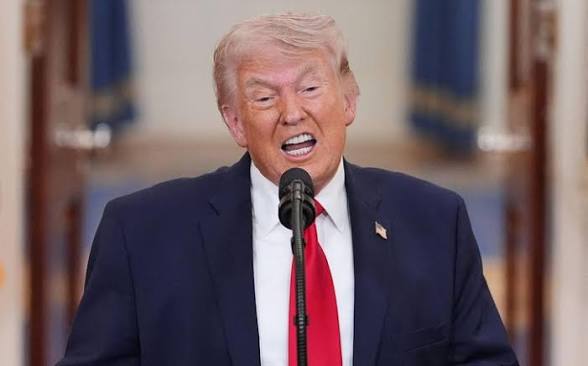
In what may prove to be a pivotal moment in the escalating confrontation between the United States and Iran, President Donald Trump has publicly ruled out the use of nuclear weapons, even as tensions between both nations remain dangerously high. Speaking late Thursday evening at the White House, Trump addressed mounting global fears about the possibility of nuclear escalation and made it clear that, at least for now, such an outcome is off the table.
When pressed by reporters on whether the United States would consider deploying nuclear weapons in its ongoing conflict with Iran, the President responded bluntly that he would not. He questioned the logic behind such a move, pointing instead to what he described as the overwhelming effectiveness of America’s conventional military operations. According to him, the United States has already inflicted significant damage on Iran’s military and strategic infrastructure without resorting to nuclear force. He went further to emphasize that nuclear weapons should never be used by any nation, reinforcing a long-standing global norm against atomic warfare.
Despite this seemingly reassuring stance, Trump’s broader message carried an unmistakable warning. While ruling out nuclear escalation, he stressed that American patience is not unlimited. The phrase “the clock is ticking” featured prominently in his remarks, signaling that Iran is running out of time to meet U.S. expectations in ongoing negotiations. His tone suggested a calculated balance between restraint and pressure, combining a refusal to cross the nuclear threshold with a readiness to intensify conventional military action if necessary.
The President’s comments come shortly after a series of aggressive U.S.-led military operations under what officials have referred to as Operation Epic Fury. Over the past several weeks, American forces have carried out sustained strikes targeting Iranian military facilities, missile installations, and components of its nuclear program. These operations, described by the administration as highly precise and strategically effective, are being framed as proof that the United States can achieve its objectives without resorting to weapons of mass destruction.
Read more on: Yobe APC Backs Consensus Model for 2027 Primaries, Endorses Tinubu for Second Term
Earlier in the week, Trump made headlines by claiming that these conventional strikes had effectively neutralized Iran’s enriched uranium stockpile, referring to it in dramatic terms as having been reduced to “nuclear dust.” While independent verification of this claim remains unclear, it reflects the administration’s broader narrative that Iran’s nuclear capabilities have been severely degraded. By emphasizing this point, Trump appears to be reinforcing his argument that nuclear weapons are unnecessary in achieving U.S. military goals.
At the same time, the geopolitical situation remains fragile and highly volatile. A temporary ceasefire, brokered with the assistance of Pakistan, has been extended, but only for a limited period. According to U.S. officials, the extension is not intended to drag on indefinitely but rather to provide a narrow window for diplomatic progress. The President indicated that this pause in hostilities is measured in days rather than weeks, underscoring the urgency of the moment.
Complicating matters further are reports of internal divisions within Iran’s leadership. U.S. intelligence sources suggest that factions within Tehran are split between those advocating for a hardline stance and others pushing for compromise. This internal struggle appears to be slowing Iran’s ability to present a unified position in negotiations, adding another layer of uncertainty to an already tense situation.
Meanwhile, the Strait of Hormuz continues to serve as a major flashpoint in the crisis. The strategic waterway, through which a significant portion of the world’s oil supply passes, has seen increased military activity in recent days. Earlier on Thursday, Trump issued a controversial directive to the U.S. Navy, authorizing forces to take lethal action against Iranian vessels suspected of laying naval mines. This order has raised concerns about the potential for sudden escalation, particularly in such a sensitive and economically vital region.
Read more on: Atiku Slams Tinubu’s $516m Superhighway Loan, Warns of Rising Debt Burden
Diplomatic efforts, centered in Islamabad, are hanging in the balance. Although U.S. negotiators remain ready to engage, recent developments have cast doubt on the immediate prospects for talks. The planned visit of Vice President J.D. Vance to Pakistan was abruptly canceled after Iran failed to commit to the proposed negotiation framework. Despite this setback, Trump expressed cautious optimism that discussions could resume within the next 36 to 72 hours, suggesting that the door to diplomacy is still open, albeit not indefinitely.
In his remarks, the President framed the situation as a final opportunity for Iran to change course. He indicated that the United States is willing to give Tehran a chance to meet its demands, but he also made it clear that failure to do so would result in renewed and potentially intensified military action. His comments conveyed a sense of confidence in America’s capabilities, coupled with a warning that previous strikes could be repeated with even greater impact.
The global implications of this standoff are significant. Financial markets and international observers have responded with cautious relief to Trump’s rejection of nuclear weapons, viewing it as a step away from the most catastrophic scenario. However, the continued threat of large-scale conventional conflict remains a serious concern. Oil prices have already reacted to the instability, with Brent crude hovering near the $100 per barrel mark, reflecting fears of disruption in the energy supply chain.
Read more on: NYSC Member Beaten To Death by Vigilantes in Benue State
As the situation unfolds, the central question remains whether Trump’s reliance on conventional military power represents a strategic calculation rooted in confidence, or a subtle diplomatic signal aimed at bringing Iran back to the negotiating table. By removing the nuclear option from consideration, the administration may be attempting to lower the stakes just enough to make compromise possible, while still maintaining intense pressure on Tehran.
For now, the world watches closely as this narrow window for diplomacy begins to close. The coming days are likely to determine whether the crisis moves toward a negotiated resolution or slides back into open confrontation. Either way, the balance between restraint and force that Trump has outlined will continue to shape the trajectory of one of the most dangerous geopolitical standoffs in recent years.
Read more on: