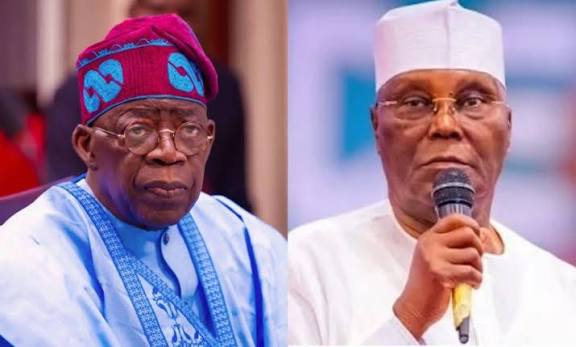
Nigeria’s political landscape took on a sharper edge on Thursday, April 23, 2026, as tensions between key figures in the country’s leadership came into full public view. Former Vice President Atiku Abubakar delivered a strong and pointed criticism of President Bola Tinubu over a fresh move by the administration to secure a substantial external loan. The development has quickly become a focal point of national debate, drawing attention not only to the proposed infrastructure project it is meant to fund, but also to broader concerns about Nigeria’s rising debt burden and fiscal direction.
At the heart of the controversy is a formal request by President Tinubu to the Nigerian Senate, seeking approval for a 516.3 million dollar loan. According to the administration, the funds are intended to support the construction of the Sokoto to Badagry Superhighway, an ambitious road project designed to connect the North West to the South West. The proposal was officially presented to lawmakers through a letter read on the Senate floor by Senate President Godswill Akpabio, marking the beginning of what is expected to be a closely watched legislative process.
The project itself has been framed by supporters as a transformative investment in national infrastructure. The Sokoto to Badagry Superhighway is envisioned as a major economic corridor that could significantly improve connectivity across regions, facilitate trade, and reduce travel time for both commuters and commercial transporters. Proponents argue that the benefits could ripple across multiple sectors, from agriculture and manufacturing to logistics and small scale enterprise.
Details of the loan arrangement indicate that it is being sourced through a syndicated financing deal led by Deutsche Bank. The terms include a tenure of nine years, along with a three year grace period before repayment begins. The interest structure is tied to the Secure Overnight Financing Rate, commonly referred to as SOFR, with an additional margin of 5.3 percent per year. These specifics have become part of the ongoing discussion, as analysts and critics alike attempt to assess the long term implications of such borrowing.
Read more on: NYSC Member Beaten To Death by Vigilantes in Benue State
Supporters within the Senate have already begun to make the case for why the loan should be approved. Senator Adamu Aliero is among those who have highlighted the potential gains, noting that the highway could reduce the journey time between Sokoto and Lagos from roughly thirteen hours to just six. Such a shift, if achieved, could lower transportation costs, improve efficiency in the movement of goods, and strengthen economic ties between regions that are often seen as operating in separate spheres.
Despite these arguments, the proposal has encountered stiff resistance from Atiku Abubakar, who has emerged as one of its most vocal critics. In a statement released through his spokesperson, Phrank Shaibu, the former Vice President made it clear that his opposition is not rooted in a rejection of infrastructure development itself, but rather in what he describes as a pattern of excessive and poorly justified borrowing by the current administration.
Atiku’s critique was delivered in firm and unambiguous terms. He warned that Nigeria is already grappling with a heavy debt load and that taking on additional external obligations without sufficient transparency or a clear repayment strategy could deepen the country’s financial vulnerability. In his view, the proposed loan raises serious questions about fiscal responsibility and long term planning.
Read more on: Kaduna Court Rejects El-Rufai’s Bail Request
He argued that the government appears to be committing the country to financial decisions that could have lasting consequences, particularly for future generations. The absence of detailed public information about the cost benefit analysis of the project, he said, makes it difficult to determine whether the expected returns justify the scale of borrowing. He also expressed concern about what he described as a lack of openness in the way such major financial decisions are being handled.
A key element of Atiku’s argument centers on Nigeria’s current debt profile. Recent figures suggest that the nation’s total public debt has climbed to approximately 159.28 trillion naira, equivalent to about 110.97 billion dollars as of the first quarter of 2026. This level of indebtedness, he contends, already places significant strain on the country’s finances, particularly when combined with the high cost of servicing that debt.
Debt servicing alone is said to account for roughly 15.8 trillion naira in the 2026 budget, representing a substantial portion of government expenditure. This reality has fueled concerns that an increasing share of national revenue is being directed toward repaying existing obligations, leaving less room for investment in critical sectors such as education, healthcare, and social welfare.
Another dimension of the criticism relates to current global oil prices. With Brent crude trading at around 102 dollars per barrel, well above the benchmark used in Nigeria’s budget projections, some analysts and opposition figures argue that the country should be experiencing a revenue boost. From this perspective, the decision to seek additional loans appears difficult to justify, as it suggests that available resources may not be being fully or effectively utilized.
Read more on: Tragedy in Edo as 12 Die, 14 Sustain Injuries in Crash
Atiku and others have pointed to this situation as a contradiction. They argue that if oil revenues are indeed higher than anticipated, the government should be in a position to fund at least part of its infrastructure agenda without resorting to new borrowing. The reliance on external financing under such conditions, they say, raises questions about fiscal management and prioritization.
Adding further complexity to the situation is the recent departure of Wale Edun from his position as Minister of Finance. His resignation, which reportedly occurred just two days before the loan request became public, has sparked speculation about possible disagreements within the administration over economic policy. While no official link has been confirmed, some insiders suggest that Edun may have been uncomfortable with the scale or pace of borrowing being pursued.
His replacement, Taiwo Oyedele, now faces the immediate task of navigating this contentious issue. As the new face of the country’s financial leadership, he is expected to defend the rationale behind the loan, address concerns raised by critics, and provide assurances about the government’s broader fiscal strategy. This comes at a time when public scrutiny is particularly intense and political opponents are keen to capitalize on any perceived missteps.
The debate has also taken on a regional dimension, given the geographic scope of the proposed highway. The Sokoto to Badagry route spans multiple states and connects areas that are often associated with distinct political and economic identities. While the project has been presented as a national initiative, its potential impact on specific regions has inevitably become part of the conversation.
Read more on: Soldiers Strike in Borno Waterways, Destroy Boats and Kill Dozens of Terrorists
Atiku, who has strong political ties to the northern part of the country, has been careful to frame his opposition in national rather than regional terms. He has emphasized that his concerns are rooted in the need for sustainable and accountable development, rather than any desire to block projects that could benefit particular areas. According to him, all Nigerians deserve infrastructure that is built on sound financial principles and does not place undue burdens on future generations.
Meanwhile, the Senate has begun its formal consideration of the loan request. The proposal has been referred to the Senate Committee on Local and Foreign Debts, chaired by Senator Aliyu Wamakko. The committee has been given a one week timeline to review the details and report back to the full chamber, setting the stage for what could be a decisive moment in the unfolding debate.
As lawmakers examine the proposal, they are likely to weigh a range of factors, including the potential economic benefits of the highway, the terms of the loan, and the broader context of Nigeria’s fiscal health. Their decision will not only determine the fate of this particular project but could also signal how the country intends to balance its development ambitions with the realities of its financial position.
Beyond the immediate question of the 516.3 million dollar loan, the situation reflects deeper issues within Nigeria’s political and economic landscape. It highlights the ongoing tension between the desire for rapid infrastructure development and the need for careful financial management. It also underscores the role of political opposition in shaping public discourse and holding those in power to account.
Read more on: Terrorists Attack Borno and Adamawa Border Communities
With a major investment summit reportedly on the horizon in Abuja, the timing of this controversy adds another layer of significance. The government is likely eager to project an image of stability and opportunity to potential investors, while critics are pushing for greater clarity and accountability in how public resources are managed.
In the end, the debate over the Sokoto to Badagry Superhighway loan goes beyond the specifics of one project. It raises fundamental questions about how Nigeria chooses to finance its future, how it balances competing priorities, and how transparent and inclusive its decision making processes are. Whether the loan is ultimately approved or rejected, the discussions it has sparked are likely to have lasting implications for the country’s economic direction and political dynamics.
Read more on:
- Iran Reportedly Launches Attacks on Ships in Hormuz Strait
- Nigeria Reports Fresh COVID-19 Case Years After Pandemic
- President Tinubu Ousts Finance Minister and 1 Other, Appoints New Replacements
- Former President Jonathan Responds After Atiku’s Criticism
- FG Slams 13-Count Treason Charges on Alleged Coup Plotters