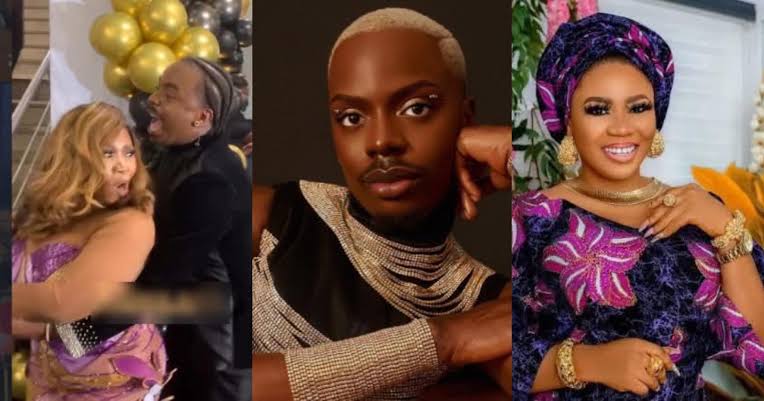
The Nigerian entertainment industry has once again found itself at the center of an intense social media conversation, this time sparked by a brief but widely discussed red carpet moment involving Nollywood actress Wumi Toriola and digital creator Enioluwa Adeoluwa. What initially appeared to be a casual exchange at a glamorous industry gathering has since evolved into a much broader debate touching on respect, generational differences, and the persistent scrutiny surrounding Toriola’s age.
The moment that triggered the controversy was captured during a livestream from a fan attending the event. In the clip, Enioluwa, known for his lively personality and easygoing interactions with celebrities, approached the actress and greeted her simply by saying “Wumi, how are you?” without attaching any honorific such as “Aunty” or “Sis,” which are commonly used within Nigerian culture to acknowledge seniority and show respect, particularly in professional spaces like Nollywood.
While the interaction itself lasted only a few seconds, it was enough to ignite widespread reactions online. For many viewers, especially those familiar with the traditions of the Yoruba film industry, the omission of a respectful title was seen as inappropriate. Within that cultural context, even a small difference in age or industry experience often calls for a certain level of deference, and the use of honorifics is considered more than just a formality. It is a reflection of values that emphasize respect, hierarchy, and acknowledgment of those who have spent years building their careers.
Read more on: Jude Okoye Speaks Out With Celebratory Post as Psquare Rift Continues
Not everyone interpreted the moment in the same way. A significant number of social media users, particularly younger audiences, defended Enioluwa’s approach. They argued that his brand is built on friendliness and relatability, and that he often addresses many public figures in a similar manner regardless of age or status. To them, the greeting was not intended to be disrespectful but rather consistent with a more modern, globalized style of interaction where formal titles are less emphasized.
As the video continued to circulate, the conversation quickly took a different turn. What began as a debate about manners and cultural expectations soon expanded into renewed speculation about Wumi Toriola’s age. This is not the first time the actress has faced such discussions, but the current situation gave the topic fresh momentum. Some critics suggested that the perceived informality in Enioluwa’s greeting might have been influenced by assumptions about her age, while others used the moment as an opportunity to question the accuracy of her publicly known age.
Faced with the growing wave of commentary, Wumi Toriola chose to address the situation directly through her social media platforms. In a series of posts that quickly gained traction, she made it clear that she was not pleased with the direction of the conversation. Although she did not explicitly mention Enioluwa by name, her message left little doubt about the issues she was responding to.
She emphasized that being friendly or “vibey,” as she put it, should not come at the expense of basic manners and cultural awareness. According to her, there is a clear distinction between being approachable and disregarding established norms of respect. She pointed out that the industry she belongs to is rooted in traditions that value acknowledgment of seniority, and she does not see those values as outdatedu or negotiable.
Read more on: Tonto Dikeh’s Ex Olakunle Churchill Breaks Silence on Divorce Rumours
Her response also addressed the recurring focus on her age, which she described as unnecessary and, at times, deliberately provocative. She pushed back against claims that she looks older than her stated age or that she has been dishonest about it. In a candid remark, she noted that people can appear different depending on circumstances, sometimes looking older and sometimes younger, which is simply part of being human. However, she insisted that official records exist and should be respected, adding that attempts to “age her out” of the industry are both unfair and misguided.
This reaction did not come in isolation. In recent weeks, Toriola has already been vocal about what she perceives as a pattern of provocation from different quarters within the entertainment space. She had previously referenced what she called her “mumu button,” suggesting that there is only so much she is willing to tolerate before responding firmly. The current situation, in the eyes of many observers, appears to be part of a larger tension between established industry figures and a new wave of younger creatives who operate by different social rules.
The divide between these two groups has become increasingly visible in recent years. Traditional Nollywood, particularly within the Yoruba sector, has long been guided by a strong sense of hierarchy. Actors who have spent years honing their craft are accorded a level of respect that extends beyond their work to their personal interactions. This system has helped shape the industry’s identity and maintain a sense of order and continuity.
On the other hand, the rise of digital creators and influencers has introduced a new dynamic. Personalities like Enioluwa have built their followings on authenticity, accessibility, and a sense of equality with their audience and peers. In this space, the emphasis is less on hierarchy and more on connection. Titles and formalities are often set aside in favor of a more relaxed and conversational approach.
Read more on: Zinoleesky Exits Naira Marley’s Camp, Starts His Own Record Label
These differing perspectives are not inherently incompatible, but moments like this highlight how easily misunderstandings can arise when they intersect. What one person sees as warmth and familiarity, another may interpret as a lack of respect. Without clear communication or mutual understanding, such differences can quickly escalate into larger conflicts.
Social media has played a significant role in amplifying the situation. Hashtags related to the incident began trending within hours, with users taking sides and sharing their opinions. Supporters of Enioluwa argued that the backlash was exaggerated and that the industry needs to evolve with the times. They questioned whether the insistence on honorifics still holds the same relevance in an era where global influences are reshaping communication styles.
Meanwhile, those backing Toriola maintained that respect should not be sacrificed in the name of modernity. They argued that cultural values are an essential part of identity and should be preserved, especially within industries that are deeply rooted in tradition. For them, the issue was not about resisting change but about ensuring that progress does not come at the cost of fundamental principles.
Amid all the debate, one thing remains clear: Wumi Toriola is not stepping back from her position. Her recent work and continued presence in Nollywood underscore her influence and staying power. Far from being sidelined by the conversation, she appears determined to assert her place and defend the standards she believes in.
Read more on: BNXN Claps Back at Fat Joe’s Claims He Influenced His Name Change
Interestingly, the discussion has also drawn attention to the broader challenges faced by female actors in the industry. Age, in particular, tends to be a more sensitive topic for women, often carrying implications about relevance, opportunities, and public perception. The fact that this issue resurfaced so quickly in the wake of a seemingly unrelated incident speaks to how deeply ingrained such biases can be.
As the situation continues to unfold, it serves as a reflection of a changing entertainment landscape. The boundaries between traditional and modern approaches are becoming increasingly blurred, and navigating that transition requires a level of awareness and adaptability from all parties involved.
For now, the red carpet moment that sparked the controversy has become more than just a fleeting interaction. It has opened up a wider conversation about how respect is defined, how culture evolves, and how individuals within the same industry can bridge generational divides without losing sight of what matters to them.
Whether this incident will lead to greater understanding or simply fade as another social media trend remains to be seen. What is certain, however, is that it has brought important questions to the forefront, and those questions are likely to continue shaping discussions within Nollywood and beyond for some time.
Read more on:
- Court Delivers Surprise Ruling in Mercy Johnson’s Defamation Case Against Angela Okorie
- Blessing CEO Starts Refunding Donors Amid Controversy Over Alleged Cancer Scam
- Laycon Reflects on How BBNaija Win Saved His Mother’s Life
- Davido and Chris Brown Finally Set to Release Long-Awaited Joint Album
- Mr P disclose his change of birthday date amid ongoing fued with twin brother Paul