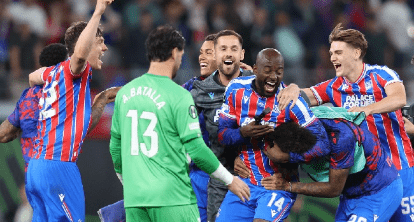
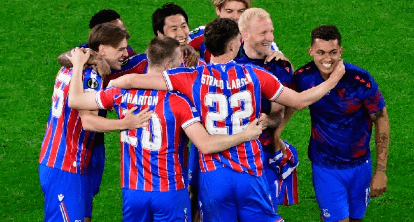
A new chapter has been permanently etched into Crystal Palace’s history as the South London club produced a disciplined, hard-fought, and emotionally charged performance to defeat Rayo Vallecano 1-0 in the UEFA Conference League final at the Red Bull Arena in Leipzig. After 90 tense minutes of tactical chess and physical intensity, the Eagles lifted the 2025–26 trophy, marking the first European silverware in the club’s 121-year existence.
The scenes at full-time reflected years of patience and gradual growth finally rewarded. For a club long associated with resilience and identity rather than silverware on the continental stage, this victory represents a seismic moment in its modern evolution. It also served as a fitting farewell for Oliver Glasner, who concludes his tenure as manager after two-and-a-half transformative years in charge.
A Final Defined by Fine Margins and One Moment of Instinct
The decisive moment arrived early in the second half, but its significance will echo for decades in South London folklore.
Jean-Philippe Mateta, a striker whose future had been uncertain just months earlier after a collapsed move to AC Milan due to a failed medical, became the unlikely hero of the night. In a twist of footballing fate that seemed almost scripted, he delivered the goal that secured continental glory.
The breakthrough came in the 51st minute after sustained pressure from Crystal Palace immediately following the restart. Adam Wharton, growing in influence as the match progressed, unleashed a powerful effort from distance that forced Rayo Vallecano goalkeeper Augusto Batalla into a difficult save. The rebound dropped into a dangerous area inside the six-yard box, and Mateta reacted quicker than anyone else. With composure under immense pressure, he guided the ball into the net from close range, sending the Palace supporters into uncontrollable celebration.
That goal would ultimately define the final, separating two teams that otherwise could not be split on quality or intent.
Read more on: Manchester City Open Talks Over Shock Move to Bring Pedro Porro Back from Tottenham
Rayo Dominate Ball, Palace Control the Game
Despite the narrow scoreline, the match was shaped by Crystal Palace’s tactical discipline rather than attacking dominance. Oliver Glasner’s side adopted a compact 3-4-3 structure designed to absorb pressure, restrict central passing lanes, and exploit transitional moments.
Rayo Vallecano enjoyed 59 percent possession and attempted to impose their rhythm throughout the contest. However, their control of the ball rarely translated into genuine attacking threat. Palace’s defensive structure remained rigid and well-coordinated, forcing Rayo into wide areas and speculative deliveries.
The back three of Maxence Lacroix, Chadi Riad, and Jaydee Canvot produced one of their most complete performances of the season. Their combined total of 41 clearances underlined the scale of their defensive workload, as they consistently repelled crosses, blocked cut-backs, and neutralised aerial danger. Their positioning and timing ensured that Rayo’s attacking players were kept at arm’s length for most of the night.
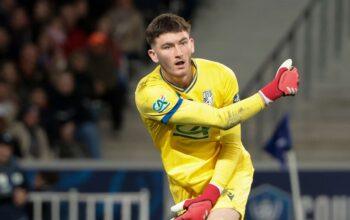
Dean Henderson, meanwhile, experienced a relatively quiet evening by final standards. He was required only once for a meaningful save, which he executed comfortably, maintaining focus despite long periods without action.
Midfield Control and Wharton’s Rising Influence
While Mateta delivered the decisive moment, Adam Wharton was arguably the most influential figure over the course of the match. His performance combined composure, tactical intelligence, and physical presence in equal measure.
Wharton not only contributed the shot that led to the winning goal but also dictated Palace’s ability to transition from defence to attack. His partnership with Daichi Kamada proved crucial in disrupting Rayo’s midfield structure. The pair worked tirelessly to close passing lanes, apply pressure in key zones, and prevent Rayo from settling into sustained possession in dangerous areas.
Frustration grew within the Spanish side as the match progressed, reflected in the accumulation of bookings as Palace repeatedly broke up their rhythm. The intensity of Palace’s midfield work ensured that Rayo were forced into hurried decisions rather than controlled build-up play.
Read more on: Femi Azeez Double Sinks Zimbabwe as Super Eagles Cruise Into Unity Cup Final in London
Missed Chances and Narrow Escapes
Although Palace’s attacking output was limited, they came agonisingly close to doubling their lead. Yéremy Pino produced one of the standout moments of the final when he struck a curling free kick that beat the goalkeeper but crashed against both posts in quick succession before bouncing clear. It was a moment that briefly silenced the stadium and served as a reminder that the contest was never truly secure until the final whistle.
Despite that near miss, Palace remained organised and disciplined, resisting Rayo’s late pressure with maturity beyond expectation.
Glasner’s Departure and His Lasting Legacy
Following the final whistle, attention naturally shifted to Oliver Glasner, whose influence on Crystal Palace has been transformative. His departure marks the end of a managerial era that reshaped the club’s identity both domestically and in Europe.
Midfielder Adam Wharton spoke with admiration about the Austrian manager’s impact, highlighting the cultural shift he has brought to the squad. According to Wharton, Glasner has instilled a winning mentality that has allowed Palace to compete in high-pressure environments with belief rather than hesitation.
Under Glasner’s leadership, Palace have secured three major trophies, including their first-ever European title. His achievements also extend beyond South London, having previously guided Eintracht Frankfurt to Europa League success in 2022. His reputation as a tactically astute manager in knockout competitions has only been strengthened by this latest triumph.
He leaves behind a squad that is no longer content with survival or mid-table stability but is now equipped with the experience and expectation of competing for honours.
Read more on: Harry Kane Wins European Golden Shoe
What the Victory Means for Crystal Palace’s Future
Although the club’s Premier League campaign ended in a disappointing 15th-place finish, this European success fundamentally alters the narrative of their season.
By winning the Conference League, Crystal Palace have secured automatic qualification for the 2026/27 UEFA Europa League, ensuring another season of continental football at a higher level of competition. The victory also contributes to a historic moment for English football, with multiple Premier League clubs continuing to dominate European tournaments across different tiers.
Palace’s triumph adds them to a growing list of English clubs that have recently lifted the Conference League trophy, further cementing the Premier League’s depth and influence across European competitions.
Match Statistics and Breakdown
The final reflected a classic contrast between possession and efficiency. Rayo Vallecano controlled 59 percent of the ball compared to Crystal Palace’s 41 percent. However, their superiority in possession did not translate into meaningful attacking output.
Crystal Palace registered seven total shots, with two on target, while Rayo Vallecano managed nine shots but only one on target. Defensive resilience proved decisive, with Palace recording 41 clearances compared to Rayo’s 33. Discipline also played a role, as Rayo accumulated six yellow cards, double the number shown to Crystal Palace.
Read more on: Barca Open Fresh Negotiations with Man Utd Over Revived Marcus Rashford Move
Lineups and Tactical Setup
Crystal Palace lined up in a 3-4-3 formation featuring Dean Henderson in goal, with a defensive trio of Jaydee Canvot, Maxence Lacroix, and Chadi Riad. The wing-back roles were occupied by Daniel Muñoz and Tyrick Mitchell, while Adam Wharton and Daichi Kamada controlled midfield areas. In attack, Ismaïla Sarr, Jean-Philippe Mateta, and Yéremy Pino formed the front line, with tactical substitutions including Strand Larsen and Guessand introduced in the second half.
Rayo Vallecano deployed a 4-2-3-1 system with Augusto Batalla in goal, supported by Rațiu, Lejeune, Ciss, and Chavarría in defence. The midfield pairing of Valentín and López anchored the side, while de Frutos, Palazón, and García Rivera supported lone striker Alemão. Despite their structure and possession, they struggled to break down Palace’s defensive block.
A Night That Will Echo Through South London
For Crystal Palace supporters, this is more than a trophy lift in a European final. It is a defining moment that reshapes how the club is perceived, both at home and abroad. From years of inconsistency and mid-table battles to standing atop a European competition, the journey reflects persistence, planning, and a squad that has matured into a genuine competitive force.
As celebrations continue, one truth stands clear: Crystal Palace are no longer outsiders in European football. They are champions.
Read more on:
- Messi Diagnosed With Left Hamstring Fatigue, Return Timeline Uncertain
- Real Madrid End La Liga Season in Style with 4-2 Victory Over Athletic Club
- Real Madrid Confirm Major Summer Overhaul as Two Players Exit Ahead of Mourinho Return
- Ex-Arsenal Star Reveals Real Madrid Transfer Snub as His Only Career Regret