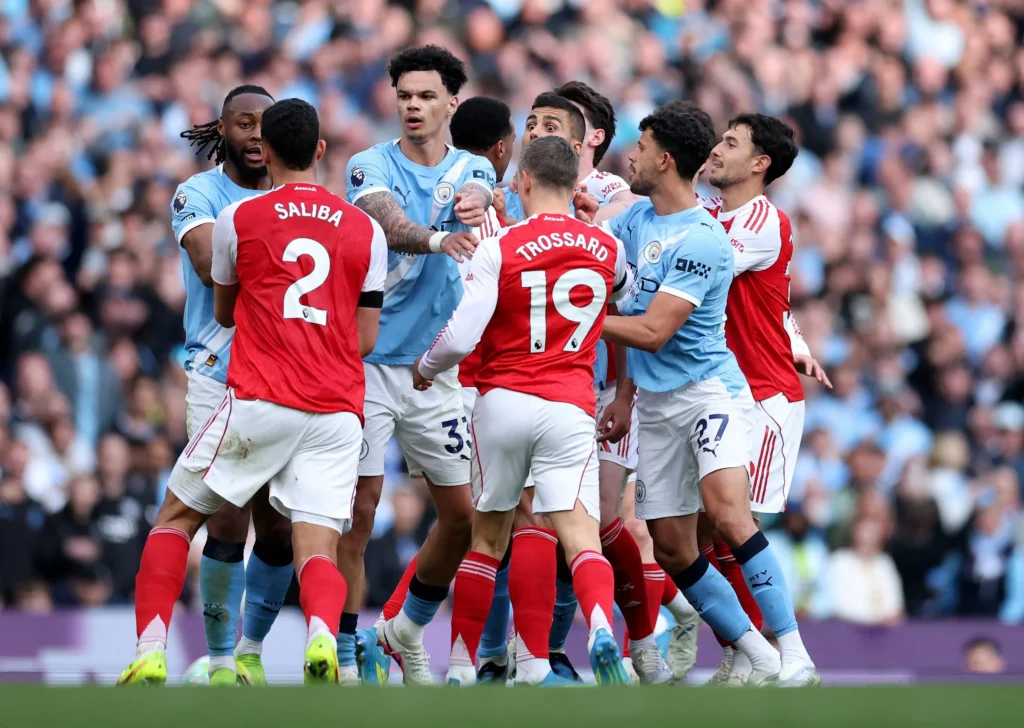
The Premier League has finally brought clarity to one of the most hotly debated scheduling situations of the season, confirming the revised dates for a series of crucial fixtures involving Arsenal, Manchester City, and Chelsea. What was already shaping up to be a fiercely contested title race has now taken on an added layer of drama, as the timing of these matches could significantly influence how the final weeks of the campaign unfold.
With only a narrow margin separating the top contenders, every decision carries weight. The announcement has not only intensified discussions among fans and pundits but has also sparked frustration in certain quarters, particularly within the Manchester City camp. At the same time, Arsenal appear to have been handed a scenario that could play to their advantage, at least on paper, while Chelsea find themselves juggling priorities in a way that could impact multiple outcomes across the table.
One of the most striking aspects of the newly released schedule is the demanding sequence of fixtures facing Manchester City. Pep Guardiola’s side will now have to navigate three extremely important matches within a span of just seven days. This compressed run is not just physically taxing but also mentally draining, given the stakes attached to each game.
Read more on: Arsenal Receive Double Injury Lift Ahead of Atletico Semi-Final Clash
The sequence begins on May 13, when City host Crystal Palace in a Premier League encounter that could have direct implications for the title race. Just three days later, on May 16, they will step onto the Wembley pitch to face Chelsea in the FA Cup final, a match that carries its own immense pressure and expectation. Then, with barely any time to recover, City will return to league action on May 19, traveling to face Bournemouth in what could be a decisive fixture in determining whether they retain their crown.
Unsurprisingly, this scheduling has not gone down well at the Etihad Stadium. Reports suggest that Manchester City made efforts to have at least one of these fixtures adjusted in order to allow for better recovery time, particularly with the FA Cup final sandwiched between two league games. Their preference was to bring the Bournemouth match forward, which would have eased the burden on the squad ahead of the Wembley showdown. However, that request was ultimately rejected.
The decision has fueled a sense of frustration within the club, with sources indicating that City feel the outcome could have a tangible impact on their ability to compete at the highest level across all competitions. The refusal is believed to have been influenced by opposition from other clubs, including Arsenal, who had little incentive to support a change that might benefit their closest rivals.
From a neutral perspective, the situation highlights the ongoing challenge of balancing fairness with logistical realities in a league as competitive and commercially driven as the Premier League. Fixture congestion is not a new issue, especially for teams competing on multiple fronts, but its timing in this instance has amplified its significance.
Read more on: Eze’s Moment of Magic Sends Against NewsArsenal Past Newcastle in Hard-Fought Emirates Victory
While Manchester City wrestle with an intense schedule, Arsenal’s path through the closing stages appears comparatively straightforward. Mikel Arteta’s side will play their final home game of the season against Burnley on May 18, a Monday night fixture that now carries enormous importance. The timing means Arsenal will take to the pitch after City have already contested the FA Cup final, potentially giving the Gunners a clearer picture of what is required from their remaining matches.
This could prove to be a subtle but meaningful advantage. Knowing the outcome of a rival’s major final can influence not only tactical decisions but also the psychological approach of players. If City were to emerge victorious at Wembley, they might carry renewed confidence into their final league games. Conversely, a defeat could leave them vulnerable, both physically and emotionally, as they attempt to refocus on the title race within a matter of days.
For Arsenal, the spacing of their fixtures allows for a more measured buildup. Although they are also dealing with the demands of a Champions League semi-final against Atletico Madrid, their domestic schedule provides slightly more breathing room during this critical period. Managing player fitness and maintaining consistency will be key, but the structure of their run-in offers a degree of stability that City currently lack.
Chelsea, meanwhile, occupy a unique position in this unfolding drama. Their involvement in the FA Cup final has had a ripple effect on the schedule, forcing adjustments that extend beyond their own fixtures. One of the most notable changes sees their league clash with Tottenham pushed to May 19, placing it on the same night as Manchester City’s trip to Bournemouth.
Read more on: West Ham Edge Everton in Intense London Stadium Battle
This rearranged London derby is significant for several reasons. Chelsea are still chasing a European qualification spot, meaning every point is vital as they look to secure their place in continental competition next season. Tottenham, on the other hand, find themselves in a precarious situation, battling to avoid relegation in what has been a turbulent campaign.
The convergence of these narratives adds an extra layer of intensity to the match. Chelsea cannot afford to ease off, given their ambitions, while Tottenham are likely to approach the game with desperation and urgency. The outcome could have implications not only for both clubs but also for the broader league picture, indirectly affecting the title race depending on how results fall elsewhere.
Looking at the final stretch as a whole, the sequence of key dates paints a picture of a season heading toward a dramatic conclusion. The action begins with Manchester City’s clash against Crystal Palace on May 13, followed by the FA Cup final against Chelsea on May 16. Arsenal’s encounter with Burnley on May 18 then sets the stage for a pivotal night on May 19, when both City and Chelsea are in action simultaneously. The campaign will ultimately culminate on May 24, when all teams play their final matches of the season, a day that often delivers unforgettable moments.
Read more on: Anfield Roars as Liverpool Beat Crystal Palace
The broader question now being debated is whether the Premier League’s handling of the situation represents a fair application of its rules or whether it has inadvertently created an imbalance at a crucial point in the season. On one hand, the league must adhere to established scheduling frameworks and consider the interests of all clubs, broadcasters, and competitions. On the other, the timing of these decisions can have a profound impact on competitive outcomes, particularly when margins are so fine.
For Manchester City, the challenge is clear. Their squad depth and experience will be tested to the limit as they attempt to navigate a demanding run that could define their season. Guardiola has often relied on rotation to keep players fresh, but even the most well-resourced squads can feel the strain under such conditions. The ability to maintain focus and avoid injuries will be critical.
Arsenal, by contrast, will aim to capitalize on any slip-ups. After years of rebuilding, they find themselves in a position where the title is within reach. The relative balance of their schedule could provide the platform they need, but it also brings its own pressure. Expectations are high, and any misstep could prove costly, especially if City manage to overcome their difficulties.
Chelsea’s role as both participant and potential disruptor adds another intriguing dimension. Their performance in the FA Cup final could influence City’s momentum, while their league fixtures may shape the race for European places and even impact the relegation battle. In many ways, they are positioned at the center of several intersecting storylines.
Read more on: Real Madrid Drop Points in La Liga After Draw with Betis
As the season approaches its climax, the focus will inevitably shift from scheduling debates to performances on the pitch. Yet it is impossible to ignore how the structure of these final weeks could shape the narrative. Football is often decided by fine margins, and factors such as rest, recovery, and timing can be just as important as tactics and talent.
Supporters from all sides will have their own interpretations of fairness. Some will argue that Manchester City, given their resources, should be able to cope with the demands placed upon them. Others will contend that the refusal to adjust the schedule has introduced an unnecessary obstacle at a decisive moment. Arsenal fans, meanwhile, may view the situation as a natural consequence of the league’s rules rather than any deliberate advantage.
What remains certain is that the title race has entered a phase where every detail matters. The interplay between domestic and cup competitions, the physical condition of players, and the psychological impact of results will all contribute to determining the eventual champion.
In the end, the debate over scheduling may fade, but the outcomes it helps shape will be remembered. Whether this sequence of fixtures proves to be the turning point in Arsenal’s favor or simply another challenge for Manchester City to overcome is a question that will be answered in the coming weeks. For now, the stage is set for a gripping finale, one that promises tension, drama, and perhaps a few unexpected twists before the curtain falls on the 2025 to 2026 Premier League season.
Read more on:
- Super Eagles Confirm Death of Ex-Striker Michael Eneramo
- Capello Warns England “Play With Fear” as He Assesses Their Trophy Chances
- Fenerbahçe Prepare Formal Complaint Over Osimhen’s hand Protective
- US Envoy Urges FIFA to Replace Iran for 2026 World Cup
- Barcelona Edge Celta Vigo to Extend La Liga Lead
- Man City Edge Burnley to Reclaim Premier League Summit as Haaland Ends Drought