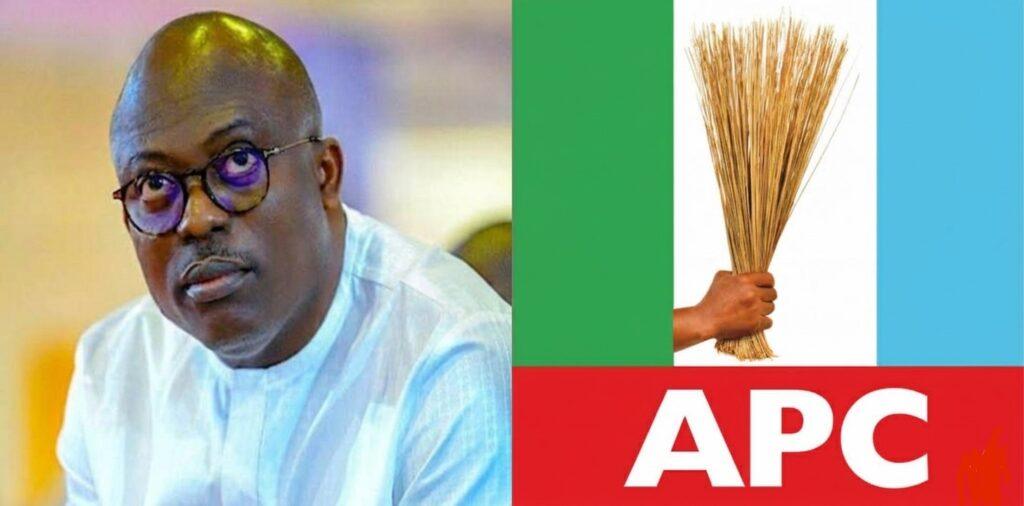
The political atmosphere in Rivers State has taken another dramatic turn, further intensifying an already heated internal struggle within the All Progressives Congress. In a development that has sparked widespread reactions across the Niger Delta, the APC has released its final list of aspirants cleared to participate in the House of Representatives primary elections scheduled for Saturday, May 16, 2026.
What stands out most in the announcement is not just who made the list, but who did not. Several prominent figures closely aligned with Governor Siminalayi Fubara have been disqualified from contesting, a move that many observers interpret as a significant blow to the governor’s influence within the party.
Key Loyalists Shut Out of the Race
In an official statement released on Friday, the Rivers State APC Publicity Secretary, Chibike Ikenga, confirmed that four aspirants had been excluded from the primaries. All of them are widely recognized as loyal supporters of Governor Fubara and have played visible roles in backing his administration during ongoing political tensions in the state.
Among those disqualified is Hon. Awaji Inombek Abiante, a serving member of the House of Representatives. Abiante has been one of the most outspoken defenders of the governor at the federal level, often taking strong positions in support of Fubara’s policies and political stance.
Also barred from the race is Hon. Boma Goodhead, another sitting lawmaker known for her vocal and consistent alignment with the governor. Goodhead has built a reputation as a strong political voice and has remained a visible figure in the current political landscape of Rivers State.
The list of disqualified aspirants also includes Air Commodore John Opara, a retired military officer, and Hon. Anderson Igbiki, whose name has appeared in some reports as Anderson Alisson. While these figures may not command the same level of national attention as Abiante and Goodhead, their exclusion still contributes to the broader narrative of a targeted political move against a particular faction within the party.
For many analysts, the removal of these individuals from the race is not a routine administrative decision. Instead, it is being viewed as a calculated step that could reshape the balance of power within the APC in Rivers State.
Read more on: Dangote Refinery Files Lawsuit Against Nigerian Government Over Petrol Import Permits
Cleared Aspirants Suggest a Shift in Power
While the disqualification list has drawn significant attention, the names of those who were cleared to contest paint an equally revealing picture. A total of 21 aspirants received approval to participate in the primaries, and among them are several figures believed to be aligned with the Minister of the Federal Capital Territory, Nyesom Wike.
One of the most notable names on the cleared list is Martin Amaewhule, the Speaker of the Rivers State House of Assembly. Amaewhule has emerged as a central figure in the political opposition to Governor Fubara within the APC. His clearance to contest for the Obio Akpor Federal Constituency is seen by many as a strong indication of where the party’s internal support may be leaning.
Amaewhule’s role in the ongoing political developments in Rivers State cannot be understated. As Speaker, he has been at the forefront of legislative actions that have often placed him at odds with the governor. His inclusion in the race, especially at a time when key allies of Fubara have been excluded, is likely to deepen existing divisions.
The composition of the cleared list suggests that the internal structure of the APC in Rivers State may still be heavily influenced by figures and alliances that predate Governor Fubara’s entry into the party.
A Party Divided Into Two Camps
To fully understand the significance of these developments, it is important to consider the broader context of political realignment in Rivers State. Governor Fubara’s defection from the Peoples Democratic Party to the APC in late 2025 was a major political event that reshaped the state’s political landscape.
However, rather than creating unity within the APC, the move appears to have introduced a new layer of rivalry. The party is now broadly divided into two main factions, each with its own set of loyalties and strategic objectives.
On one side is the bloc associated with Governor Fubara. This group consists of political figures who either moved with him from the PDP or have since aligned themselves with his leadership. Their goal is to strengthen the governor’s position within the APC and ensure that his influence extends across both executive and legislative structures.
On the other side is the faction linked to Nyesom Wike. This group represents the established power base within the party, including long standing members and those who have maintained loyalty to Wike’s political network. Despite Fubara’s position as governor, this faction appears to retain significant control over the party’s internal mechanisms.
The disqualification of Fubara’s loyalists from the primaries is widely seen as a reflection of this internal struggle. It suggests that the balance of power within the APC may still favor the established structure rather than the newer entrants aligned with the governor.
Read more on: Police Arrest Suspected Armed Thugs with Links to Lawmaker During Ekiti APC Primary
Rising Tensions and Political Signals
The timing of the disqualifications has added to the sense of tension surrounding the situation. Just days before the release of the final list, Governor Fubara reportedly walked out of an APC screening exercise, an action that many interpreted as a sign of frustration or protest.
This incident, combined with the latest development, paints a picture of a party grappling with deep internal disagreements. It also raises questions about the level of cohesion within the APC as it prepares for both the primaries and future elections.
Political observers believe that the decision to exclude key loyalists sends a strong signal about the direction of the party’s leadership. It indicates that control over candidate selection remains firmly in the hands of certain influential figures, regardless of the governor’s position.
For Fubara, the situation presents a significant challenge. With several of his closest allies sidelined, his ability to shape the outcome of the primaries and, by extension, the composition of the federal legislative delegation from Rivers State may be limited.
Implications for the Primaries and Beyond
As the APC prepares to conduct its House of Representatives primaries, the focus will not only be on who emerges as candidates but also on how the process impacts party unity. The exclusion of prominent figures is likely to generate discontent among their supporters, which could affect turnout and participation.
There is also the possibility that these internal divisions could weaken the party’s overall position in future elections. A divided party may struggle to present a united front against opposition forces, particularly in a politically competitive state like Rivers.
For the electorate, the situation underscores the complexity of political dynamics within the state. Decisions made within party structures often have far reaching consequences for governance and representation.
Read more on: Nigeria and Germany Strengthen Ties with €365 Million Development and Investment Partnership
A Familiar Pattern in Rivers Politics
Rivers State has long been known for its intense political rivalries and shifting alliances. The current situation is, in many ways, a continuation of that pattern. Power struggles, strategic defections, and internal conflicts have frequently shaped the state’s political narrative.
What makes this moment particularly significant is the scale and visibility of the division within a single party. The APC, which might have been expected to consolidate power following Fubara’s defection, now finds itself navigating a complex internal contest for control.
As the primaries unfold, attention will be closely focused on both the outcomes and the reactions from different factions. The decisions made in the coming days could have lasting implications for the political future of Rivers State.
For now, the situation remains fluid, with many unanswered questions. Can the APC manage its internal differences and move forward as a cohesive unit, or will the current crisis deepen further? The answer may become clearer as events continue to unfold, but one thing is certain: Rivers State politics is once again at the center of national attention.
Read more on:
- US and China Agree Iran Must Never Obtain Nuclear Weapons
- Wike Fires at Makinde, Rejects PDP-APM Alliance and Questions His Presidential Ambition
- Trillions in the Ground, Still Searching for Bars As NCC Reveals Telcos’ N2.5tn Infrastructure Gamble
- Carries Out Execution of 32-Year-Old Accused of Spying for Israel