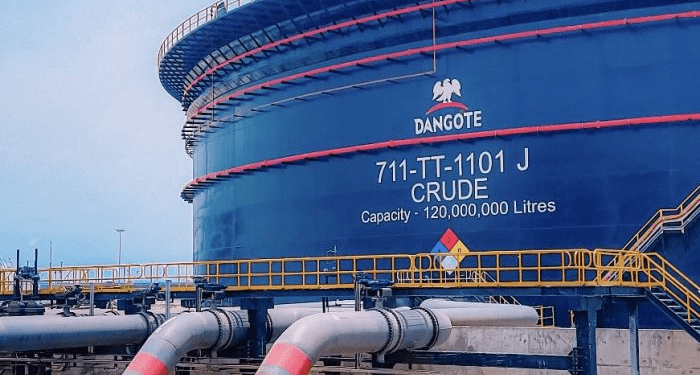
A fresh wave of tension has erupted in Nigeria’s downstream oil sector as the fragile balance between domestic refining ambitions and government import policy appears to have collapsed. In a dramatic escalation that could reshape the future of fuel supply in Africa’s largest economy, the Dangote Petroleum Refinery has taken the Federal Government of Nigeria to court. The refinery is seeking to invalidate newly issued petrol import licenses granted to the Nigerian National Petroleum Company Limited (NNPC) and several licensed private fuel marketers.
The case, filed at the Federal High Court in Lagos on Friday, signals a major confrontation between Africa’s most ambitious private refinery project and the country’s petroleum regulatory framework. What was once seen as a collaborative push toward energy self-sufficiency has now turned into a high-stakes legal battle with far-reaching economic and political implications.
A Deepening Rift in Nigeria’s Oil Sector
At the core of the dispute is a fundamental disagreement over how Nigeria should balance local refining capacity with fuel imports. The Dangote Petroleum Refinery, which has a production capacity of 650,000 barrels per day, argues that Nigeria is now capable of meeting the vast majority of its petrol consumption domestically. According to the company’s position, the continued issuance of import licenses undermines both national refining progress and the economic viability of local production.
The refinery’s legal team is challenging the Nigerian Midstream and Downstream Petroleum Regulatory Authority, commonly known as NMDPRA, accusing the agency of acting contrary to the provisions of the Petroleum Industry Act. The PIA, which was introduced to reform Nigeria’s petroleum sector, contains provisions that prioritize local refining capacity. Dangote’s argument hinges on the interpretation that importation of petrol should only be permitted when domestic production is insufficient to satisfy national demand.
In its filing, the refinery maintains that it currently has the capacity to supply between 80 percent and 90 percent of Nigeria’s daily fuel requirements. Based on this claim, it argues that there is no justification for the issuance of large-scale import licenses to marketers and the national oil company.
Read more on: Police Arrest Suspected Armed Thugs with Links to Lawmaker During Ekiti APC Primary
Controversial Import Licenses Under Scrutiny
The legal action specifically targets recent import approvals issued to several major downstream marketers. These include NIPCO, AA Rano, Matrix, Shafa, Pinnacle, and Bono. Collectively, the licenses reportedly authorize the importation of approximately 720,000 metric tonnes of petrol, a volume that the refinery considers excessive and unnecessary under current production conditions.
Dangote Petroleum Refinery is asking the court to nullify these licenses entirely. It also seeks a judicial declaration that the regulatory authority acted unlawfully in issuing them while domestic refining capacity is allegedly sufficient to meet national demand.
The refinery further claims that the approvals were granted in violation of an earlier court order which was intended to preserve the status quo while domestic refining capacity was being developed and stabilized. According to its legal argument, the regulator’s actions represent what it describes as a policy reversal that undermines investor confidence in Nigeria’s refining sector.
Fuel Pricing Dispute Adds Pressure
Beyond legal and regulatory arguments, pricing dynamics have also intensified the conflict. The refinery is currently selling petrol at an estimated retail price of around 1,200 naira per litre. In contrast, imported petrol from licensed marketers is reportedly being sold at prices ranging between 1,285 naira and 1,295 naira per litre.
On the surface, Dangote’s pricing appears more competitive. However, the refinery argues that continued reliance on imports distorts the market and weakens the long-term viability of domestic refining investments. The company claims that despite its lower pricing, the market structure still favors importers in ways that undermine its operational stability and projected returns.
Industry analysts suggest that this pricing gap highlights a deeper structural issue in Nigeria’s downstream petroleum sector, where logistics, foreign exchange costs, and distribution margins continue to shape final pump prices regardless of local production capacity.
Read more on: Nigeria and Germany Strengthen Ties with €365 Million Development and Investment Partnership
A Familiar Battle Reignites
This is not the first time Dangote Petroleum Refinery has taken a confrontational stance against regulators over importation policy. In 2025, the company filed a separate lawsuit against both the NMDPRA and the NNPC, seeking damages of approximately 100 billion naira. That case was eventually withdrawn in July of the same year following high-level intervention by the Federal Government, which was aimed at de-escalating tensions and ensuring market stability.
The withdrawal of that earlier case was widely interpreted as a temporary truce between the refinery and the government. However, the latest legal filing suggests that any informal agreement or understanding reached at the time has since broken down.
In its current suit, the refinery accuses regulators of engaging in what it calls a policy somersault. It argues that inconsistent policy direction has created uncertainty in the downstream sector and sent mixed signals to investors who had anticipated a transition toward domestic fuel sufficiency.
Competing Narratives: Stability Versus Self-Sufficiency
The Federal Government, through its regulatory agencies, has historically defended the issuance of import licenses as a necessary mechanism for maintaining fuel supply stability across the country. Officials argue that despite increased domestic refining capacity, Nigeria’s consumption levels remain high and unpredictable, requiring a flexible approach that includes both local production and imports.
Regulators also maintain that a competitive import market prevents monopolistic control and helps stabilize prices in the short term. From this perspective, relying solely on a single dominant domestic refinery could expose the country to supply risks, pricing distortions, or operational disruptions.
On the other hand, Dangote Refinery presents itself as a cornerstone of Nigeria’s long-term energy independence strategy. The company insists that its investment was made with the expectation that the country would gradually reduce dependence on imported refined petroleum products. According to its position, continued importation not only undermines this objective but also discourages further private investment in large-scale industrial infrastructure.
Read more on: US and China Agree Iran Must Never Obtain Nuclear Weapons
Economic Stakes and National Implications
The stakes in this legal battle are enormous. Nigeria remains one of the world’s largest importers of refined petroleum products despite being a major crude oil producer. The success or failure of domestic refining efforts has significant implications for foreign exchange reserves, fuel subsidy management, inflation, and broader economic stability.
If Dangote Refinery’s claims are upheld, it could mark a decisive shift toward import restriction policies and a stronger emphasis on domestic refining dominance. This would fundamentally reshape Nigeria’s downstream oil market, potentially reducing import dependence and strengthening local industrial capacity.
However, if the government’s position prevails, it would reinforce a hybrid supply model where domestic refining operates alongside regulated imports, ensuring flexibility but potentially limiting the market share of local producers.
The Threat of Export Diversion
Perhaps one of the most significant warnings emerging from the refinery is the possibility of redirecting its entire output to international markets if regulatory conditions are perceived as unfavorable. Company insiders have suggested that if import licenses continue to flood the domestic market, making it difficult for the refinery to operate profitably within Nigeria, exporting fuel could become a viable alternative.
Such a move would have serious implications for Nigeria’s energy security. It could potentially return the country to a state of heavy dependence on imported refined products, despite having one of the largest private refineries in the world operating within its borders.
Read more on: Wike Fires at Makinde, Rejects PDP-APM Alliance and Questions His Presidential Ambition
Court Proceedings Awaited
The Federal High Court in Lagos has not yet assigned a date for the initial hearing of the case. However, the inclusion of key government officials, including the Attorney General of the Federation and Minister of Justice, Lateef Fagbemi, as defendants underscores the national importance of the dispute.
Legal experts expect the case to attract significant attention from policymakers, investors, and international energy markets. Depending on how the court rules, the outcome could redefine the relationship between private refinery operators and government regulators in Nigeria for years to come.
For now, the country watches as one of its most consequential industrial disputes unfolds, with the future of fuel production, pricing, and energy independence hanging in the balance.
Read more on:
- Trillions in the Ground, Still Searching for Bars As NCC Reveals Telcos’ N2.5tn Infrastructure Gamble
- Carries Out Execution of 32-Year-Old Accused of Spying for Israel
- Court Slams Ex-Power Minister Mamman with 75-Year Jail Term
- Outrage as Ex Nigerian Lawmaker Dies Following Abuja Kaduna Highway Abduction