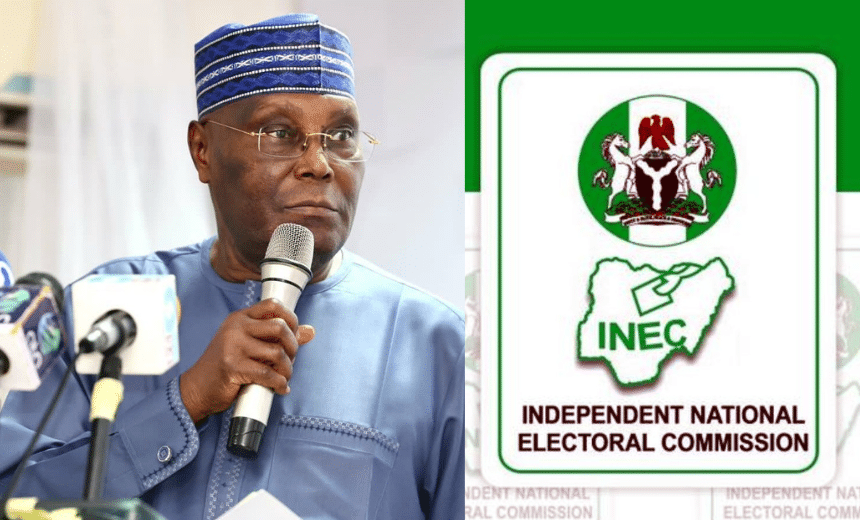
Nigeria’s political atmosphere is becoming increasingly tense as former Vice President Atiku Abubakar has launched a fierce criticism of the Independent National Electoral Commission, accusing the body of compromising its neutrality and actively working against democratic principles ahead of the 2027 general elections.
In a strongly delivered statement that has quickly drawn national attention, Atiku alleged that INEC is no longer acting as an independent referee in Nigeria’s political process. Instead, he described the commission as an institution that is being used to protect the interests of the ruling party while weakening the opposition. His remarks come at a time when political alignments are beginning to take shape and various actors are positioning themselves for what is expected to be a highly contested election cycle.
The immediate trigger for Atiku’s outburst is the ongoing crisis surrounding the African Democratic Congress, a party that has recently emerged as a central platform for opposition figures seeking to consolidate their influence. Over the past year, the ADC has attracted prominent politicians who are looking to build a united front capable of challenging the dominance of the ruling All Progressives Congress.
Tensions escalated earlier this month when INEC withdrew its recognition of the ADC’s national leadership following a court ruling that has itself generated significant controversy. The decision effectively removed the party’s executive leadership from INEC’s official records, creating a situation in which the party is unable to carry out essential functions. Without recognized leadership, the ADC cannot organize its internal structures, conduct conventions, or officially nominate candidates for upcoming elections.
Read more on: Benin Republic Announces New President-Elect
For Atiku and his allies, this development is not simply an administrative matter. They view it as a calculated move that could derail the opposition’s efforts to present a credible challenge in 2027. The timing of the decision has raised eyebrows, coming just as political mobilization is beginning to intensify across the country.
The situation reached a dramatic point on April 6, 2026, when Atiku Abubakar joined forces with other major political figures, including former Labour Party presidential candidate Peter Obi and former Kano State governor Rabiu Kwankwaso, in a protest at INEC headquarters in Abuja. The demonstration, organized under the banner of Occupy INEC, drew significant attention and symbolized a rare moment of unity among opposition leaders who have often operated in separate political spaces.
Speaking during his latest briefing, Atiku did not hold back in his assessment of the electoral commission. He argued that what is currently unfolding goes beyond routine oversight or legal compliance. In his view, it represents a deliberate attempt to weaken democratic structures by targeting opposition platforms at a critical moment.
He expressed concern that INEC’s actions are contributing to a broader pattern in which institutions that are supposed to safeguard democracy are instead being used to entrench political power. According to him, this trend could ultimately lead to a situation where the appearance of democracy is maintained, but genuine political competition is eroded.
Central to Atiku’s argument is the belief that the ADC is being subjected to a divide and weaken strategy. The recognition of a rival faction within the party has further complicated matters, creating internal divisions that make it difficult for the party to operate effectively. Atiku and his supporters have suggested that these divisions are being amplified by external forces that have an interest in preventing the emergence of a strong opposition coalition.
Read more on: President Tinubu Signals Tougher Military Push Against Terror Groups
The practical consequences of the leadership dispute are already being felt. With no recognized executive body, the ADC faces significant logistical challenges. It cannot legally field candidates in certain elections, nor can it organize the national convention that is essential for consolidating its structure ahead of 2027. These constraints threaten to stall the momentum that the party had begun to build following the influx of high profile members.
Atiku has also raised concerns about the broader implications of these developments for Nigeria’s political system. He warned that if the current trajectory continues, the country could drift toward a situation in which one party dominates the political landscape with little meaningful opposition. Such an outcome, he argued, would undermine the core principles of a multi party democracy and reduce elections to mere formalities rather than genuine contests of ideas and leadership.
INEC, for its part, has pushed back against these accusations. Officials from the commission have maintained that their actions are guided strictly by the rule of law. According to their explanation, the decision to withdraw recognition from the ADC’s leadership was based on a valid court order, and the commission is obligated to comply with judicial rulings regardless of the political implications.
In a rare and direct response, INEC spokesperson SP Ramhan Nansel emphasized that the commission does not have the discretion to ignore court decisions. He stated that doing so would itself constitute a violation of the legal framework that governs Nigeria’s electoral process. From INEC’s perspective, the issue is not about politics but about adherence to due process.
However, this explanation has done little to convince the opposition. Critics have pointed to what they perceive as inconsistencies in how INEC handles similar cases. They argue that while some party disputes have lingered unresolved for years, the commission acted with unusual speed in implementing the court ruling affecting the ADC. This perceived disparity has fueled suspicions that the process may not be as neutral as it is being presented.
Read more on: Chibok Parents, Foundation Express Concern Over Fading Global Attention
Beyond the immediate dispute over party leadership, Atiku and his allies have also linked their concerns to other aspects of the electoral process. One of the key issues they have highlighted is the ongoing voter revalidation exercise. This initiative, which involves updating and possibly removing certain voter records, has been described by the opposition as a sensitive process that requires a high level of transparency and trust.
Atiku’s camp has questioned whether INEC, given the current controversy, can be relied upon to manage such a process fairly. They have raised the possibility that millions of voter records could be affected in ways that might influence the outcome of future elections. While no concrete evidence has been presented to support these claims, the concerns reflect a broader lack of confidence in the system.
Interestingly, the unfolding situation appears to be fostering a greater sense of unity among opposition leaders. Despite past rivalries and differences in political strategy, figures like Atiku Abubakar and Peter Obi have shown a willingness to collaborate in response to what they see as a common challenge. Their joint appearance at the Abuja protest sent a strong signal that the stakes of the current moment may be pushing them toward a more coordinated approach.
There have been rumors in recent weeks suggesting possible shifts in leadership dynamics within the opposition, including speculation about alliances and potential ticket arrangements for 2027. While some of these claims remain unverified, the visible cooperation between key figures suggests that discussions about a united front are ongoing.
Read more on: Pope Leo XIV Breaks Silence, Challenges Trump Over Foreign Policy Dispute
For Atiku Abubakar, the situation carries a sense of urgency that goes beyond routine political competition. At 79 years old, he is widely seen as approaching what could be his final opportunity to contest for Nigeria’s highest office. This context adds weight to his current campaign, as he seeks to frame the upcoming election not just as a personal ambition but as a broader struggle for the integrity of Nigeria’s democratic system.
His recent statements reflect an effort to shape the narrative early, positioning the 2027 elections as a critical test of whether Nigeria can sustain a genuinely competitive political environment. By raising concerns about institutional bias and electoral fairness now, he appears to be laying the groundwork for a larger debate that is likely to intensify as the election draws closer.
Meanwhile, civil society organizations and political observers are watching developments closely. The tensions between the opposition and INEC highlight a growing trust deficit that could have significant implications for voter confidence. If left unaddressed, such concerns may affect not only the credibility of the electoral process but also public participation in it.
The Occupy INEC protests, while still limited in scale, have already drawn attention to these issues. They serve as a reminder that questions about electoral integrity are not confined to political elites but resonate with a broader segment of the population. As the protests continue to simmer, there is a possibility that they could evolve into a larger movement depending on how events unfold.
Read more on: Commanding Officer and Six Troops Killed in Borno
At this stage, the situation remains fluid. INEC has stood firm in its position, while the opposition continues to push back against what it sees as an unjust and politically motivated decision. The courts may yet play a decisive role in resolving the ADC leadership dispute, but the political ramifications are already being felt.
As Nigeria moves closer to the 2027 elections, the current controversy underscores the importance of strong and credible institutions. The ability of INEC to maintain public trust will be crucial in determining how the electoral process is perceived both domestically and internationally.
For now, the focus remains on the unfolding confrontation between Atiku Abubakar and the electoral commission. It is a clash that goes beyond individual personalities, touching on fundamental questions about governance, accountability, and the future of democracy in Nigeria.
Whether this moment will lead to meaningful reforms or deepen existing divisions is still uncertain. What is clear, however, is that the road to 2027 has already begun, and it is shaping up to be as complex and contentious as any in the country’s recent history.
Read more on:
- NDLEA Nabs 93-Year-Old Man, Doctor in Shocking Nationwide Drug Crackdown
- Borno State Governor Addresses Military Strike in Border Market
- Six-Day Ultimatum as Bandits Demand 700 Cattle and 1,000 Sheep from Residents
- Another Top Legislator Passes Away as Circumstances Unfold
- Atiku Criticizes Tinubu Over Nigeria and Kenya Fuel Price Comparison