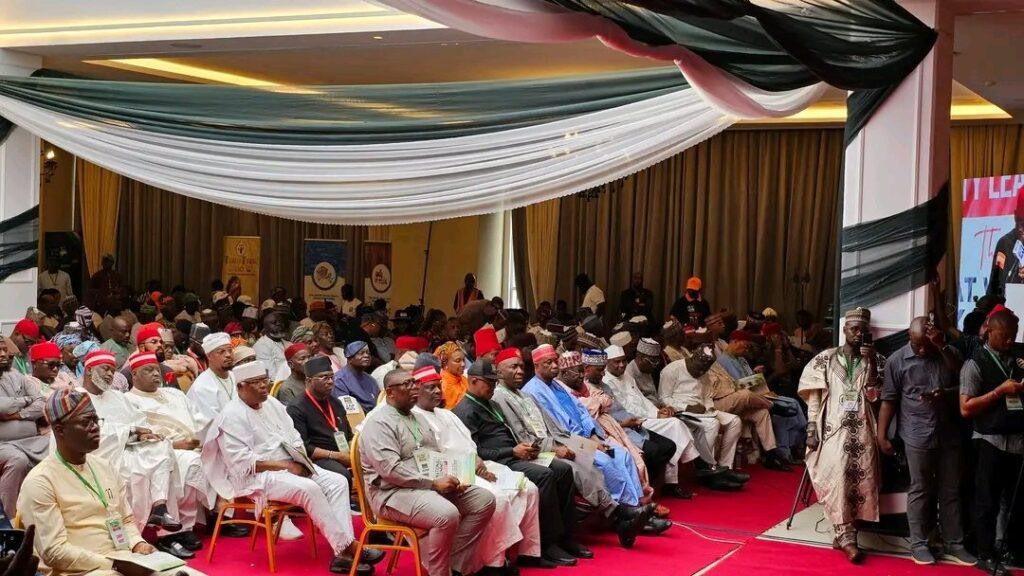
Nigerian political leaders and attendees gather in a decorated hall for an opposition summit in Ibadan.
Ibadan, the historic capital of Oyo State, became the center of national political attention on April 25, 2026, as a powerful coalition of opposition figures converged for what many are already describing as a defining moment in Nigeria’s political trajectory. The meeting brought together a mix of seasoned political heavyweights and emerging influencers, all united by a shared objective of strengthening collaboration ahead of the next electoral cycle.
Among those present were former Vice President Atiku Abubakar of the Peoples Democratic Party, Peter Obi of the Labour Party, and Senator Rabiu Musa Kwankwaso of the New Nigeria Peoples Party. Adding a fresh dynamic to the gathering was Ambassador Olufemi Ajadi Oguntoyinbo, a rising political voice within the NNPP who has steadily gained recognition for his advocacy for youth inclusion and grassroots engagement. Also playing host was Governor Seyi Makinde of Oyo State, whose presence further underscored the importance of the meeting within the broader national context.
The significance of the Ibadan gathering cannot be overstated. For years, Nigeria’s opposition space has been marked by fragmentation, competing ambitions, and a lack of unified direction. While individual leaders have commanded strong followings in different regions, the absence of a coordinated strategy has often weakened their collective ability to challenge the ruling party effectively. This meeting, however, appeared to signal a shift in that pattern.
Observers noted that the atmosphere at the summit was one of cautious optimism, with participants emphasizing the need to prioritize national interest over personal ambition. Discussions reportedly focused on critical issues affecting the country, including the persistent security challenges that continue to impact several regions, the state of the economy, and concerns about electoral transparency.
Read more on: 30 Kwara Rulers Flee Palaces Amid Rising Kidnap Threat
Security emerged as one of the central themes of the engagement. Participants expressed concern over ongoing instability in parts of the North and the Middle Belt, as well as the broader implications for national unity and development. The leaders reportedly agreed that any meaningful political collaboration must include a clear and practical approach to addressing insecurity, which remains one of the most pressing concerns for Nigerians.
Economic issues were also at the forefront of deliberations. With rising inflation, unemployment, and a general sense of economic hardship among citizens, the opposition figures used the platform to critique current policies while exploring alternative strategies. There was a shared understanding that economic recovery would require not just policy adjustments but also coordinated leadership and a willingness to engage diverse stakeholders across the country.
Another major point of discussion centered on electoral integrity. The leaders emphasized the importance of strengthening democratic institutions and ensuring that future elections are conducted in a manner that reflects the true will of the people. Calls for reforms in the electoral process were highlighted, with participants stressing that transparency and accountability must be at the heart of any credible democratic system.
Amid these high-level discussions, Ambassador Ajadi’s role stood out as particularly noteworthy. While the other figures at the summit have long been established in national politics, Ajadi represents a newer wave of leadership that seeks to connect more directly with younger Nigerians. His contributions to the conversation reportedly focused on the need for inclusivity and the importance of creating opportunities for emerging voices within the political space.
Read more on: Palestinians Hold First Elections Since Gaza War
Ajadi’s presence also symbolized a potential bridge between different generations of political actors. As someone who has consistently advocated for youth participation, he brings a perspective that resonates with a significant portion of Nigeria’s population. His involvement in such a high-profile gathering suggests that the opposition is beginning to recognize the value of integrating fresh ideas with established political experience.
The choice of Ibadan as the venue for the summit carried its own political symbolism. Often regarded as a key political hub in the Southwest, the city has historically played an important role in shaping national discourse. By hosting the meeting there, the opposition leaders appeared to be making a deliberate statement about the importance of the region in future political calculations.
For Atiku Abubakar and Peter Obi, the gathering provided an opportunity to reconnect with the Southwest, a region that has been politically competitive in recent years. Senator Kwankwaso’s participation further demonstrated the NNPP’s growing ambition to expand its influence beyond its traditional strongholds. Together with Ajadi’s increasing visibility in the region, the meeting highlighted the potential for a more coordinated approach to engaging voters in the Southwest.
While no formal announcement of a merger or the creation of a unified political platform was made, sources close to the discussions indicated that the Ibadan summit may be the beginning of a broader series of engagements. These efforts are expected to focus on aligning the policies and strategies of the various opposition groups, with the ultimate goal of presenting a more cohesive alternative to the ruling party.
Read more on: Middle East Crisis: Recent Developments
Reactions to the summit have been swift and varied. Representatives of the ruling party were quick to downplay its significance, describing it as a gathering of individuals driven by personal ambition rather than a genuine commitment to national progress. Such dismissals, however, have done little to dampen the interest generated by the event.
Political analysts and observers have pointed to the turnout of supporters and the level of coordination evident at the meeting as indicators that the opposition may be entering a new phase. The ability of leaders from different political backgrounds to come together in a public and structured manner suggests a growing recognition of the need for unity.
At the same time, questions remain about the sustainability of such collaboration. Nigeria’s political history is filled with examples of alliances that initially showed promise but eventually faltered due to internal disagreements and competing interests. Whether the leaders at the Ibadan summit can overcome these challenges will likely depend on their willingness to make compromises and maintain a shared vision.
Governor Seyi Makinde’s involvement also adds an interesting dimension to the unfolding developments. As a sitting governor with considerable influence in the Southwest, his role in hosting the summit may signal a broader effort to position the region as a key battleground in the next electoral cycle. His engagement with leaders from different parties suggests a pragmatic approach to politics, one that prioritizes dialogue and collaboration.
Read more on: Lagos Police Arrest Cameroonian Cyber Fraud Kingpin in INTERPOL Raid
For many Nigerians, the idea of a more unified opposition offers a sense of possibility. In a political environment where power dynamics often appear entrenched, the emergence of a coordinated alternative could reshape the landscape in significant ways. However, translating that possibility into reality will require more than high-profile meetings and symbolic gestures.
The coming months are likely to be critical in determining the direction of this emerging alignment. Continued engagement among the leaders, as well as efforts to build consensus at both the national and grassroots levels, will play a crucial role. The ability to articulate a clear and compelling vision for the country will also be essential in gaining the trust and support of voters.
As the political conversation continues to evolve, the Ibadan summit stands out as a moment that could mark the beginning of a new chapter. Whether it ultimately leads to a lasting transformation or becomes another fleeting episode in Nigeria’s complex political history remains to be seen.
What is clear, however, is that the dynamics of opposition politics are changing. With figures like Ajadi stepping into more prominent roles alongside established leaders such as Atiku, Obi, and Kwankwaso, there is a growing sense that the boundaries of political engagement are expanding. The challenge now lies in sustaining that momentum and translating it into meaningful outcomes for the country.
Read more on: Police Arrest “One Chance” Robbery Gang, Recover Guns and Stolen Items in Asaba
The question on many minds is whether this show of unity can endure the pressures that lie ahead. Political alliances are often tested by differing priorities and the realities of electoral competition. Yet, if the leaders involved can maintain their focus on shared goals, the Ibadan gathering may well be remembered as the point at which a more coordinated opposition began to take shape.
For now, the summit has succeeded in capturing national attention and sparking renewed debate about the future of Nigeria’s political system. It has also highlighted the importance of dialogue and collaboration in addressing the country’s challenges. As events continue to unfold, all eyes will remain on how this emerging alignment develops and what it could mean for the years ahead.
Read more on: