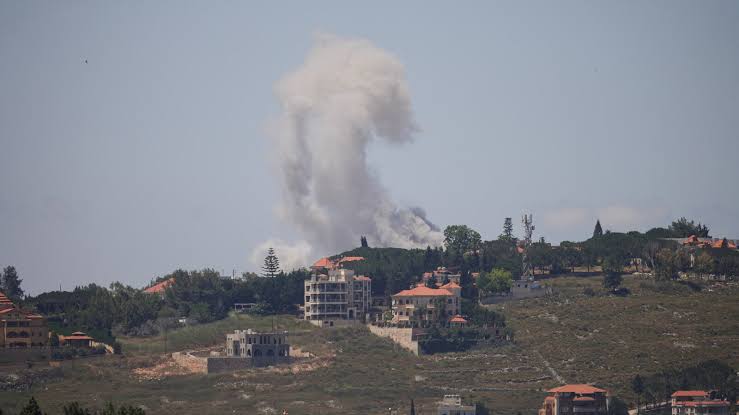
The already fragile US brokered effort to stabilize tensions in the Middle East has suffered a major setback following a deadly Israeli airstrike in southern Lebanon. The attack, which hit a Lebanese Armed Forces vehicle along a key route in the Nabatieh region, resulted in the deaths of a senior military commander, a captain, and a soldier.
The incident marks one of the most significant losses for the Lebanese state military since renewed conflict began in March 2026, and it has raised serious doubts about the survival of a recently announced temporary ceasefire agreement facilitated through diplomatic channels in Washington.
How the Strike Happened
According to official statements from the Lebanese Armed Forces, the targeted vehicle was moving along the Khardali to Nabatieh corridor, a strategic road linking several southern towns including Kfar Tebnit and Khardali, when it was struck by an Israeli missile.
The strike killed a brigadier general, who held a senior operational role within the Lebanese army, along with a captain and an enlisted soldier. The loss has been described within Lebanese military circles as a severe blow to command structure and morale.
In an official response, the Lebanese Armed Forces strongly condemned the attack, describing it as part of what they called repeated and deliberate Israeli aggression. The army stated that such actions only strengthen their resolve and undermine any remaining efforts aimed at restoring stability in the region. They further argued that the strike reflects an attempt to disrupt ongoing diplomatic attempts to reduce tensions and prevent further escalation.
Read more on: Iran Launches Missile Strikes in Gulf After US Hits Radar Sites
Israel’s Account of the Incident
The Israel Defense Forces confirmed responsibility for the strike but presented a different account of events. According to Israeli statements, the operation took place in an active combat zone where troops were on high alert following intelligence reports suggesting possible preparations for a Hezbollah drone or rocket attack.
Israeli officials claimed that the vehicle in question was moving in a manner considered suspicious within an area that requires coordination for military movement. Based on this assessment, the vehicle was targeted.
The IDF further stated that the incident is under internal review, framing the strike as a possible case of operational misjudgment in a highly tense and fast moving battlefield environment.
Ceasefire Under Serious Strain
The timing of the attack has added further pressure to an already unstable diplomatic process. Only days earlier, a US supported agreement had been announced between Israeli and Lebanese authorities, aimed at reducing hostilities through the establishment of controlled zones and limiting the presence of non state armed groups in southern Lebanon.
However, the agreement has struggled from the outset due to deep divisions on the ground. While the Lebanese government participated in negotiations, Hezbollah rejected the terms entirely, describing them as unacceptable and one sided.
Hezbollah’s leadership has insisted that Israeli forces must fully withdraw from southern Lebanon before any cessation of hostilities can be considered. The group has also stated that resistance operations will continue as long as what it considers occupation persists.
This divide has left the Lebanese state military in a difficult position. Although not a direct participant in the conflict between Israel and Hezbollah, the army has increasingly found itself operating in contested areas, attempting to assert authority in regions where hostilities remain active.
Read more on: Former UNILORIN Vice Chancellor Professor AbdulGaniyu Ambali Dies at 68
Wider Wave of Violence Across Southern Lebanon
The strike on the Lebanese Armed Forces vehicle occurred alongside a broader surge of violence across southern Lebanon, where airstrikes and artillery fire have intensified in multiple locations.
In Saksakiyeh, an Israeli strike reportedly killed six people and injured several others. In another incident in Zebdine, five individuals were killed, including a woman and a paramedic affiliated with a local rescue organization.
At the same time, Israeli military officials issued fresh evacuation warnings for several towns, including Aramta, Mashghara, Kfar Houna, Sajad, and Ansariyah, instructing residents to move north of the Zahrani River for safety.
These evacuation orders have contributed to growing displacement across the region, as families abandon homes under rapidly deteriorating security conditions.
Ongoing Fighting Around Strategic Locations
One of the focal points of recent fighting has been the area surrounding Beaufort Castle, a historically significant stronghold in southern Lebanon. Israeli authorities previously claimed control of the site, although conflicting reports and ongoing surveillance activity suggest continued contestation in the area.
Hezbollah has released drone footage showing activity around the castle, suggesting that Israeli control may not be fully established or stable. The footage was presented with messaging intended to challenge Israeli claims of battlefield success.
Meanwhile, media within Israel has reported internal criticism of government statements regarding progress in the northern front, with some analysts suggesting that military achievements are being overstated for domestic consumption.
Read more on: Over 1,000 Nigerians Complete Evacuation Registration Amid Rising Tensions in South Africa
Humanitarian Situation Worsens
As military operations continue, the humanitarian impact in Lebanon has reached alarming levels. According to figures from the Lebanese Ministry of Public Health, more than three thousand five hundred people have been killed since the escalation of conflict in March 2026, with nearly eleven thousand others injured.
Large scale displacement has also become a defining feature of the crisis, with more than one million people forced from their homes. Entire communities in southern and eastern regions have been uprooted as fighting spreads and infrastructure continues to collapse.
Humanitarian agencies report worsening food shortages, with a significant portion of the population now facing severe food insecurity. Supply routes have been disrupted, and access to basic necessities has become increasingly difficult in many areas.
The United Nations Refugee Agency has described scenes of mass movement from affected towns, with families fleeing on foot, motorcycles, and overloaded vehicles as they attempt to reach safer areas further north.
Rising Pressure on Diplomacy
The killing of a senior Lebanese military officer has added a new and dangerous dimension to an already volatile conflict. Lebanese leadership has condemned the strike as a serious violation of sovereignty and international law, warning that continued escalation could further destabilize the country.
For international mediators, particularly the United States, the incident highlights the difficulty of sustaining any meaningful ceasefire in a situation where state authority is limited and non state armed actors remain deeply involved in the fighting.
With continued cross border attacks, ongoing airstrikes, and competing political demands from all sides, the prospects for lasting peace appear increasingly uncertain.
Read more on:
- Peter Obi Criticizes Tinubu’s Approval of 1,000 Forest Guards for Oyo State
- Middle East Tensions Persist as Ceasefires Fail and Humanitarian Crisis Worsens
- Crisis in Oyo State as Massive Manhunt Intensifies as Kidnappers Demand ₦1 Billion and Push for Sharia Law
- NCDC Steps Up Preparedness as Ebola Threat to Nigeria Remains High