Nigeria’s political environment has taken on an increasingly tense and volatile tone on Wednesday, April 15, 2026, as two major developments dominate national discourse. On one hand, the ruling All Progressives Congress (APC) is grappling with deep internal disagreements over leadership control and party ownership following a recent wave of political defections. On the other hand, a deadly military air operation in the North-East has triggered a heated exchange between former Vice President Atiku Abubakar and the Presidency, further intensifying debates around national security, civilian protection, and the conduct of counter-insurgency operations.
Together, these two unfolding issues have created a politically charged atmosphere in Abuja and beyond, with analysts describing the moment as one of the most sensitive intersections of party politics and national security discourse in recent months.
APC INTERNAL STRUGGLE DEEPENS AS LEADERSHIP MOVES TO MANAGE FACTIONAL TENSIONS
Within the headquarters of the All Progressives Congress in the Federal Capital Territory, the party’s National Chairman, Professor Nentawe Yilwatda, has moved to address growing concerns over what insiders are describing as a widening divide between long-standing party loyalists and recent political defectors who have joined the ruling party from opposition ranks.
In recent weeks, the APC has witnessed an influx of high-profile politicians from opposition parties such as the Peoples Democratic Party and the Labour Party. While party leaders publicly welcome these defections as a sign of growing political strength and consolidation ahead of future elections, the internal reality appears more complicated. Many of the so-called “legacy members,” referring to individuals who were part of the APC’s formation and early development around 2013, are increasingly expressing concern that their influence within the party structure is being gradually diluted.
Read more on: Akpabio Sets 2027 Timeline for Insecurity, Defends Tinubu, Reacts to U.S. Staff Reduction
Speaking after a closed-door meeting with key stakeholders from the Federal Capital Territory, Professor Yilwatda addressed these concerns directly. His remarks were firm and carefully framed to reassure founding members while also discouraging internal hostility toward new entrants.
He emphasized that the party remains a collective structure built over time by a wide range of contributors and insisted that no individual or group should attempt to dominate it through force of numbers or recent political migration. In a pointed statement, he explained that the APC is fundamentally a structure built through long years of effort and sacrifice, and therefore cannot be overtaken by individuals who only recently joined its ranks.
The chairman’s message was widely interpreted as a response to rising fears among party elders who believe that the increasing wave of defections could shift internal power dynamics in ways that marginalize them.
According to party insiders, the phraseology used by the chairman, particularly his reference to individuals arriving as “warriors” and attempting to take control of a house built by others, reflects a growing sensitivity within the APC about internal cohesion and identity. While the party continues to expand politically, it is also struggling to maintain unity among its diverse factions.
To address these tensions, Professor Yilwatda announced what he described as a five-dimensional framework for power sharing and internal balance within the party. This framework, according to him, is designed to ensure inclusivity while maintaining fairness across different interest groups.
The first component of this structure focuses on geopolitical balance, ensuring that all six geopolitical zones in the country are adequately represented in leadership positions and decision-making bodies. Party officials believe this is essential for maintaining national appeal and preventing regional dominance.
The second element emphasizes gender and youth inclusion. The APC leadership has reportedly acknowledged that past political arrangements have often sidelined women and younger members, and the new approach seeks to move beyond symbolic representation toward more substantive roles in governance and party administration.
Read more on: Atiku Accuses INEC of Undermining Democracy
The third and most sensitive component addresses the emerging distinction between legacy members and recent defectors. While the party continues to welcome new entrants, there is an effort to preserve what insiders describe as institutional memory and recognition for those who contributed to the party’s foundation and growth. This balancing act is proving to be one of the most delicate challenges facing the leadership.
The fourth dimension focuses on internal discipline and loyalty structures, while the fifth seeks to improve transparency in appointments and leadership selection processes.
In addition to these reforms, the chairman introduced a new vetting requirement for individuals joining the party from other political platforms. Under this guideline, any defector seeking leadership roles within the APC must present documented proof of formal resignation from their previous party, including acceptance of that resignation by the appropriate authorities in their former political organization. Party officials say this measure is intended to prevent political opportunism and ensure that entrants transition properly rather than switching allegiance abruptly for strategic advantage.
Despite these assurances, political observers note that tensions within the APC are unlikely to disappear quickly. The integration of new political actors into an established system often leads to competition over influence, appointments, and access to party structures, and the current situation appears to be no exception.
NATIONAL SECURITY CONTROVERSY SPARKS WAR OF WORDS OVER JILLI MARKET AIRSTRIKE
While the ruling party manages internal disagreements, a separate but equally significant controversy has erupted at the national level concerning a military air operation carried out in the North-East.
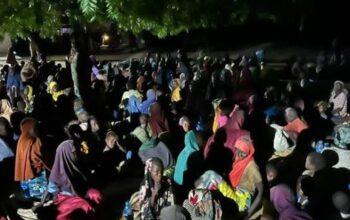
The incident in question involves an airstrike conducted on April 11 at the Jilli Market area along the Borno and Yobe border region. Initial reports from local sources suggest that the operation, which was reportedly aimed at insurgent positions, resulted in the deaths of several individuals, including civilians. Some accounts estimate the death toll to be as high as 56, although official figures remain under review.
The incident has sparked strong political reactions, most notably from former Vice President Atiku Abubakar, who publicly condemned the airstrike. In his response, he described the operation as a serious intelligence failure and expressed concern that civilian lives may have been lost in what was intended to be a precision strike against terrorist elements.
Read more on: Benin Republic Announces New President-Elect
Atiku argued that such incidents raise fundamental questions about the effectiveness of current military strategies in the fight against insurgency in the North-East. He maintained that no security objective can justify the loss of innocent lives in a civilian setting, and he called for greater accountability and transparency in military operations.
His comments quickly gained traction across political and public discourse, with supporters praising his stance as a necessary call for humanitarian consideration in conflict zones. However, the Presidency responded swiftly and forcefully, rejecting the allegations and defending the conduct of the military operation.
Sunday Dare, Special Adviser to the President on Media and Public Communication, issued a detailed rebuttal to Atiku’s statements. In his response, he accused the former Vice President of politicizing a sensitive security matter and attempting to undermine the morale of the armed forces.
The Presidency’s defense of the operation rests on several key arguments. First, officials maintain that the area referred to as Jilli Market has not functioned as a legitimate civilian trading center for several years. According to this position, the location had been effectively abandoned as a civilian marketplace due to prolonged insurgent activity and had instead become a zone of operational interest for terrorist groups.
Second, government sources argue that intelligence reports indicated the area was being used as a logistics and coordination hub by insurgent factions, including Boko Haram and ISWAP elements. They claim that recent security operations and arrests in the region support the assessment that the location was no longer functioning as a civilian economic center.
Third, the Presidency insists that the airstrike was based on verified intelligence and formed part of ongoing efforts to disrupt terrorist supply chains and operational networks in the region.
In a particularly strong political statement, Sunday Dare accused opposition figures of exploiting national tragedies for political advantage. He suggested that such criticisms, if not carefully framed, risk weakening national unity and providing psychological advantage to insurgent groups.
The exchange between Atiku Abubakar and the Presidency has since escalated into a broader national debate about the balance between military necessity and civilian safety. Human rights advocates and security analysts have also begun calling for an independent review of the incident to establish clearer facts and prevent similar occurrences in the future.
Read more on: President Tinubu Signals Tougher Military Push Against Terror Groups
GOVERNMENT ORDERS INVESTIGATION AMID GROWING PUBLIC SCRUTINY
In response to mounting pressure from both political actors and civil society, the Federal Government has announced the initiation of a full independent investigation into the Jilli airstrike. The purpose of the inquiry, according to official statements, is to review the targeting process, verify intelligence procedures, and assess whether operational protocols were properly followed.
While the investigation is underway, the political and emotional impact of the incident continues to resonate across the country. Communities in the affected region remain anxious, and national attention is increasingly focused on the broader implications of military tactics in densely populated or previously civilian areas that may have been infiltrated by insurgent groups.
A COUNTRY FACING SIMULTANEOUS POLITICAL AND SECURITY PRESSURES
The convergence of these two major developments has placed Nigeria in a moment of heightened political sensitivity. Within the APC, questions about identity, loyalty, and power distribution are testing the durability of internal party structures. At the national level, the controversy surrounding the Jilli Market airstrike is reigniting longstanding debates about how best to conduct counter-insurgency operations without endangering civilian lives.
As these events continue to unfold, observers say the coming weeks will be critical in determining not only the stability of the ruling party but also public confidence in military operations and government accountability.
Read more on:
- Chibok Parents, Foundation Express Concern Over Fading Global Attention
- Pope Leo XIV Breaks Silence, Challenges Trump Over Foreign Policy Dispute
- Commanding Officer and Six Troops Killed in Borno
- NDLEA Nabs 93-Year-Old Man, Doctor in Shocking Nationwide Drug Crackdown
- Borno State Governor Addresses Military Strike in Border Market